


Home>Summer School>Pre-College Programmes>On Campus Programme>Core Courses
Pre-College Programme Core Courses

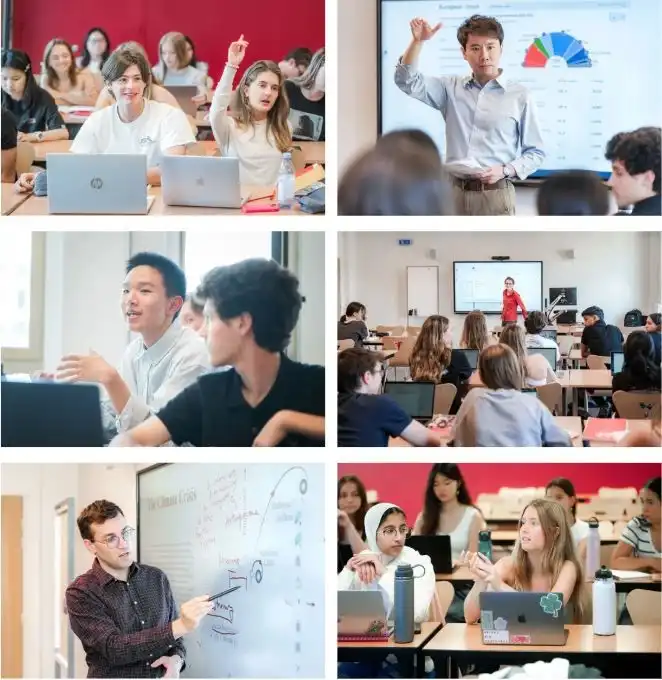
The core courses are taught by various members of the Sciences Po faculty and/or by internationally recognised experts from the academic world. The range of core courses in the social sciences covers a wide variety of topics related to international relations. With the exception of the course “Democracy in Europe”, all courses are taught in English. Participants may select one core course to follow for each week of the programme.
Students also take part in interactive small-group sessions focused on academic methodology, designed to strengthen their essential academic skills, particularly in academic writing, research methods, and oral presentations.
Join us on November 28th for the virtual undergraduate open house! Our team will be presenting the Pre-College programmes. Register here!
Core courses in 2027
Week 1:
- Professor: Carl Rihan
- This course offers a foundational introduction to International Relations and Foreign Policy Analysis: why states behave as they do, how their leaders decide, and how they operate within an international order that is being contested and remade. It is designed for students considering undergraduate studies in international affairs, political science, economics or global governance.
Download the course overview for Foreign Policy (PDF, 327 KB).
- Professor: Earl Wang
- The course serves as an introduction to the field of study in European Union (EU) foreign policy. Students will acquire knowledge about the institutional design and dynamics of EU foreign policy, and concrete examples of the EU’s engagement in global affairs.
Download the course overview for European Union Foreign Policy (PDF, 220 KB).
- Professor: Barthélémy Michalon
- This course aims at discovering, acquiring and practicing basic negotiating techniques, especially in an international context. Throughout the course, students face a wide variety of scenarios and challenges (ranging from everyday life situations to international issues), which they are expected to tackle by resorting to negotiation, with different degrees of complexity.
- Professor: TBA
- More information on this course will be available shortly!
Week 2:
- Professor: Carl Rihan
- This course gives students the literacy to understand how the technologies reshaping world politics actually work (data, cyber operations, algorithms, connected devices, cryptocurrencies and artificial intelligence) and the analytical tools to judge what each of them does to the balance of power, to security and to human rights.
Download the course overview for Emerging Technologies (PDF, 320 KB).
- Professor: Earl Wang
- The course serves as an introduction to the field of study in European Union (EU) foreign policy. Students will acquire knowledge about the institutional design and dynamics of EU foreign policy, and concrete examples of the EU’s engagement in global affairs.
Download the course overview for European Union Foreign Policy (PDF, 220 KB).
- Professor: Barthélémy Michalon
- This course aims at discovering, acquiring and practicing basic negotiating techniques, especially in an international context. Throughout the course, students face a wide variety of scenarios and challenges (ranging from everyday life situations to international issues), which they are expected to tackle by resorting to negotiation, with different degrees of complexity.
- Professor: Mathieu Fulla
- Ce cours interrogera les causes du rejet de plus en plus massif par les Européens des structures traditionnelles de la démocratie libérale et montrera que ce phénomène n’est pas - loin de là ! - synonyme d’un déclin du politique, qui se réinvente sous d’autres fromes, à droite comme à gauche.
Download the course overview for La Démocratie en Europe (PDF, 284 KB).


