
Home>Graduate profile: François Poujaud, dual degree in Urban Policy
17 February 2026
Graduate profile: François Poujaud, dual degree in Urban Policy
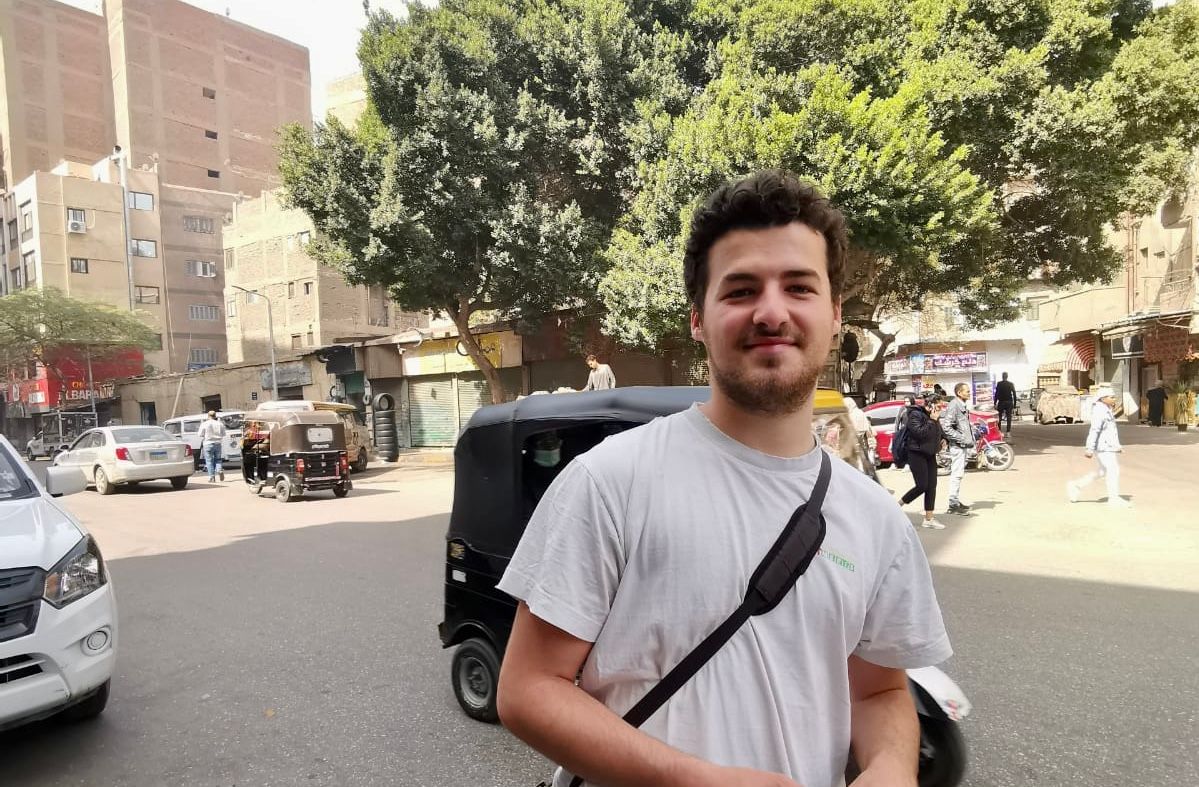
François Poujaud holds a dual master's degree in Urban Policy from the Urban School and the London School of Economics (LSE). François received the Best Overall Performance Prize, awarded by the Department of Geography and Environment of the LSE. This prize is awarded to the student with the highest overall grade point average in their class, recognizing academic excellence and outstanding results throughout their studies.
• What was your background before joining the Urban School?
I am Franco-Chilean and spent around fifteen years living between Chile and France. Growing up across two continents and within very different urban, social and cultural contexts sparked an early interest in urban and regional dynamics. Later, through internships and university exchanges, I lived in Morocco, Germany and Spain. These experiences allowed me to compare different ways of inhabiting space and approaching spatial planning.
Keen to connect spatial issues with a solid understanding of economic dynamics, I pursued a degree in Geography and Planning at Sorbonne University alongside a Business Administration programme at EM Lyon Business School. My internships focused on applied urban development, first with a private developer and later on the construction site of the Paris 2024 Olympic and Paralympic Village. Framed by a strong climate adaptation agenda, this project informed my dissertation on the sustainability challenges of major urban developments and their governance arrangements.
Seeking to better understand how the climate and environmental crisis is reshaping territories and everyday living conditions, I spent my gap year travelling as far as Indonesia, mainly overland and by sea, across 18 countries. Conducted as part of the Territory Project, this journey resulted in a documentary based on local encounters and field observations, exploring urbanisation, resource management and regional transformation through case studies in the Middle East and Southeast Asia.
Together, these experiences shaped my interest in urban and regional policy, which I developed further at Sciences Po and the LSE.
• What did the Urban Policy double degree with the LSE bring you?
The Urban Policy double degree enabled me to understand cities and territories as interdependent socio-ecological and political-economic systems. It also helped me develop a critical and empirical approach to public policy, equipping me with the tools to evaluate and design place-based urban and regional policies, attentive to dominant narratives and to their concrete effects on populations.
The first year, within Sciences Po’s Master in Regional and Urban Strategies (STU), I received multidisciplinary and practice-oriented training in urban and regional policy in France and Europe. This included a strong focus on public policy analysis frameworks and on interactions between public and private actors across different scales. A capstone project carried out for IHEDATE on Spain’s ecological transition allowed me to analyse how European, national and local governance frameworks translate into projects combining top-down and bottom-up approaches, while revealing political, social and territorial power relations.
The second year, at the LSE, I joined the MSc in Local Economic Development (LED) to deepen an applied economic geography perspective on regional development policy. The programme enabled me to analyse regional disparities, growth and inequality dynamics and to reflect on the design of policies rooted in local capabilities and institutional contexts, across both Southern and Northern settings.
• Your dissertation took you to an informal settlement in Nairobi. What struck you most in the field?
At the LSE, I focused my research dissertation on climate adaptation in informal settlements. Today, these areas are home to over one billion people and are among the most exposed to the impacts of climate change, despite having very low carbon footprints. In Kibera, one of sub-Saharan Africa’s largest urban informal settlements in Nairobi, Kenya, I studied two Nature-based Solutions (NbS) projects co-designed and implemented by residents and a non-profit organisation. Three years after their implementation, I assessed their effects on local economic development and residents’ perceived well-being, beyond their primary objective of reducing flood risk.
By engaging with residents, shopkeepers, NGO staff, and both formal and informal authorities, I was able to bring the literature into dialogue with lived realities that only direct, on-the-ground exchanges can reveal. This fieldwork also allowed me to reflect critically on my own positionality as a student researcher trained in European institutions.
What struck me most was that residents viewed these green infrastructures less as technical solutions than as mechanisms that reduce everyday uncertainty. These NbS projects and their co-production generated indirect but significant benefits for residents (time savings, avoided healthcare and repair costs, greater continuity in work and schooling) and fostered a sense of dignity, recognition, and agency. A comparison of the two sites shows that the durability of these socio-economic benefits depends above all on how well they are anchored in local social relations, space and governance structures. When these conditions are in place, benefits accumulate over time; when they are not, they remain fragile, reversible, and unevenly distributed.
This research convinced me that producing effective policies first requires a nuanced understanding of the social and institutional conditions under which solutions do, or do not, take effect.
• Looking ahead, what kind of role or organisation would you like to work in?
At this stage, I am seeking to work within an action research approach that combines fieldwork and analysis, in an international organisation or a research institute. I am particularly interested in evaluating urban and regional policies and projects, with a focus on infrastructure and climate adaptation in sub-Saharan Africa, Latin America, and Europe.
In a context where public decision-making frameworks remain largely oriented towards the short term, my objective is to produce empirically grounded analyses that go beyond aggregated indicators and better integrate the long-term social, regional, climatic, and environmental impacts.
Information Sessions: Masters

Find out more about the Masters programs and the wide choice of specialisations offered by the 8 Schools of Sciences Po during our webinars dedicated to applicants.