
Home>Careers in the Transition: What Paths Open for Paris Climate School Graduates
10 February 2026
Careers in the Transition: What Paths Open for Paris Climate School Graduates
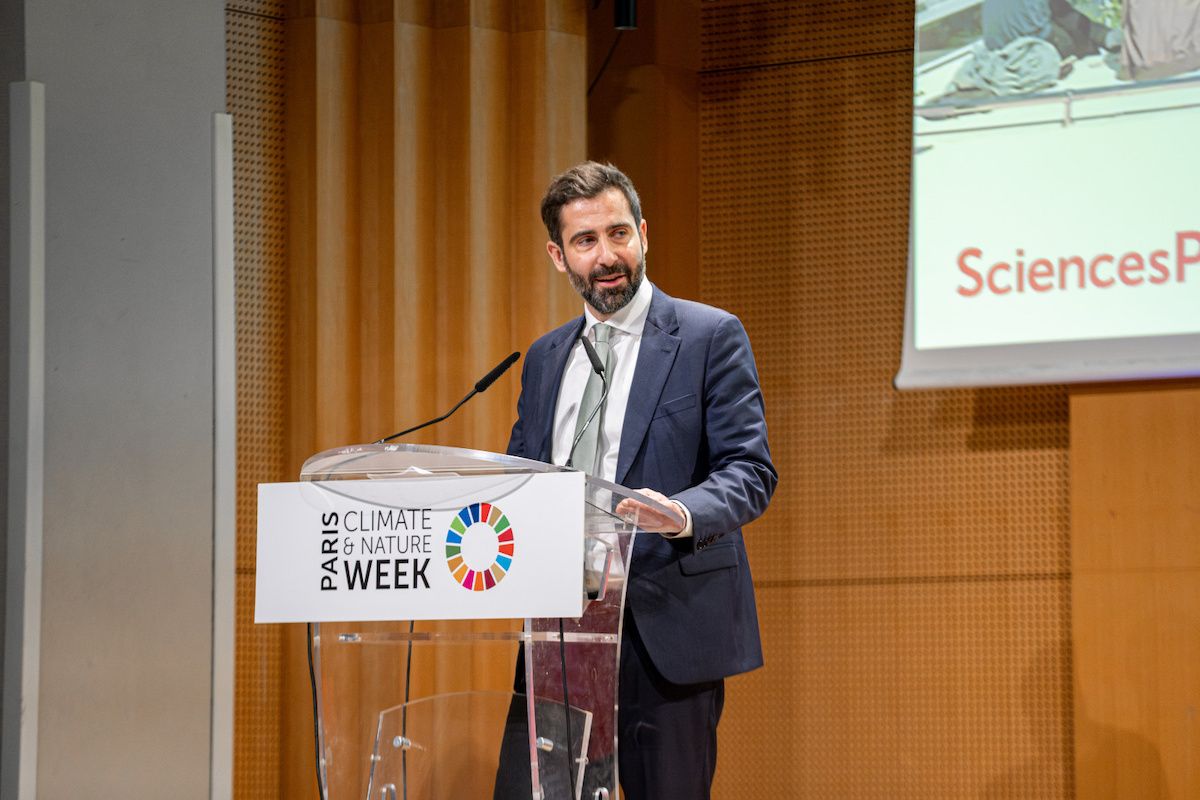
At Sciences Po, the Paris Climate School trains a new generation of professionals ready to take action at the heart of the ecological transition. To understand the career opportunities available to graduates, and how the school equips them to get there, we spoke with Emmanuel Guérin, the School’s Vice‑Dean. His insights reveal the breadth of pathways open in France and around the world.
What jobs, sectors, and types of organizations do Paris Climate School graduates go on to work in?
Emmanuel Guérin : The question of employability is something we’ve really spent a lot of time on prior to creating the school. We made a point of listening carefully to future employers, to make sure we truly understand the kinds of skills they’re looking for. And these employers come from both the public sector, at the local, national, and international levels, and the private sector.
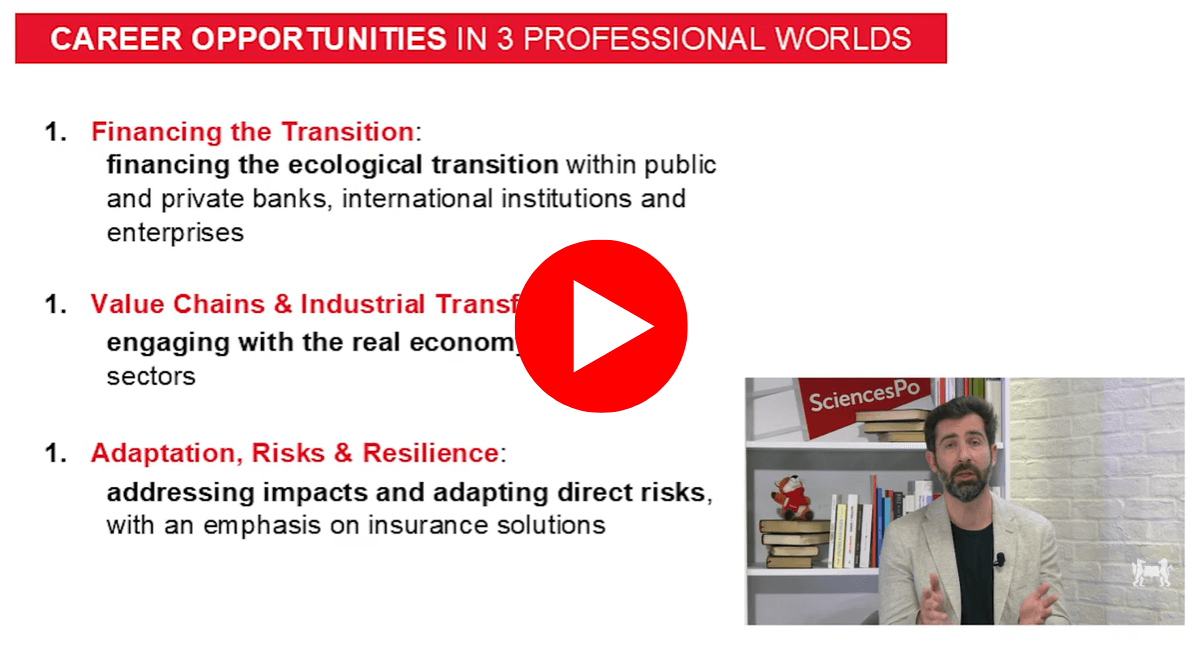
For the first specialization, “Financing the Transition”, opportunities lie within financial institutions: private banks, asset‑management firms, but also public development banks. For example, the French Development Agency at the national level, the European Investment Bank at the regional level, and at the international level institutions like the World Bank. And of course, graduates will have opportunities in working in consulting firms, and international organizations such as the UN or the OECD.
When it comes to the “Value Chains & Industrial Transformations” track, which prepares students to work in strategic management and transformation roles, there are two main pathways. One is to work as a policy expert within a government or an international organization, across all sectors, for instance the industry, energy, agriculture, and so on. The other is to join companies, engaging with the real economy across the same wide range of sectors.
Finally, for the “Adaptation, Risks & Resilience” track, which trains experts who assess climate impacts, manage risks, and design adaptation strategies, we’re targeting both the private sector - especially insurance - as well as the public sector, where civil servants will be responsible for designing and implementing adaptation and resilience policies in cities, countries, or at the international level.
To sum it up, we’ve put a lot of effort and seriousness into making sure the school offers both a strong theoretical foundation and the practical tools students need to succeed in their careers.
Emmanuel Guérin presents the program’s career opportunities:
How Does the Paris Climate School Combine Theory and Practice to Prepare Students for Real‑World Impact?
EG : First of all, the ambition of the Master in Ecological Transition, Risks and Governance is really to combine strong theoretical foundations with very practical tools, tools you’ll actually use once you enter the professional world. At Sciences Po, you’ll follow rigorous academic courses. There’s real intellectual ambition and seriousness behind this. To give you an example: you won’t just take a course on the "economics of the environment". Instead, you’ll study proper micro‑ and macro‑economics, but revisited through the lens of ecological transformation.
Then, through the three specialization tracks - "Financing the Transition", "Value Chains & Industrial Transformations", and "Adaptation, Risks & Resilience" - you’ll go in depth and really learn the skills needed to lead the transition. Each track is designed to equip you with both the analytical frameworks and the practical know‑how required to operate in your chosen field.
Courses are taught both by Sciences Po’s permanent faculty, ensuring academic excellence, and by industry professionals who bring real‑world expertise and applied methods. So the idea is simple: solid theory, real‑world application, and the ability to step into the job market with confidence and expertise.
Emmanuel Guérin presents the professionalization within the curriculum:
Information Sessions: Masters
Find out more about the Masters programs and the wide choice of specialisations offered by the 8 Schools of Sciences Po during our webinars dedicated to applicants.