Home>Academics>Master in Ecological Transition, Risks and Governance

Master in Ecological Transition, Risks and Governance

Starting in the Fall Semester of 2026.

Section #objectives

General Objectives

The Master in Ecological transition, Risks and Governance at Paris Climate School trains students to develop the tools, skills and knowledge they need to effectively understand, analyze and manage issues in the ecological transition field, including climate sciences, earth interdependencies and energy systems, legal stakes of climate changes, economics for the transition, geopolitics of climate and resources, etc.

Discover the Master in Ecological Transition, Risks and Governance in video

Section #orientations

Main orientations and specific features

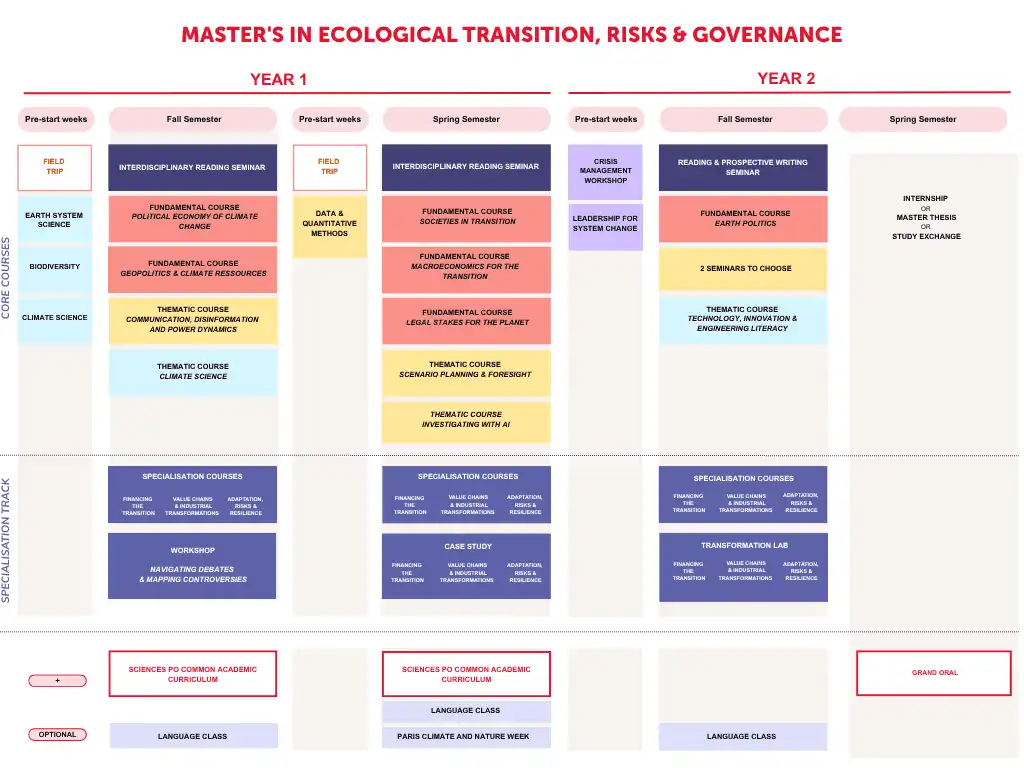
The curriculum in Ecological transition, Risks and Governance is divided into three academic semesters and one semester dedicated to a professional internship, a master thesis or an exchange study program at a partner university.

The three semesters at Sciences Po offer a rigorous academic training at the intersection of environmental sciences and social sciences. 

It is structured around five intellectual pillars:

Interdisciplinary foundations

Students study Master fundamental courses relating to the major challenges of the ecological transition, including: 

  • Economics for the Transition
  • Legal Stakes for the Planet
  • Societies in Transition
  • Geopolitics & Climate Diplomacy
  • Earth Politics

These courses provide in-depth knowledge of the economic, social, political and legal dynamics of transition, in order to train professionals capable of analysing interdependencies and anticipating conflicts or trade-offs at all levels.

Biophysical and technological Literacy

Students are equipped to engage critically with scientific knowledge, through the following courses and modules: 

  • Earth System & Interdependencies
  • Scientific Literacy
  • Technology, Innovation & Engineering Literacy
  • Climate Science

They give students the ability to engage with the exact sciences, understand the physical and technological processes at work, and integrate material and systemic constraints into their future decisions.

Three specialisation tracks based on professional integration and applied practice

The programme offers three specialisation tracks that allow students to build in-depth expertise:

  • Financing the Transition
  • Value Chains & Industrial Transformations
  • Adaptation, Risks & Resilience

Each specialisation track combines one course per semester with progressive practical applications:

  • Practitioner-led seminars;
  • Interdisciplinary case studies based on real-world challenges;
  • A "Transformation Lab" in Year 2, functioning as a policy and institutional design clinic;
  • A mandatory internship and a final Master’s thesis or capstone.

Risk, Adaptation, and Resilience

The program addresses the growing imperative to manage systemic risks, adapt to non-linear disruptions, and anticipate cascading crises

In addition to the specialisation track dedicated to these topics, several modules explore risk governance and crisis management, insurance instruments and financial adaptation.

Methodologies and Decision Sciences

Students are trained in both quantitative and qualitative methods (statistics, modelling, field inquiry, scenario-building, controversy mapping), and develop strategic competencies in crisis simulation, robust decision-making, change management and organisational transformation.


Section #Maquette

Below is the degree structure for the Master in Ecological transition, Risks and Governance :

   
Section #Course description

[In construction]

Core Course

Main teachers : 

  • Laurence Tubiana, Doyenne de la Paris Climate School 
  • Emmanuel Guerin, Vice-Doyen de la Paris Climate School 

Summary

The course will provide theoretical foundations for analysing climate and resources through a geopolitical lens. It examines climate change and resource constraints as forces that transform the core categories of international relations, rather than as additional policy domains. Drawing on the main schools of thought in international relations—realism, liberal institutionalism, constructivism, as well as critical and postcolonial approaches—the course unpacks and redefines key concepts such as power, sovereignty, security, national interest, legitimacy, and interdependence. 
Attention is paid to how the climate crisis and climate action redefine power—who holds it, how it is exercised, and through which material, economic, regulatory, and ideational instruments—as well as how they reshape the definition and defence of the national interest under conditions of long-term risk and uncertainty. The course also explores the role of ideas, scientific knowledge, values, and norms in shaping geopolitical strategies and legitimizing policy choices.

Building on these foundations, the course then adopts geographical and thematic perspectives to examine how climate and resource geopolitics play out in practice. It analyses the evolution of global climate and resource governance, from early multilateral negotiations to the Paris Agreement and beyond, as well as the growing fragmentation of the international order. 

Particular attention is paid to the strategies of major powers (the United States, China, and the European Union), emerging economies, and vulnerable states; to the geopolitics of energy systems and critical minerals; to climate finance and North–South relations; and to the security implications of both the climate crisis and climate action. 

The course also examines the political consequences of climate action itself—industrial competition, trade tensions, technological races, and the strategic use of interdependence in a decarbonizing and resource-constrained world—inviting students to critically assess the prospects for cooperation, competition, and conflict in the decades ahead.

Main teachers : 

  • Lucas Chancel, Professor of Economics, Sciences Po
  • Jean Pisani Ferry, Economist and Director of Bruegel
  • Luiz Awazu Pereira da Silva, Economist, former Deputy General Manager of the Bank for International Settlements and a former Deputy Governor of the Central Bank of Brazil.

Summary

The course will provide theoretical foundations for analysing climate and resources through a geopolitical lens. It examines climate change and resource constraints as forces that transform the core categories of international relations, rather than as additional policy domains. Drawing on the main schools of thought in international relations—realism, liberal institutionalism, constructivism, as well as critical and postcolonial approaches—the course unpacks and redefines key concepts such as power, sovereignty, security, national interest, legitimacy, and interdependence. 
Attention is paid to how the climate crisis and climate action redefine power—who holds it, how it is exercised, and through which material, economic, regulatory, and ideational instruments—as well as how they reshape the definition and defence of the national interest under conditions of long-term risk and uncertainty. The course also explores the role of ideas, scientific knowledge, values, and norms in shaping geopolitical strategies and legitimizing policy choices.

Building on these foundations, the course then adopts geographical and thematic perspectives to examine how climate and resource geopolitics play out in practice. It analyses the evolution of global climate and resource governance, from early multilateral negotiations to the Paris Agreement and beyond, as well as the growing fragmentation of the international order. 

Particular attention is paid to the strategies of major powers (the United States, China, and the European Union), emerging economies, and vulnerable states; to the geopolitics of energy systems and critical minerals; to climate finance and North–South relations; and to the security implications of both the climate crisis and climate action. 

The course also examines the political consequences of climate action itself—industrial competition, trade tensions, technological races, and the strategic use of interdependence in a decarbonizing and resource-constrained world—inviting students to critically assess the prospects for cooperation, competition, and conflict in the decades ahead.

Specialization Track

Scientific Advisor

  • Jean Boissinot, Director of Studies and Risk Analysis at the ACPR (Autorité de contrôle prudentiel et de résolution), and Secretary General of the Network for Greening the Financial System (NGFS)

Summary

Finance is a key enabler of structural transformation in the economy. As such, it has an important role to play in the transition toward a net-zero and climate-resilient economy. However, developments since the Paris Agreement and its art. 2.1.c) calling for “climate consistent financial flows” have been hampered by two seemingly opposite attitudes. Some have imagined that the private financial sector could be the main engine of the transition, substituting for climate policy and climate action effectively falling short of their advertised ambition. Others have suggested that green or sustainable finance was mostly an advertising gimmick, the trend of a moment to be ridden for commercial purpose. This specialization takes a foundational approach, revisiting a wide range of traditional finance courses to combine them with a climate and nature perspective.

The specialization pursues three main objectives:

  • To equip students with strong and broad foundations in finance with a built-in understanding of how to embed climate and nature considerations within this framework. Through a series of modules, the specialization revisits most of the usual finance courses (financial intermediation, corporate finance, financial markets, insurance, etc.) against planetary boundaries and a transition perspective.
  • To develop students’ analytical skills through a variety of actual case studies to allow them to turn foundational knowledge into practical know-how. The specialization combines foundational modules with thematic modules, exposing students to “transition issues” and exploring approaches to finance them.
  • To enable students to develop a “system perspective” and a better grasp at how to leverage on finance for the transition. Rather than a piecemeal approach based on rather specialised knowledge, the specialization aims at providing the students with a broad perspective to understand how various techniques and initiatives can work together for finance to find its place in a “whole of the economy” transition.

At the end of the specialization, students will have acquired knowledge of green and sustainable finance and understanding of its potential and limitations enabling them to engage effectively with financial institutions and public decisions-makers on both policy and projects. The specialization equips students with the knowledge and analytical skills required to pursue careers in green and sustainable finance, across both public and private financial institutions

Section #career

Career opportunities

The Paris Climate School's curriculum has been developed in collaboration with recruiters from both the public and private sectors. They all agree on the need for cross-disciplinary profiles with a systemic vision of transition. 

Future graduates will be prepared to take on a range of strategic positions:

  • In companies: strategy management, financial management, risk management, corporate social responsibility management, etc.;
  • In government: general management of administration, public bodies, etc.;
  • In local authorities: within the governance of a region, department, or city;
  • In European and international institutions and ministries.

They will be able to work on public environmental policies, as well as economic and sectoral policies.

Section #contact

Contact

If you have any questions, please send an email to paris.climate-school@sciencespo.fr.

Find out more