
Home>The IPCC Leadership at Sciences Po: Where Are We Headed?
08.12.2025
The IPCC Leadership at Sciences Po: Where Are We Headed?

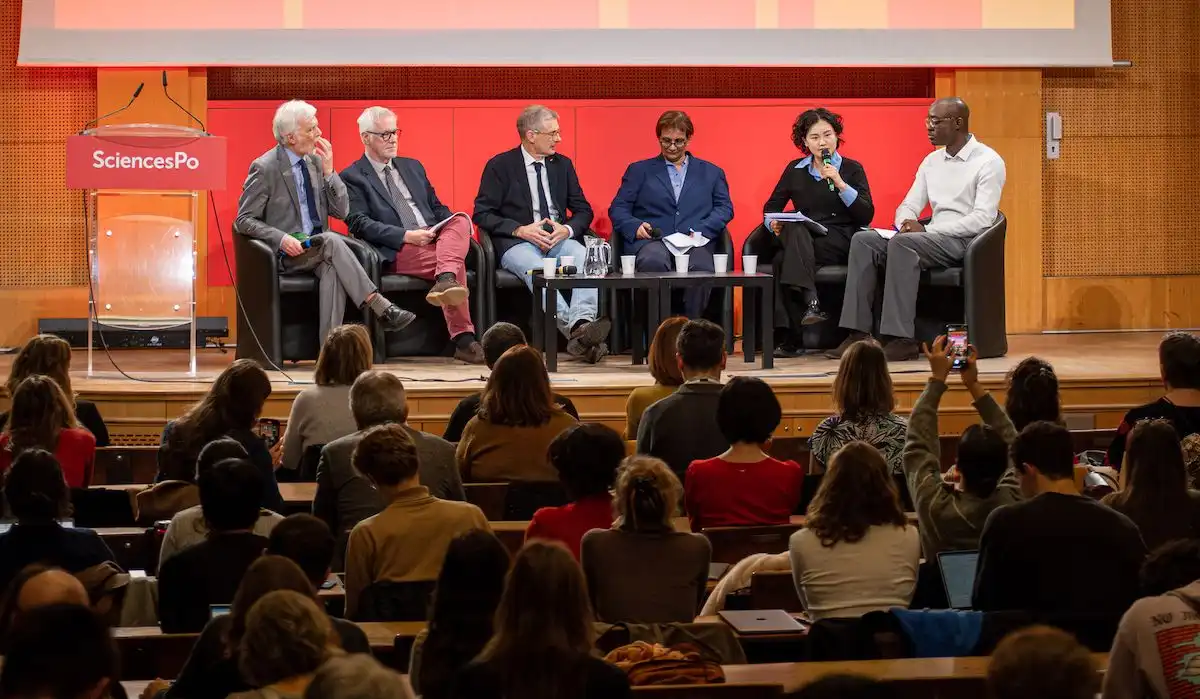
In 2024, the hottest year ever recorded, global temperatures exceeded 1.5°C above pre-industrial levels for the first time, temporarily crossing the threshold set by the Paris Agreement and confirmed by the Intergovernmental Panel on Climate Change (IPCC, GIEC in French). The acceleration of climate impacts worldwide is now confirming long-standing scientific warnings and intensifying social, economic, and geopolitical pressures. Marking the 10th anniversary of the Paris Agreement offers a crucial moment to reflect: How far have we come, and where are we heading in the global response to climate change?
On 3 December, as the 640 authors of the next IPCC Working Group reports prepare for their first-ever joint Lead Author Meeting this December, Sciences Po and the IPCC co-hosted a landmark panel discussion. The President of the IPCC, Jim Skea, and members of its leadership, Joy Jacqueline Pereira, Bart van den Hurk, and Robert Vautard, shared their insights on the progress achieved, the challenges ahead, and the future directions for global climate action. They looked back on nearly four decades of climate research and assessment, reflecting on the scientific foundations built since the IPCC’s creation. They also reviewed what the past ten years of climate action have delivered — and what still needs to be done to meet the temperature goals set in Paris and safeguard our collective future. Two Master's students, Godfried Akuesson (School of Public Affairs) and Younju Lee (Paris School of International Affairs), moderated the event.


« COP21 was a success because of the conjunction of the three S: Science, Society, and State [...] The goal of limiting global warming to 1.5°C comes from a crucial convergence between science and diplomacy. »
Laurent Fabius
Chair of the Circle of COP Presidents, President of COP21


« There is clearly a gap between the messages that science is conveying and the actions that are actually being taken by individual governments [...] Climate change is so difficult because dealing with it involves touching absolutely every aspect of society and economy, it cannot just be done by technology fixes, it goes much deeper. »
Jim Skea
Chair of the IPCC


« I want to make a commitment to truth. We need facts, we need science, we need a discussion based on the realities that science can explain. Otherwise, there is simply no possibility of dialogue. »
Luis Vassy
President of Sciences Po
Created in 1988, the IPCC provides governments with authoritative assessments on climate change, its impacts, and possible responses. Its 2018 Special Report on Global Warming of 1.5°C highlighted that climate risks grow sharply with the speed, height, and duration of temperature increases, and that some impacts — including the loss of certain ecosystems — may be irreversible.
Open house days 2026

Virtual Undergraduate Open House day 2026
Come meet our teams and students at our campuses.
Virtual Graduate Open House day 2026
Meet faculty members, students and representatives and learn more about our 30 Master's programmes.
