
Home>Mona-Lisa Isnard, Master in Political Science (class of 2023)
9 February 2026
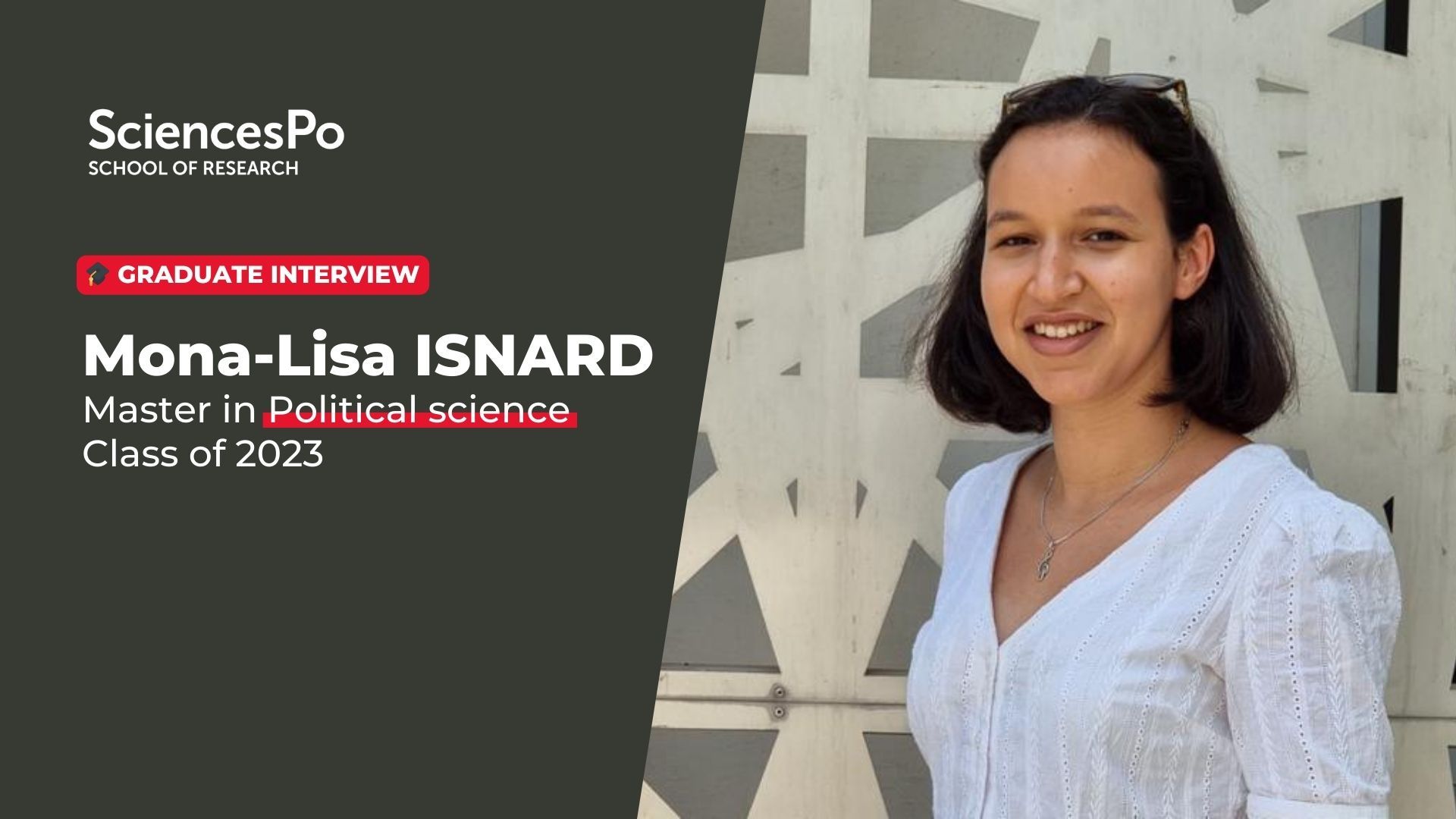
Mona-Lisa Isnard, Master in Political Science (class of 2023)
CAN YOU TELL US ABOUT YOUR ACADEMIC BACKGROUND? HOW DID YOU BECOME INTERESTED IN POLITICAL SCIENCE?
Initially, I had no particular interest in political science, and my career path has been rather unusual. I first turned to gastronomy, which led me to enrol in a culinary training programme. During my second semester, I did an internship in some very prestigious kitchens. Unfortunately, this experience proved to be very trying: I was confronted with an environment marked by sexism, violence and machismo. I therefore decided to end this course, while validating my year by obtaining a CAP (Certificate of Professional Competence) in cooking.
I then did an internship at the culinary media outlet Atabula (now Bouillantes), which allowed me to continue to nurture my passion for gastronomy. I then turned to more general studies, which could eventually lead me to journalism school. That's how I ended up at the Sorbonne (Paris IV) studying for a Bachelor's degree in History.
During these three years, including one spent abroad at University College London, I had the opportunity to take courses in the history of international relations, contemporary world history, cultural geography, and more. It was then that I developed a real enthusiasm for international relations. So I decided to try my luck at Sciences Po, in a Master in Political Science and International Relations at the School of Research, with a very specific project in mind: to write about the role of gastronomy in international relations.
WHAT DID YOU GAIN FROM YOUR YEARS OF STUDY AT THE SCHOOL OF RESEARCH? WHAT MEMORIES DO YOU HAVE OF YOUR SCHOOL, YOUR CLASS, AND YOUR TEACHERS?
First and foremost, those three years gave me a solid theoretical foundation in various fields: sociology, philosophy, history, political science, comparative politics, political theory, etc. This common foundation not only nourishes general culture, but also open-mindedness and critical thinking. It also gave me a better understanding of the contemporary world and the issues we face, while providing me with a rigorous methodology, particularly in terms of research.
However, these years have not been easy. I joined Sciences Po in the midst of the Covid crisis and had to spend my entire first year behind a screen. In my second year of the Master's programme, I worked part-time at the Ministry, which was a real organisational challenge.
I also had the immense good fortune to take a gap year between my M1 and M2, an experience I highly recommend. It allowed me to complete two internships: one at the cooperation and cultural action department of the French Embassy in Tunisia, the other at the Ministry of Ecological Transition, within the General Commission for Sustainable Development (CGDD).
These internships offer the opportunity to put theoretical knowledge into practice, to confront the realities of the professional world and to develop meaningful initial experience, which is useful when leaving school and looking for your first job.
WHICH TEACHER OR COURSE HAD THE BIGGEST IMPACT ON YOU?
I have to mention my research supervisor, Christian Lequesne. He supported me for a year and a half, was always available, kind, attentive and gave excellent advice. Thanks to him, I was able to bring my project to fruition while being guided along the right path. I can't thank him enough.
I also greatly appreciated the teachings of Emmanuelle Tourme-Jouannet. For me, it was a real introduction to international law, and I found the course on international environmental law particularly fascinating.
WHAT IS YOUR CURRENT POSITION?
I am currently responsible for partnerships (development and sponsorship) at the Palladio Foundation and works on sustainable urban issues. Previously, I spent three years as a project manager and sustainable development officer at the General Commission for Sustainable Development (CGDD) of the Ministry of Ecological Transition.
DO YOU HAVE ANY ADVICE FOR A STUDENT WHO WANTS TO ENTER THE SECTOR YOU WORK IN TODAY?
If I had to give one piece of advice, it would be: ‘Never close any doors!’ Just because you have followed a different path or had varied experiences, what many people call an atypical career path, does not mean you cannot decide to change direction. Similarly, just because you studied in a particular field does not mean you cannot gain professional experience in another. Trust yourself.
Find out more:
Information Sessions: Masters
Find out more about the Masters programs and the wide choice of specialisations offered by the 8 Schools of Sciences Po during our webinars dedicated to applicants.