
Home>12th Graduate Conference in Political Theory : "Speech and Politics" with Miranda Fricker
27 May 2026
12th Graduate Conference in Political Theory : "Speech and Politics" with Miranda Fricker
About this event
From 27 May 2026 10:00 to 28 May 2026 18:30
Room B010
1 pl. Saint-Thomas-d'Aquin, 75007, ParisThis event is accessible to people with reduced mobility.
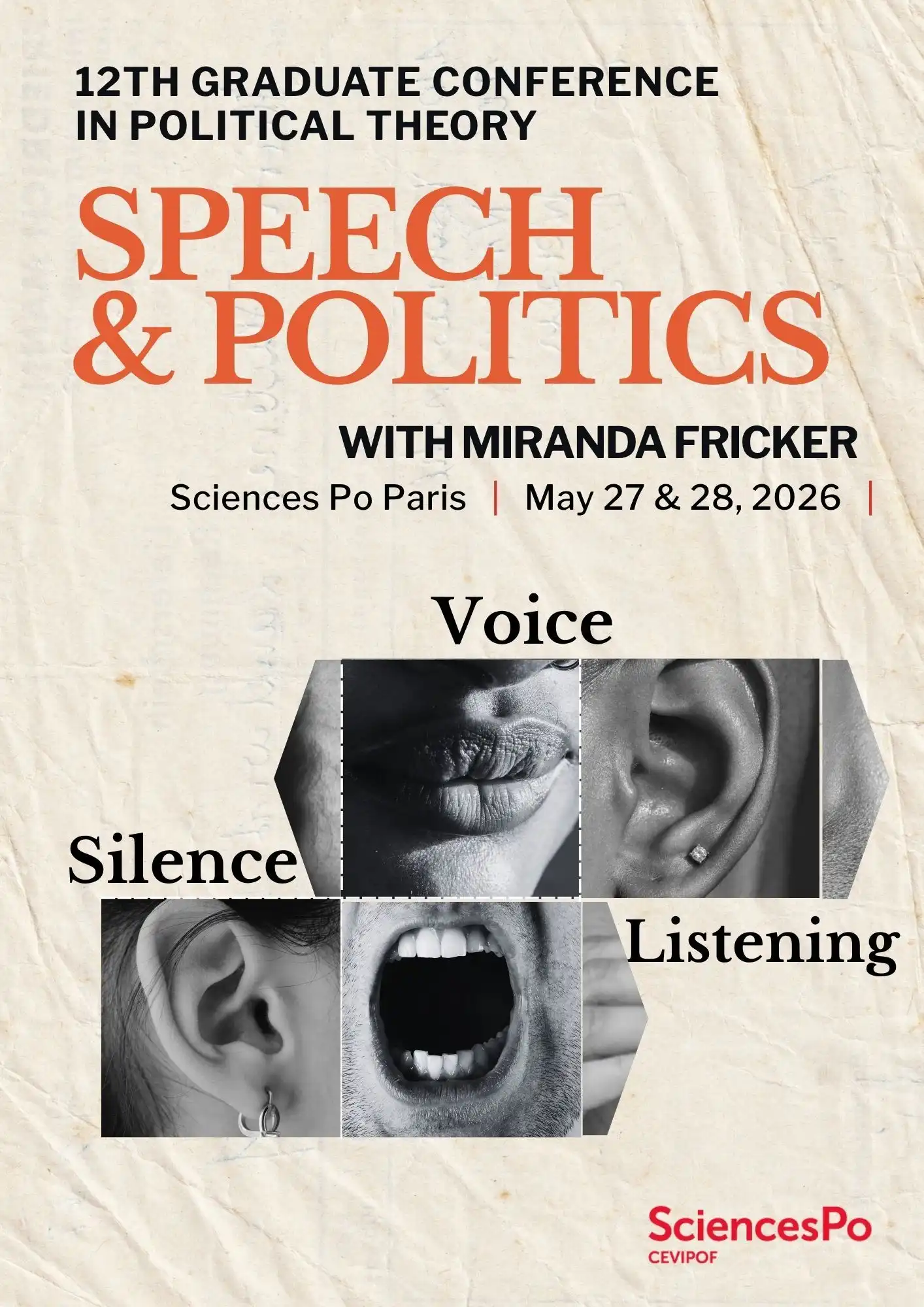
We are pleased to announce the 12th Graduate Conference in Political Theory at Sciences Po, which will take place in Paris on May 27–28, 2026. This year’s theme is “Speech and Politics,” and we are honored to welcome Miranda Fricker as a guest speaker, who will deliver the keynote lecture on May 27.
In a context where the conditions of speaking, listening, and silence are being profoundly reconfigured, this conference seeks to revisit the links between discursive practices and political phenomena. We invite early-career researchers in political theory, philosophy, social sciences, and related disciplines to submit papers addressing, among others, the following themes:
-Voice: expression, authority, speaking out, truth-telling
-Silence: invisibilization, self-censorship, structural constraints
-Listening: recognition, reception, inequalities of audibility
The Organisation Commitee :
- Lino CASTEX, CEVIPOF, Sciences Po Paris, lino.castex@sciencespo.fr
- Perrine CHABANEL, CERI, Sciences Po Paris, perrine.chabanel@sciencespo.fr
- Lucie GRANIER-SICARD, Centre Gilles Gaston Granger, Université d'Aix-Marseille, lucie.granier@sciencespo.fr
- Gabrielle JOURDE, CEVIPOF, Sciences Po Paris, gabrielle.jourde@sciencespo.fr
- Aymeric LEROY, CEVIPOF, Sciences Po Paris, aymeric.leroy@sciencespo.fr
With the support of Sciences Po's Centre for Political Research (CEVIPOF), School of Research and Gender Studies Programme.
Please Register with this link. The access to Sciences Po cannot be granted if you did not register.

Conference Program
Jour 1 – 27.05 / Day 1 – 27 May
Sciences Po - Campus St Thomas - Salle B010 (1 place St Thomas D'Aquin)
9h30 : Accueil et Petit déjeuner B010
10h / 10h15 : Mot d’ouverture
10h15 / 11h45 – Panel 1 : Dialogue et démocratie : le problème de la voix / Dialogue and Democracy: The Problem of Voice
- Samuel Chicheportiche (Université libre de Bruxelles), « “Parler politiquement” dans l’œuvre de Platon : parole dialoguée, parole imposée, parole empêchée. »
- Clara Lucas (Sciences Po Bordeaux), « La participation politique par la parole populaire dans le mouvement des Gilets jaunes à La Réunion. »
- Oscar Basnier (Sciences Po Paris), « Apprendre à se taire : les voix du silence pour délibérer. »
11h45 / 12h – Pause café
12h00 / 13h30 – Panel 2 : Quelle parole politique pour les représentant·e·s et les allié·e·s épistémiques ? / What Kind of Political Speech for Representatives and Epistemic Allies?
- Pascal Walther (Freie Universität Berlin), “Empathetic Speaking: Feminist Challenges to the Classical Rhetorical Framework of Public Speech.”
- Marco Mafezzoli (Sorbonne-Université), « La parole des sans-voix : Habermas, Rousseau et nous. »
- Tanguy Sandré (UVSQ, Université Paris Saclay), “Des histoires d’extinction avec les narvales : une auto-ethnographie pour narrer la justice au-delà de l’espèce.”
13h30 / 15h – Pause déjeuner
15h00 / 16h30 – Panel 3 : L’écologie au croisement des enjeux politiques et épistémiques / Ecology at the Intersection of Political and Epistemic Issues
- Étienne Goron (Sorbonne-Nouvelle), « Les racines d’un “ethos minoritaire” : militantisme écologiste et expression publique dans les premières années de la Ve République (1968-1981). »
- Lucile David (Université Lumière Lyon 2), « Voice sans Audience: conditions d’audibilité et de réception d’une écologie au féminin chez Françoise d’Eaubonne. »
- Chloé Dhaille (UVSQ, Université Paris Saclay), « Tisser des histoires de vie silenciées : expérience de terrain à Venecia, Cundinamarca (Colombie). »
17h30 / 19h00 – Conférence de Miranda Fricker / Keynote Lecture by Miranda Fricker
Sciences Po - Amphi SIMONE VEIL (28 rue des Saints Pères)
"‘Say you're sorry!‘ Apology As Foucauldian ‘avowal’”
19h30 – Cocktail
Jour 2 – 28.05 / Day 2 – 28 May
Sciences Po - Campus St Thomas - Salle B010 (1 place St Thomas D'Aquin)
10h / 10h15 : Accueil et Petit déjeuner B010
10h15 / 11h45 Panel 4 : Matérialités du son et de l’écoute : la politique entre acoustique et audibilité / The Materiality of Sound and Listening: Politics between Acoustics and Audibility
- Maxime Maréchal (Université Paris 1 Panthéon-Sorbonne), “Giving one’s word(s). The ambiguous involvement of interpreters in the epistemic injustice of asylum interviews”.
- Nil Delal Sahin (Istanbul Bilgi University & Kadir Has University), “The Philosophy of Listening: The Ethics and Political Ontology of Audibility.”
- Rémi Zanni (Université des Antilles), « Silencier par le brouhaha : phénoménologie acoustique de l’espace public. »
11h45 / 12h – Pause café
12h / 13h30 – Panel 5 : Opacités et scènes du silence / Opacities and Scenes of Silence
- Ciara Luxton (Sciences Po Paris), “Egalitarianism and the Right to Opacity: Friends or Foes?”
- Theodore Lai (Georgetown University), “A Politics of Intimate Speech: War and Speech in Aeschylus’s Oresteia.”
- Maria Camila Castro (Cornell University), “Showing Silence.”
13h30 / 15h – Pause déjeuner
15h / 16h30 – Panel 6 : Le traumatisme, du silence au discours / Trauma: From Silence to Speech
- Éléonore Paré (University of Ottawa), “The Double-Edged Sword of Trauma Discourse: Reflections from Experiences of Sexual Violence.”
- Léane Van den Driessch (Université Paris 8), « Le silence autour des violences sexistes et sexuelles dans l’Église : parole empêchée, genre et corporéité résistante en contexte chrétien. »
- Laurine Pinazo (Université Paris Cité), « Le courage de la vérité dans le #MeTooInceste : penser la prise de parole politique des incesté·e·s avec Michel Foucault. »
17h / 18h – Conférence de Elise Huchet / Keynote Lecture by Elise Huchet
“L’inaudibilité sociale : un impensé de la philosophie politique ? Jalons pour une analyse des rapports entre parole et politique”