
Home>Populist, far-right and far-left parties in Europe: The PopuList, the reference database, gets a makeover
30 June 2026
Populist, far-right and far-left parties in Europe: The PopuList, the reference database, gets a makeover
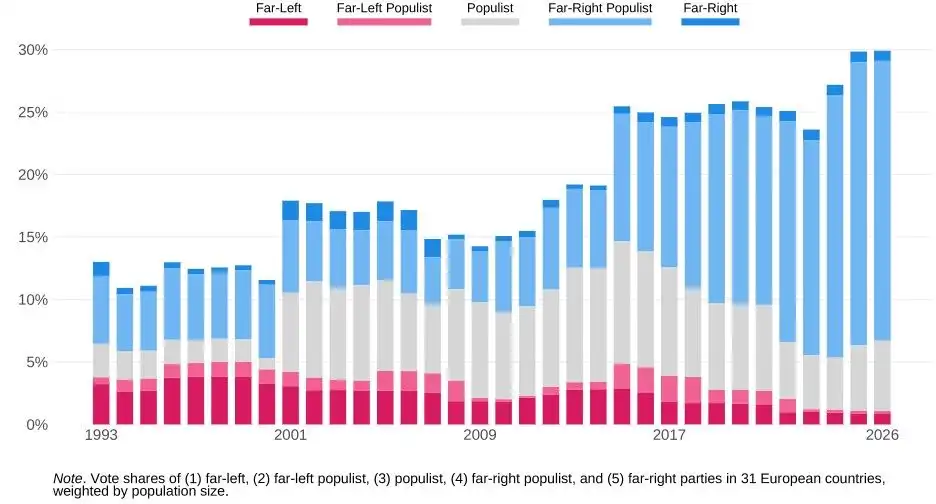
Nowadays, 23% of voters in Europe vote for a far-right party.
This is revealed by the new version of The PopuList, the database tracking the ideological shifts of far-right, far-left, as well as populist parties in Europe, since 1989.
The PopuList distinguishes, in particular, between populist parties—defined by their opposition between the ‘pure people’ and ‘corrupt elites’— far-right parties characterised by nativism and authoritarianism, and far-left parties that challenge the structures of contemporary capitalism and advocate for a profound redistribution of power and resources. It also indicates which of these parties are Eurosceptic.
The database, a key reference tool particularly in political science, currently covers 31 countries (including all EU members) and takes into account all parties that have won at least one seat or exceeded the 2% threshold in national parliamentary elections during the period 1989–2026.
This project is led by a team of eight academics specialising in comparative politics, including Caterina Froio, Associate Professor at the Centre for European Studies and Comparative Politics. It also draws on the expertise of over a hundred specialist colleagues from each country covered.
Launched in 2018 in its first version, The PopuList has, over the years, become one of the most widely used databases by researchers working on European populism around the world.


« The aim of ‘The Populist’ is to provide a reliable tool, based on collective validation, for comparing populist, far-right and far-left parties in Europe, and to track their ideological transformations as well as their relationship with democratic norms and institutions. From a societal perspective, this tool helps to clarify labels that are often used in a confusing manner in public debate. »
Caterina Froio
Associate Professor at the Centre for European Studies and Comparative Politics
This new, fourth version is accompanied by a more interactive and user-friendly website.
The PopuList 4.0 in figures:
- 31 European countries covered (European Union + Iceland, Norway, the United Kingdom, Switzerland).
- 133 far-right parties
- 65 far-left parties
- 201 populist parties
Cross-referencing this data with national election results reveals that:
- nearly 1 in 4 voters in Europe (23%) now vote for a far-right party (compared with 7% in 2006 and 11% in 2016);
- nearly one in three votes for a populist party;
- and only around 1% for a far-left party (lowest vote share since 1989).

The PopuList project is led by Matthijs Rooduijn and a team comprising Caterina Froio, Daphne Halikiopoulou, Sarah de Lange, Paul Taggart, Andrea Pirro, Cas Mudde and Stijn van Kessel, who are supported by nearly 150 colleagues specialising in the relevant parties across the 31 countries. The update for the period 2023–2026 was made possible by the work of Luke Fischer, a research assistant.
Find out more
- An article in the Guardian: Nearly a quarter of voters in Europe now back far-right parties
- The academic article describing the database: Rooduijn, Matthijs, Andrea L. P. Pirro, Daphne Halikiopoulou, Caterina Froio, Stijn Van Kessel, Sarah L. De Lange, Cas Mudde, and Paul Taggart. The PopuList: A Database of Populist, Far-Left, and Far-Right Parties Using Expert-Informed Qualitative Comparative Classification (EiQCC). British Journal of Political Science 54, no. 3 (2024): 969–78.