
Home>CNRS-Sciences Po researchers measure the dangers of phasing out expert fact-checking agencies for electoral processes worldwide
8 July 2026
CNRS-Sciences Po researchers measure the dangers of phasing out expert fact-checking agencies for electoral processes worldwide
A recent study by CNRS-Sciences Po researchers is cited by Meta's Oversight Board in its March 26, 2026 decision on the dangers of phasing out expert third-party fact-checking. Meta's Oversight Board issued a warning on the platform’s plans to deploy crowd-sourced fact-checking AI systems to replace third-party partnerships providing expert fact-checking. The study, published in Science Advances, shows how this system, conceived for and tested on US audiences, operates across national political settings structured along different polarizing issues and ideological axes. Researchers of the study combined High-Performance Computer clusters to process massive platform data, with tools from comparative politics to analyze polarization and moderation actions across five continents.
Meta's Oversight Board issued an advisory opinion on the company's plans to adopt crowd-sourced AI fact-checking systems (modeled after X's Community Notes), replacing traditional third-party fact-checking programmes. Over the past decade, a network of collaboration emerged around the platform, through which flagged content could be transmitted to domain experts and professional journalists in third-party partner institutions for fact-checking. Over the past five years, platforms have explored the possibility of phasing out these collaborations in favor of crowd-sourced algorithmic moderation.
Meta’s Oversight Board cites in its decision a study by CNRS-Sciences Po researchers Paul Bouchaud and Pedro Ramaciotti, recently published in Science Advances, entitled: "Community Notes undermoderate polarizing content by design creating risks in electoral processes". The study uses social media public opinion data from the European Polarisation Observatory, a center funded by a consortium of universities including Sciences Po, London School of Economics, and Central European University among others, and by the Open Institute for Digital Transformations at Sciences Po, created by TIERED*.
Crowd-sourced fact-checking systems such as Community Notes rely on regular users that propose a note of moderation for a post they may find “misinformed or potentially misleading”. Then, other users see it attached to the post, requesting broader voting on whether the moderation note is useful or not.
Several research works have shown that individual assessments of veracity are dependent on the ideological alignment with the claims being discussed. To address this dependency, systems like Community Notes take into consideration the ideological leaning of notes and users that rate them, seeking to select notes that receive positive rating from across the political spectrum. The core heuristic behind the Community Notes algorithm is that cross-ideology consensus helps to filter out misinformation because it can identify content whose veracity is so contested that even ideologically diverse individuals can agree on its untruthfulness. An important limitation of this system is that it was conceived for polarization in the US context, along a single Liberal-Conservative axis.
The CNRS-Sciences Po study first infers multiple ideological and issue positions for users across 13 countries spanning five continents to then examine which dimensions of polarization the Community Notes AI system captures worldwide and how this impacts crowd-based automatic moderation. To achieve this, the study combines High-Performance Computer clusters to process masses of data on online activity with survey research in comparative politics.
The results of the study show that because the system relies on cross-ideological consensus to detect misinformation, it cannot — by design — and it does not adequately process content that activates polarization. The study demonstrates this by comparing how moderation notes related to four national elections are processed against all other notes in the same periods: the 2024 US presidential, the 2024 UK general, the 2024 French parliamentary, and the 2025 German federal elections (see figure). Across elections, notes given to posts about the elections were systematically underselected as moderation actions by the platform when compared to notes on other topics.

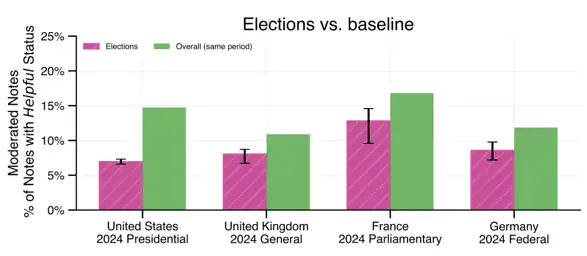
The study holds direct regulatory consequences, as it indicates that. systems such as Community Notes cannot, alone, constitute steps to secure information integrity during elections. Under the Digital Services Act of the EU, online platforms must assess and address systemic risks, in particular risks to electoral processes (DSA, Art. 34(1)(c)). Phasing out expert fact-checking in favor of crowd-sourced fact-checking systems such as Community Notes, is therefore at odds with the obligations established for platforms under the DSA.
*TIERED benefits from government funding administered by the National Research Agency (ANR) under the France 2030 program and by the European Union's NextGenerationEU program, under reference number “ANR-22-EXES-0014”.




