
Home>Back to School 2026: The President of Sciences Po Welcomes the First-Year Students
22 September 2026
Back to School 2026: The President of Sciences Po Welcomes the First-Year Students

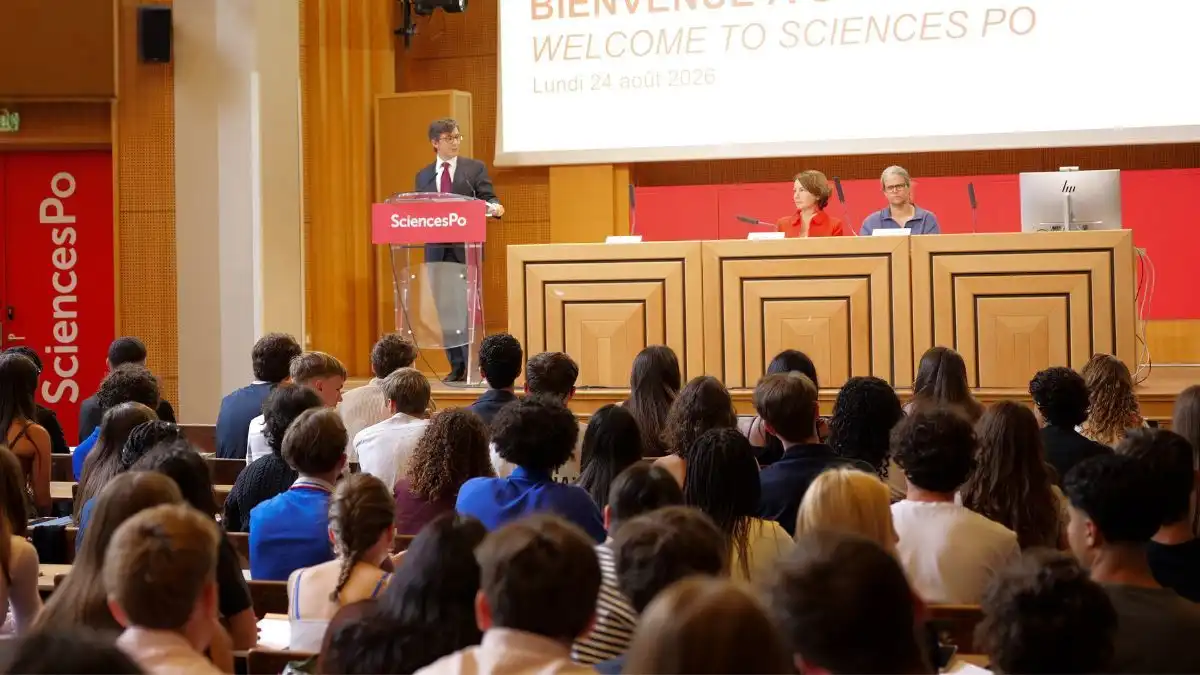
Monday 24 August, 9.00 am: Sciences Po opened its doors to nearly 1,800 new first-year Bachelor’s students at the Undergraduate College, who were embarking on two intensive weeks of pre-term classes.
They took their seats in the lecture halls – at one of our six French campuses or in the iconic Émile Boutmy amphitheatre in Paris – to listen to the address given by the President of Sciences Po, Luis Vassy, a speech centred on three principles which he considers to be the very raison d’être of our institution: merit, truth, and freedom.
“Merit, which has opened this door for you and which you must continue to cultivate; truth, as a standard you must hold yourselves to; freedom, both as a shared system to be protected and as an individual right to be fully exercised: these, in essence, are the values I wish to place at the heart of your first year at Sciences Po.”
Discover the hopes, advice, and warnings that will guide new students throughout their academic and professional journeys.
The full video replay (in French)
The written speech, in full
Dear students,
This morning, whether you are here in Paris or joining us online from our campuses, you are taking your first steps at Sciences Po, within an extremely rich and diverse community: students from every continent, lecturers who are among the very best in their fields, drawn from both academia and the professional world. As you know, this is one of the distinctive features of this institution. When I arrived, I saw happy faces, but also some that looked a little anxious. I wanted to tell you that this is a perfectly normal feeling, one that I myself experienced when I joined Sciences Po in 1997. It was a very different university from the one you see today, as nearly 1,800 of you are joining Sciences Po this year – an absolutely exceptional growth rate that is also a sign of this institution’s success over the decades.
Our task, together with the teams around me, will, of course, be to ensure that the joy remains and that the anxiety fades away in the weeks, days, and hours ahead. To this end, you have teams at Sciences Po who are fully committed to supporting you and assisting you throughout your time here.
I cannot name them all, but allow me to mention in particular Jeanne Lazarus, Dean of the Undergraduate College; her Executive Director, Marie Rassat; Kate Vivian, Director of the Department of Student Life; and Anne-Solenne de Roux, Vice President for Academic Affairs. And, of course, the campus teams and their directors, whom I greet from afar and look forward to seeing again in Le Havre, Dijon, Menton, Nancy, Reims, and Poitiers.
I realise that’s already a lot of names and faces to get to know. I want you to bear one thing in mind right from the start: the journey you are embarking on today will be an intellectual experience, but also a deeply human one. It will be filled with encounters, friendships, discoveries, and, I can assure you, a certain intensity.
Sciences Po is a high-calibre academic programme. You know this, of course. You have come here to learn to work harder, better, and on more challenging subjects.
This is particularly true at a time when artificial intelligence is challenging the very idea of the university, what we do there and what we learn there. Let me be clear: AI does not make the work you will do here any less necessary; on the contrary, it seems to me that it raises the bar for what we are entitled to expect. If a machine can produce an accurate summary in a matter of seconds, it becomes all the more important that you, as Sciences Po students, know how to do more and do it better: read a text for yourselves, grasp its nuances, identify its presuppositions, verify the sources, construct an argument, and formulate a line of thought that is truly your own.
This is the purpose of the Bachelor’s degree reform that we have spearheaded alongside Jeanne Lazarus, and of which you are the first to experience and benefit from. This reform is based on two key aspects: strengthening the intellectual rigour – already high at Sciences Po – by deepening the fundamentals, notably through the introduction of a new reading course on major works of philosophy and political theory, whilst also enhancing quantitative and mathematical skills, academic writing, and proficiency in foreign languages. Alongside these intellectual ambitions, this commitment to hard work, and this ability to get to the heart of matters, you will develop your creativity and intellectual agility through the integration of the arts into Sciences Po’s educational programme.
To begin this year, I would also like to speak to you about what, in my view, constitutes the very raison d’être of this institution, which is over 150 years old. This, in my view, can be summed up in three words, three principles that complement and reinforce one another: merit, truth, and freedom.
***
Let us begin with merit, which, as soon as we publish this speech online, will earn me comments suggesting that I should go back to Year 1 to revisit the sociology course.
There is a curious unease these days surrounding words such as ‘selection’, ‘excellence’ or ‘merit’. Personally, I have none of it. Sciences Po is a selective institution, even more so today than it was 25 years ago, and I must say – as I often tell our alumni – that I doubt I could have been in your shoes given the current level of selectivity.
Last week we published the statistics from the admissions report (in French), which show an even higher standard this year for the cohort joining us – congratulations. Over 40 per cent of you passed your French baccalaureate with ‘Félicitations du jury’ (highest honours), whilst the rest of you also achieved an extremely high standard.
Sciences Po is not a school for an ‘elite’ understood as a caste that reproduces itself identically and reserves positions of power for itself. On the other hand, Sciences Po is indeed a merit-based institution: if you are here, it is because you have earned your place following an extremely rigorous selection process.
Whatever your geographical or social background, whatever your parents’ income, it is first and foremost your hard work, your efforts, your curiosity, your ability to progress, and your motivation that have brought you this far.
This does not, of course, mean that we are unaware of inequalities. On the contrary, the social sciences teach us to gauge their impact: the influence of heritage, networks, and material living conditions clearly fuel educational inequalities. But recognising deterministic factors does not mean accepting a predetermined fate. If we were to end up believing that everyone is merely a product of their background, if every success could be reduced to a prior privilege, then the very idea of education would lose much of its meaning.
A university that no longer believes in individuals’ ability to transcend what they have inherited would, ultimately, cease to believe in its own mission. And what a sad world it would be if we were to focus solely on correlations without ever realising that they are not necessarily causal links, let alone inevitable outcomes.
Allow me a little jest. I sometimes read scientific papers during the summer; I read one from the French National Institute of Statistics and Economic Studies (INSEE) the other day which suggests that height is a determining factor in social and personal success. You can see where I’m going with this: if, at 1.68 m (5'6''), I’d confined myself to musing on the inevitability of this correlation, you can well imagine that my life would have been very different.
And that is precisely why we are so committed to equal opportunities. Nothing is predetermined. It does not mean lowering standards; it is about enabling more young people to meet those standards. This has been the very essence, for the past twenty-five years, of the social policy pursued by Sciences Po, which is implemented in particular – though not exclusively – through the Equal Opportunity Programme: to broaden the pool from which we draw talent, without ever lowering our level of ambition or expectations. I would also like to commend the fact that the reform of the French admissions' procedure, which we introduced two years ago, has enabled us to significantly increase both the level of selectivity and the level of social inclusivity.
To devalue merit is a luxury that children from working-class backgrounds cannot afford, and I speak from personal experience. For those who have neither a network of contacts nor financial resources, hard work, education, and the recognition of merit remain among the most important and powerful tools for social advancement.
There is a second pitfall, the mirror image of the first: believing that merit is the end of the story. As if, once admitted here, you had acquired – at the age of eighteen, or seventeen, sixteen, or even fifteen for one or two of you – a sort of claim to the most enviable positions in society. You will never hear such rhetoric from me. Your admission is not a title of nobility. Your degree, when you graduate, will not be a private income.
Being at Sciences Po opens up opportunities for you; above all, it gives you responsibilities. I say this all the more plainly because many young people, probably just as talented and motivated as you, would have dreamt of being in your place. This opportunity should instil in you not pride, but humility; not a sense of superiority, but the desire to rise to the challenge.
***
Merit alone, however, is not enough to define what you have come here to seek. This brings me to a second word: truth.
The word may seem solemn, yet I use it without reservation. At Sciences Po, you will learn to seek the truth. Not because we claim to possess it, but precisely because it is never a given and because it takes effort to get closer to it.
There is a difference between an opinion and a proof; between an intuition and an established result; between a conviction and proven knowledge. University education begins with this distinction. It is by no means authoritarian: on the contrary, it is the very condition for rational disagreement.
Of course, all knowledge is produced somewhere, by men and women, within institutions, at a given time. The social sciences have taught us never to forget these conditions of production. But it does not follow from this that all truth is relative to the speaker’s point of view, nor that all statements carry the same weight. Truth is not the result of a system of domination.
Bruno Latour, who had a major influence on the scientific and intellectual development of Sciences Po, having served as its scientific director for many years, and who has sometimes been caricatured as a proponent of relativism, expressed concern about this as early as 2004 in a text with a very explicit title: Why Has Critique Run out of Steam? He observed that the tools of critique, designed to reveal the social conditions under which facts are produced, could be turned on their head by climate sceptics to cast doubt on even the existence of scientifically established facts.
The lesson is an important one: showing how knowledge is constructed does not mean that it is arbitrary. Criticism is not made any more intelligent by the extent to which it dissolves reality. If we cease to distinguish between the true and the false, the probable and the improbable, the proven and the asserted, then we leave ourselves defenceless against conspiracy theories, disinformation, climate scepticism, and, in the future, the most convincing artificial outputs of AI.
Embracing this requirement means accepting that we must expose ourselves to theories, analyses, and knowledge that, at times, unsettle us. This is a good thing, for you are not here merely to hear what you already agree with. You are here to encounter ideas that will challenge you, sometimes irritate you, and perhaps even make you change your mind. This is one of the great privileges of university life.
However, I wish to emphasise that our lecturers will never confuse this duty to challenge your certainties with political discourse. This is the very essence of the principle of axiological neutrality, so dear to Max Weber, to which we are collectively committed. There is a place for commitment and conviction: civil society, public debate, associative and political activities. And there is a requirement specific to the amphitheatres: that of demonstration, method, contradiction, and intellectual honesty. The two worlds naturally interact, but they must not be conflated.
This brings me to another danger: confusing critical thinking with what I would call a ‘critical overthinking’. Critical thinking is a method; ‘critical overthinking’ can become a posturing. The former examines, compares, questions, and verifies. The latter risks ending up mechanically suspecting, dismissing, and deconstructing everything that exists.
True critical thinking requires a kind of honesty that can sometimes be uncomfortable: subjecting one’s own certainties to the facts and to contradiction. It is always easier to spot others’ blind spots than one’s own. This requirement will be particularly important in the coming year, which in our country will be marked by major political elections requiring, more than ever, a rational and civilised debate.
You will therefore hear from people here with whom you will profoundly disagree. This is not a failure of the university. This is the university. The right to speak does not end where your agreement ends, and disagreement is not an attack.
Albert Camus wrote in 1946: “We suffocate among people who think they are absolutely right.” Keep this sentence in mind. The best service you can do for your convictions is to make them strong enough to withstand discussion.
***
I now come, at last, to the third word, perhaps the most important: freedom.
Before it was called Sciences Po, our school was known as the École libre des sciences politiques (free school of political sciences). This name, chosen in 1872, says something very profound about our identity. Sciences Po is a free school in both senses of the word: as a political system (the framework within which it was established) and as the individual capacity to think, speak, and act freely. Sciences Po only makes sense in a society where it is considered better to persuade than to coerce, to discuss than to silence, and to argue than to intimidate.
This is why freedom of expression at Sciences Po is absolute. This is why we have an extraordinarily rich range of student societies, political groups, and trade unions; thousands of events; and freedom of expression and academic freedom that must be guaranteed for all.
But freedom is not the law of the loudest. It does not give anyone the right to prevent others from studying, teaching, speaking, or listening. It does not give any of us the right to impose our point of view through pressure. We may challenge a lecture; we may not silence it by force. We may protest against a decision; we may not intimidate those who think differently. We can criticise the institution; we must respect the rules that make our life together possible.
Our shared responsibility is to protect this precious framework that is Sciences Po. For this framework is the very condition of pluralism. It ensures that no one has to check or conform to the prevailing opinion before speaking out, and that no majority, real or supposed, can turn disagreement into a moral failing.
This applies in lecture halls as much as in the corridors and in WhatsApp groups. Reject herd behaviour and accusations based on assumptions. Try to genuinely get to know those with whom you disagree. Kindness is not softness; it is not a weakness; it is what enables a diverse community to withstand strong disagreements without falling apart.
Freedom, finally, is also the capacity to act. It is sometimes said that Sciences Po is a school of power. I prefer to say that it is a school of the power to act: to understand a situation, to decide, to persuade, to organise, to transform the course of events rather than merely to comment on it.
This also involves being willing to put theory to the test of reality. Raymond Aron recounted that, on his return from Germany in the early 1930s, he presented Joseph Paganon – then Under-Secretary of State for Foreign Affairs – with a brilliant analysis of the situation in Germany. Paganon listened to him before asking a very simple question: “And you, if you were in my position, what would you do?” Aron admitted that his response had been far less brilliant. That question, he said, had never left his mind since. We do not wish to train commentators here, but men and women of action.
I find Aron’s lesson deeply in keeping with the Sciences Po ethos. Understanding the world is not enough: one must also ask oneself what one can do about it. Taking action requires us to take constraints into account, to prioritise, to weigh up the consequences and, often, to choose between several imperfect solutions, which enables us to steer clear of absolutist and uncompromising stances. It is not a question of abandoning one’s principles, but of asking how to put them into practice.
This is also why we must study subjects that sometimes cause us anxiety or even repulse us. I have spoken of artificial intelligence; I could also speak of the climate. If, at the start of this academic year, we are launching a new graduate school, the Paris Climate School, with a major in ‘adaptation’ – which is important – it is not because we are giving up the fight against climate change, but because we know that, in real life, adaptation will also be necessary. The same applies to war, to quote Herodotus: “No one is so foolish as to prefer war to peace, in which, instead of sons burying their fathers, fathers bury their sons.” Yet, Herodotus studies war, a subject he detests and rejects. That is what we are doing here too, by trying to understand the major geopolitical and international divisions, and the reasons why conflicts are on the rise. To this end, we have just opened a research centre dedicated to the issue of global security and conflicts.
This is precisely what we need in the face of climate change and geopolitical upheaval: to be able to study these issues freely, to nurture minds capable of thinking freely – and sometimes radically – but also capable of taking action.
It is this very freedom – the ability to act with clarity and responsibility – that Sciences Po must help you to acquire.
***
Before I conclude, I would like to add a final word about the institution you are joining.
Sciences Po is extraordinarily open to the world. Few French institutions welcome as many international students, organise as many exchange programmes, or are as open to other academic and intellectual cultures. This is one of our greatest strengths.
Sciences Po is not merely an institution set in France. It is a French academic institution. Here, rigour is combined with creativity, analytical skills with research tools, and history with mathematics. And it is this very particular, unique, and distinctive blend that will guide you in the months and years to come.
Make the most of being in this beautiful country, France. Explore our regions, Paris, and the world around you; immerse yourselves in this country. For international students on the English track, take the time to learn this beautiful language.
Merit, which has opened this door for you and which you must continue to cultivate; truth, as a standard you must hold yourselves to; freedom, both as a shared ideal to be protected and as an individual right to be fully exercised: these, in essence, are the values I wish to place at the heart of your first year at Sciences Po.
Take full advantage of the chance of being here. Forge friendships and, above all, follow Stefan Zweig’s advice in The World of Yesterday, quoting Émile Verhaeren: “Admire one another”.
Sciences Po will become your home, not just for three, five, or sometimes six years, but for a large part of your life. You will meet fascinating people here, often very different from yourselves, and almost always remarkable. Some will become friends for life.
As you embark on this new chapter of your lives, I would like to tell you that you have every reason to be confident, and we will be here to support you along the way. We are here for you – let the adventure begin!
Open house days 2026

Virtual Undergraduate Open House day 2026
Join us on Saturday, 28 November 2026, to discover our bachelor’s programme, our dual degrees and the first-year admissions process.
Virtual Graduate Open House day 2026
Join us on Saturday, 17 October 2026, to discover our 30+ master’s programmes across our eight professional schools, as well as the admissions process.