


Home>Academics>At a glance
At a glance: The Sciences Po School of Public Affairs Programmes
Sciences Po is an international research university, both selective and open onto the world, ranking among the finest institutions in the fields of humanities and social sciences.
Virtual Graduate Open House day – 17 October 2026

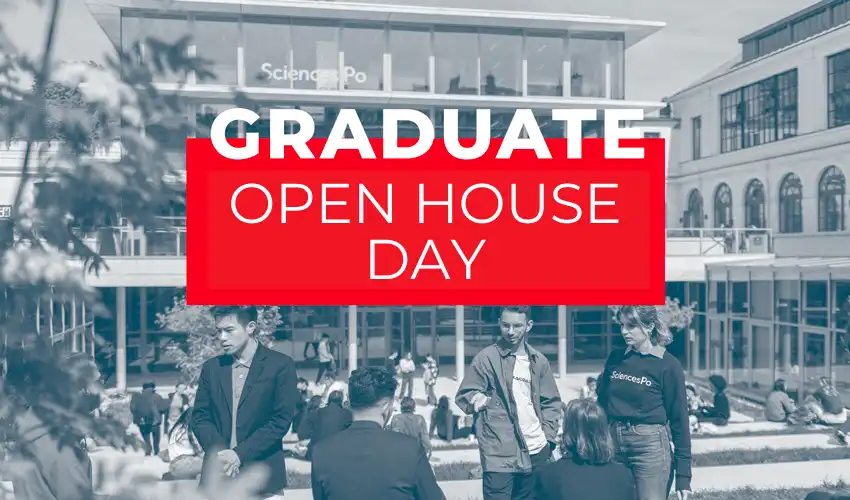
Interested in joining a master’s programme at Sciences Po? Come and discover our 30+ master’s programmes across our eight professional schools, as well as the admissions process. Speak with our deans, academic coordinators and students, as well as our admissions teams.
Sciences Po’s eight schools welcome graduate students from all over the world. Our graduate programmes provide students with both an in-depth academic background in the social sciences and hands-on experience of the professional field they aim to work in.
Discover the School of Public Affairs
The School of Public Affairs prepares the leaders and changemakers of tomorrow to address the major challenges of our time at every level - from the local and regional to the national, European and international.
Our mission is to equip students with the knowledge, skills and critical thinking needed to design robust, innovative and ethical solutions to complex public challenges.
Through a multidisciplinary curriculum taught by leading academics, experienced professionals and public decision-makers, students learn to analyse complex issues, develop informed diagnoses and formulate solutions that can inform decision-making and drive effective and responsible change.
With a strong focus on professional development, the School opens the door to a wide range of career opportunities at the intersection of the public and private sectors, as well as international organizations and NGOs. Graduates go on to pursue careers at the local, national, European and international levels.
Our two-Year Master's Programmes

The School of Public Affairs offers students the opportunity to choose between a Master in Public Policy and a Master in European Affairs, combined with a specialization/policy-stream.
Master in Public Policy
Programme objectives
The Master in Public Policy provides a high-level education for students seeking careers in the public sector, whether through competitive French and European civil service examinations or contractual recruitment, in national, European or international administrations, local authorities, international organisations, NGOs and non-profit organisations. It also prepares students for careers in the private sector and in public affairs.
The programme provides students with a multidisciplinary foundation in the key fields underpinning public policy, including public economics, public policy evaluation, and law and public policy. More broadly, it encourages students to explore the role of the state, its transformations and reforms, as well as its interactions with non-state actors involved in the development and implementation of public policy.
Programme structure
The standard Master in Public Policy programme (excluding dual-degree programmes) is completed over two years, comprising four semesters of study. The final semester is spent off campus, giving students the opportunity to undertake a full-time internship, write a Master’s thesis, develop an individual project or study abroad, depending on their professional goals.
Students may also choose to complete their second year (M2) through an apprenticeship track.
Students may take a gap year between their first and second years (M1 and M2), and may also undertake optional part-time internships during their studies.
Language requirements
Depending on the admissions procedure applicable to you, admission to the programme requires proficiency in English and/or French.
For further information on admissions procedures and language requirements, please refer to the Sciences Po Admissions Office website.
Master in European Affairs
Programme objectives
The Master in European Affairs provides an outstanding education for students seeking careers in European affairs, in both the European and national public sectors and the private sector.
The programme aims to train specialists in European affairs who can navigate and thrive with confidence in a multicultural and constantly evolving environment.
Programme structure
The standard Master in European Affairs programme (excluding dual-degree programmes) is completed over two years, comprising four semesters of study. The final semester is spent off-campus, giving students the opportunity to undertake a full-time internship, write a Master’s thesis, develop an individual project or study abroad, depending on their professional goals.
Students may also choose to complete their second year (M2) through an apprenticeship track.
Students may take a gap year between their first and second years (M1 and M2), and may also undertake optional part-time internships during their studies.
Language requirements
Depending on the admissions procedure applicable to you, proficiency in English is required to pursue the Master in European Affairs. Students who choose a policy-stream taught in French must also have a sufficient level of French.
For further information on admissions procedures and language requirements for the Master in European Affairs, please refer to the Sciences Po Admissions Office website.
10 policy streams to build professional expertise
When applying to the School, candidates choose a Master’s programme and a policy-stream to complement their core Master’s curriculum.
Policy-streams provide in-depth training in a specific discipline, a cross-cutting public policy issue or a particular area of public action. They enable students to deepen their knowledge and develop professional skills in their chosen field of expertise.
The following policy-streams are available in French to candidates applying to both the Master in Public Policy and the Master in European Affairs:
Candidates applying to the Master in Public Policy and the Master in European Affairs may also choose an English-taught policy-stream from the following:
- Social and Health Policies (new)
- Politics and Public Policy
- Economics and Public Policy
- Digital, New Technology and Public Policy
- Cultural Policy and Management
- Energy, Environment and Sustainability
Please note: the Europe in the World policy-stream is only open to candidates applying to the Master in European Affairs.
Language requirements and programme structure
- Students enrolled in a French-taught policy-stream will follow the core Master in Public Policy curriculum in French.
- Students enrolled in an English-taught policy-stream will follow the core Master in Public Policy curriculum in English (Master in Public Policy).
- Students enrolled in an English-taught policy-stream within the Master in European Affairs must ensure that they meet the English language requirements for the English-taught core curriculum.
- Students enrolled in a French-taught policy-stream within the Master in European Affairs must ensure that they meet the language requirements in both French and English.
Please carefully check the language requirements for the School’s programmes on the Sciences Po Admissions Office website.
National and international Dual Degrees
The School of Public Affairs’ Master’s programmes can also be completed as part of one of the dual-degree programmes offered within the Master in Public Policy and the Master in European Affairs.
For further information on the admissions process for dual-degree programmes, please consult the relevant admissions calendar and entry requirements. These may differ from those of the standard programmes, depending on the admissions procedure for which you are eligible.
TEACHING FORMATS AND METHODS
At the School of Public Affairs, teaching formats vary according to the learning objectives of each course. A wide range of courses and learning experiences enables students to develop and diversify their skills:
- Core courses in the Common Academic Curriculum in M1, taught alongside students from other Sciences Po Master’s Schools;
- Core courses within the Master in Public Policy or the Master in European Affairs, bringing together students from different policy-streams across the School;
- Policy-stream courses, taught to students within the same policy-stream cohort;
- Elective courses, taught in small groups on a wide range of topics and open to students from different policy-streams;
- Language courses, with a choice of 20 languages offered at Sciences Po;
- Optional courses, selected from the School’s course catalogue or offered in a second language, as well as courses offered by the Entrepreneurship Centre or the Maison des Arts et de la Création;
- Intensive pre-term sessions, including masterclasses, workshops, bootcamps and Python courses, as well as other intensive programmes.
The wide range of choices available to students allows them to build a strong foundation in knowledge and analytical methods while progressively tailoring their academic pathway to their interests and professional goals.
A wide range of assessment methods
The School uses a broad and varied range of assessment methods to help students develop strong methodological skills and adapt to the different professional environments associated with public affairs.
Through continuous assessment and final examinations - take-home assessments or in-class examinations, in written or oral form, individually or in groups - students learn to analyse issues and develop practical solutions to inform public decision-making. Assignments may include:
- Prepared or timed oral exercises: presentations on assigned or student-selected topics, current affairs briefings, presentations of academic articles, debate preparation and facilitation, simulations, and more;
- Individual and group written assignments: essays, research papers, policy briefs, briefing notes, ministerial briefs, concept notes, short-answer questions, multiple-choice tests, etc.
These diverse assessment methods are designed to train students to develop and contribute to the formulation of relevant and well-grounded public policy proposals.
Assessing core knowledge and skills
Core courses also include a range of timed, in-person assessments, including mid-term tests and final examinations, as well as essays, recommendation memos addressed to public decision-makers and other practical exercises.
Developing responsible AI literacy
Across the curriculum, and depending on the learning objectives of each course, the School provides students with practical, hands-on guidance on how to use generative AI critically and responsibly.
The Policy Lab
As part of the School of Public Affairs’s mission to equip students to rethink public action in a time of profound transformation and growing uncertainty, the Policy Lab creates spaces for reflection, collaboration and hands-on project development. It brings together a diverse range of stakeholders around initiatives that contribute to the common good.
Through the Policy Lab, students develop practical skills to conduct diagnostics and design new approaches, tools and methods for policymaking, grounded in citizens’ real-world needs and informed by today’s climate challenges.
Across its five programmes, students gain hands-on experience by working on projects with public, non-profit and private-sector partners. The programmes draw on a diverse range of approaches and methods:
- Public policy design through the Public Policy Incubator, where students work in small groups to develop concrete, tangible solutions to public-interest challenges identified by external partners;
- Controversy mapping through the POMIS (Policy-Making Initiative for Sustainability) programme, which gives students the tools to address socio-environmental challenges while taking into account the complexity and uncertainty of today’s world;
- Identifying empowerment levers to advance the Sustainable Development Goals through the Global Public Policy Network, which brings together students each year from eight leading public affairs schools around the world for an annual conference showcasing collaborative projects;
- Social science research in support of public action through the Gender Equality and Public Policy Certificate. Students receive advanced theoretical training on policies addressing inequality and discrimination, while working on real-world cases proposed by external partners;
- Algorithm auditing through the AlgoLab, launched in 2026 to help students understand the interactions between algorithmic tools and public policy decision-making.
A FRENCH AND EUROPEAN COMPETITIVE EXAMINATION PREPARATION PROGRAMME
The School of Public Affairs is home to the Competitive Examination Preparation Programme (Prépa concours), which builds on Sciences Po’s long-standing tradition of excellence in preparing students for France’s senior civil service competitive examinations.
This intensive, multidisciplinary, non-degree programme is open without a selection process to Sciences Po Master’s students from their second year (M2) onwards, as well as to students who have already completed their Master’s degree.
A selective external admission pathway is also available to students who have obtained a Master’s (Master 2) degree from another higher education institution.
As part of their studies, students can also prepare for the EU Administrator competitions (AD5 and AD7) organised by EPSO by taking courses through the European Competitive Examination Preparation Centre (CPCE).
Where do our graduates work?
The School of Public Affairs’ wide range of specialisations opens the door to diverse career paths across a broad spectrum of sectors and professional environments.
49% of our graduates work in the private sector, while 21% pursue careers internationally.
Career opportunities span the full public policy cycle, from policy design and analysis to implementation and management, across a wide range of organisations: government ministries, regional health agencies, cultural institutions, social innovation consultancies, local environmental agencies, digital transformation consultancies, NGOs, international organisations, start-ups and more.
Careers by sector
- 28% Public administration
- 14% Audit & consulting
- 12% International organisations, NGOs & non-profit organisations
- 10% Media, publishing, communications & technology
- 8% Industry, energy & transport
- 7% Culture
- 7% Banking & finance
- 5% Education, research & think tanks
- 9% Other
Careers by profession
Our graduates pursue a wide range of roles, including:
- Public sector, digital transformation, innovation and energy consultants
- Parliamentary advisers
- Public affairs managers
- Institutional relations officers
- Hospital managers and executives
- French and European civil servants
- Cultural institution managers and executives
- Senior officials in central government administrations
- Development analysts
- Sustainability and ecological transition specialists
- Security and safety officers
- Defence attachés
- Economic analysts
- Public policy evaluation specialists


