
Home>PSIA at 15: Three Deans Reflect on the Future of International Affairs
17 September 2026
PSIA at 15: Three Deans Reflect on the Future of International Affairs
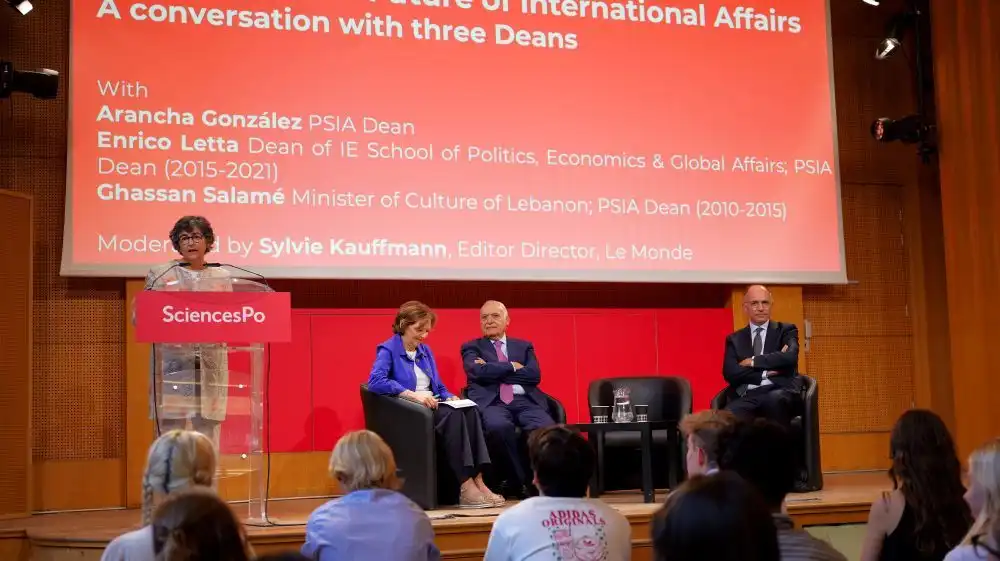
On 9 September, the Paris School of International Affairs marked its fifteenth anniversary with an inaugural lesson that brought together the School’s three successive Deans to date: Ghassan Salamé (2010-2015), Enrico Letta (2015-2021), and Arancha González (since 2021). Moderated by journalist Sylvie Kauffmann, the conversation offered a powerful moment of continuity, intellectual depth, and shared purpose. It also reaffirmed what PSIA has become over fifteen years: a place where international affairs are studied in a way that is unique, rigorous, and profoundly connected to the world.
Building PSIA: A School Born in Transformation
Opening the session, Arancha González reminded students that PSIA was built on a simple conviction: that the world is not only analyzed, the world is built. She paid tribute to her predecessors, describing Ghassan Salamé as the founding builder who laid the foundations of a school open to the world, rigorous and courageous in confronting complexity, and Enrico Letta as the dean who strengthened the structure, expanded the reach, and deepened the global presence.

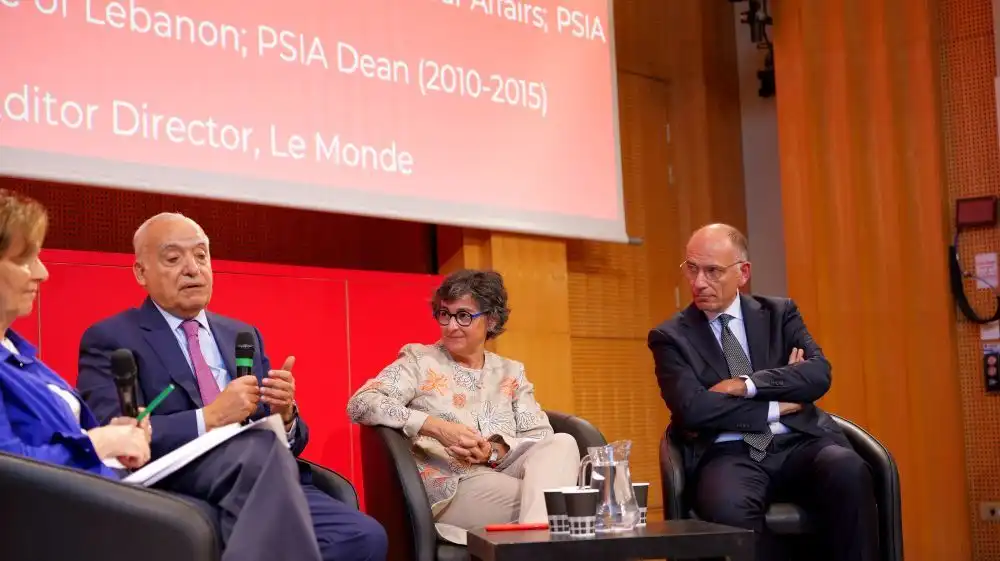
Ghassan Salamé, current Minister of Culture of Lebanon, was visibly moved to return to the amphitheater where he taught for twenty‑five years. He recalled the urgency and ambition of PSIA’s creation. Richard Descoings, then President of Sciences Po, had asked him to build a School of International Affairs in just a few months. The goal was clear: to be among the best five in five years. PSIA reached the top three in three years. The School has consistently been in the Top 4 worldwide for Politics and International Studies (QS Ranking). When founding Dean Salamé meets PSIA alumni in the corridors of the United Nations, he feels proud: “We did not fail.”
He situated PSIA’s birth within a turning point in world politics. After two decades of what he calls “post‑Cold War euphoria”, the international system was shifting. Democratization had plateaued, military budgets were rising again, and the Arab Spring revealed a new era of conflict and authoritarian resurgence. This moment, Salamé explained, required a school capable of reading new trends and preparing students to enter the field of international affairs with the required knowledge and skills for change:
We invited our students not only to understand the world but to keep in mind that they will need to change it for the better.
Europe’s Sovereignty and the Power of Dimension
Enrico Letta brought a deeply European perspective to the conversation about the future of international affairs, shaped by his experience as Italy's Prime Minister. He argued that Europe’s future depends on combining competitiveness and sovereignty. “If we skip one, we lose.”
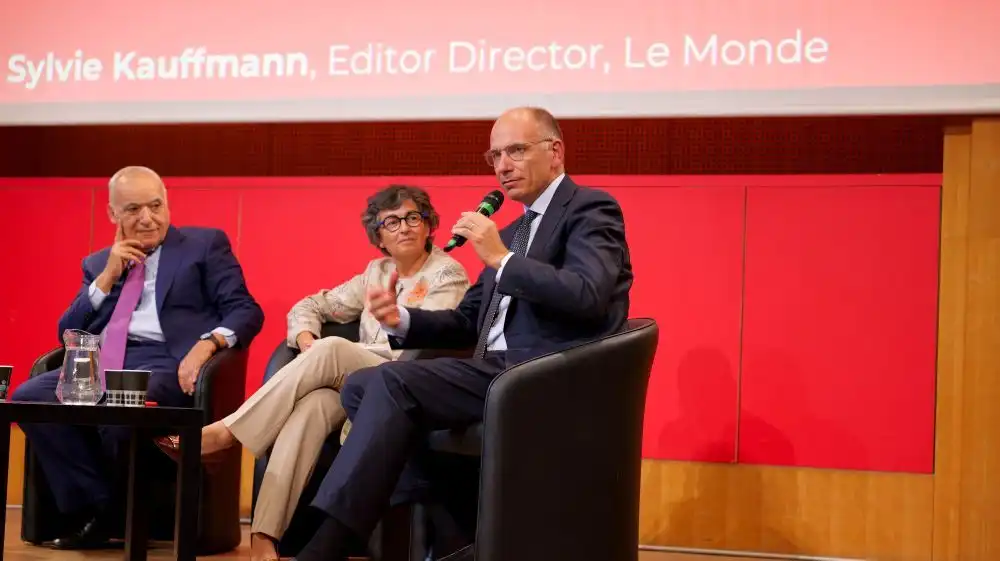
Letta insisted that in today’s world, Europe, composed by many small states, can maintain its influence through competitiveness and integration.
Europe is a big power if we are together and stay together.
Despite political tensions, he remained optimistic. In opposition, leaders take the easiest scapegoat that is the European Union. In power, they have to be pro‑European. He also reminded students of the strength of studying in Europe that “remains a place of freedom, openness, and academic excellence”
Letta closed with a personal reflection on mentorship, describing Salamé as a mentor and González as a sister. He highlighted their unique leadership qualities for a School of international excellence. He concluded with a simple message to students: “You are lucky”
Technology, Power, and the New Global Landscape
Arancha González offered a wide‑ranging analysis of the forces reshaping international affairs. She described the current moment as one defined by unconstrained power, a reversal of the post‑1945 era when states willingly limited their unilateral impulses. Since 2008, she argued, power has become more diffuse and less constrained, whether in Washington, Moscow, Beijing, or Silicon Valley.
Yet she emphasized that power today is also more distributed. Climate change, technology, and markets all act as counterweights to unconstrained state power.
On trade, she corrected common misconceptions. International trade last year grew faster than GDP.
The world is fragmented but not deglobalized.
Attempts at deglobalization, such as recent US tariffs, have largely been paid by domestic consumers. On artificial intelligence, González warned against technodeterminism. “Scientists push the boundaries of science; we have to care about the boundaries.”
She stressed the need for guardrails and noted that diffusion will be the name of the game, with Europe having a meaningful role to play.
A Community That Builds, Learns, and Leads
Throughout the Q&A, the three deans spoke with one voice on PSIA’s mission: to foster open, plural, respectful debate; to prepare students to navigate complexity; and to give them the tools to act. “Constructing agreement is not easy, but it is doable”, said Dean Gonzalez.
Enrico Letta expressed his sense of hope for diplomacy and multilateralism. “Diplomacy will never die” he said. Ghassan Salamé echoed this optimism. He praised recent UN progress on gender parity and insisted that women’s voices are necessary to address the crisis of multilateralism.
Dean Gonzalez concluded with a call to abandon the politics of inevitability. Europe, she added, performs better than commonly assumed, with longer life expectancy, lower inequality, and higher female employment than the US.
PSIA at 15: A School Like No Other
Fifteen years after its creation, PSIA stands as a school built patiently, stone by stone, by leaders who share a vision of responsibility, openness, and global engagement. Every cohort adds a new layer. As Dean Gonzalez said:
Every graduate carries a piece of the school’s architecture into the world
The inaugural lesson made one thing clear: PSIA is not simply a place to study international affairs. It is a place where international affairs are understood, challenged, and built. It is a place where students learn to navigate complexity with rigor, courage, and purpose. It is a place where future leaders are shaped.
This is PSIA.
Virtual Graduate Open House day, October 2025

On 17 October 2026: meet faculty members, students and representatives and learn more about our 30 Master's programmes.