
Home>Ismail, Career Diplomat (Foreign Service Officer), Ministry of Foreign Affairs of Türkiye
15.12.2025
Ismail, Career Diplomat (Foreign Service Officer), Ministry of Foreign Affairs of Türkiye

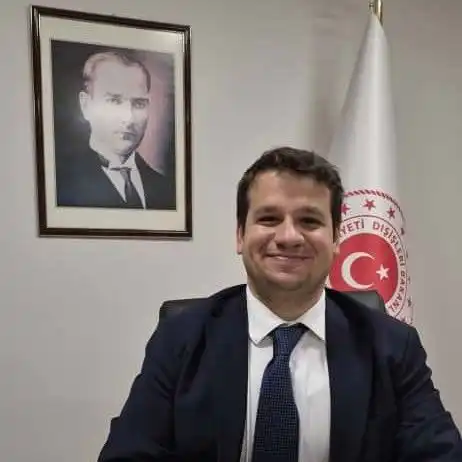
Ismail Aykin has graduated in International Governance and Diplomacy after following a double major in Political Science and International Relations and History at Boğaziçi. As a Turkish national, Ismail pursued his studies at Sciences Po with the support of French Embassy and Turkish Education Foundation scholarships. Studying on a funded basis allowed him to stand on his feet early on and to take full responsibility for shaping his academic and professional path.
Sciences Po offered an environment where intellectual curiosity, personal effort, and professional ambition could meaningfully intersect. Its international classroom and close connection to policy practice helped translate academic training into real opportunities and opened doors along the way. During his gap year at Sciences Po, Ismail worked at the OECD Global Relations Secretariat and later at the International Energy Agency. He currently serves as a Career Diplomat (Foreign Service Officer) at the Ministry of Foreign Affairs of Türkiye, where he works on all dimensions of Türkiye–China relations.
What are your main responsibilities?
In my current role, I follow political, economic, and strategic developments related to China and contribute to diplomatic decision-making through analysis and reporting. My responsibilities include drafting briefing notes and background papers, supporting inter-institutional coordination, and assisting high-level diplomatic engagements.
Beyond technical tasks, the position requires continuity and judgment. Retaining information over time, understanding institutional context, and navigating complex international issues with consistency are essential. Much of diplomacy takes place away from public view, where reliability, discretion, and analytical clarity matter most.
How did you prepare for this job?
I prepared for this role by consistently working on a subject I was genuinely interested in and motivated by. It was not something I felt obliged to do, but something I genuinely enjoyed doing.Rather than following a purely instrumental path, I chose to deepen my engagement with issues that resonated with me intellectually. At PSIA, I also wrote a master’s thesis comparing Türkiye’s development policies with those of Asian countries, which strengthened my comparative perspective and analytical discipline.
Equally important was the international environment at Sciences Po. Engaging daily with people from different backgrounds helped me realise that one’s own perspective is never the only valid one. Through group work and academic exchange, I came to better understand the importance of teamwork, human relationships, time and stress management, and constructive disagreement. Sciences Po was where I most clearly learned how to work with others under pressure and transform complexity into collective effort.
What is the most fascinating part of your job?
One of the most fascinating aspects of my work is engaging with Türkiye’s long-standing foreign policy tradition, which places emphasis on reliability, dialogue, and peace-oriented diplomacy. Türkiye’s approach to contributing to the resolution of conflicts across different regions—through mediation, facilitation, and sustained engagement—has always struck me as both principled and pragmatic.
At the same time, the role has a strong intellectual dimension. It involves working with complex information, understanding the less visible layers of events, and grasping the context behind public narratives. Being able to analyse developments beyond what is immediately apparent, and to approach sensitive issues with responsibility and discretion, makes the work intellectually demanding and deeply engaging. Together with the opportunity to contribute to peace and stability, this intellectual depth is a central reason why I chose this profession, believing that a meaningful sense of purpose matters as much as material considerations in any career choice.
How did your PSIA experience contribute to the position you hold today?
PSIA played a central role in developing my policy writing, analytical thinking, and ability to structure complex issues into clear and concise arguments. The programme encouraged intellectual discipline, clarity of expression, and sustained engagement with real-world policy debates—skills that are indispensable in diplomacy.
Beyond academics, the international classroom fostered openness, adaptability, and empathy. Interacting daily with people from different cultures and viewpoints helped me better understand the human dimension behind policy decisions and strengthened my ability to work in diverse teams—an experience that continues to shape how I approach diplomacy today.
What advice would you give to current students?
Try to discover what genuinely interests you and focus on developing yourself in that direction. Rather than holding rigid expectations about where you should end up, allow Sciences Po and the experiences you go through along the way to shape you—and resist the temptation to internalise bureaucratic constraints or let obstacles narrow your sense of possibility.
At the same time, take ownership of your journey. Whatever field you are drawn to or role you pursue, when faced with challenges, strive to make fair decisions and act in ways that contribute positively to the broader good of society. Aim to do your work well and approach it with integrity, responsibility, and respect for others—and do not forget to enjoy life along the way and to value your own happiness, as a meaningful career is inseparable from personal well-being.
Information Sessions: Masters

Find out more about the Masters programs and the wide choice of specialisations offered by the 8 Schools of Sciences Po during our webinars dedicated to applicants.
