
Home>Alfonso, Project Administrator at UNIDO
23 September 2026
Alfonso, Project Administrator at UNIDO

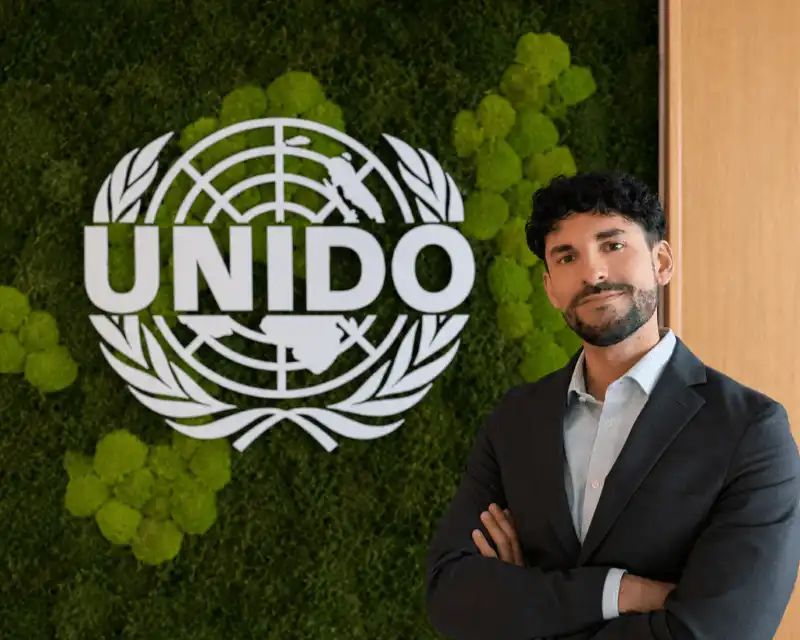
Alfonso Saldana Figueroa has graduated in International Development, with concentrations in Environment & Sustainability, and Project Management. Coming from Mexico, he works as a Project Administrator at UNIDO Skills Development, Entrepreneurship and Fair Production Unit, within the Directorate of SDG Innovation and Economic Transformation, at the HQ in Vienna.
What are your main responsibilities?
As a Project Administrator, my main responsibilities include developing and reviewing project concepts and skills-development initiatives that help young people acquire relevant, demand-driven skills aligned with the needs of industries in developing countries. Inclusive and sustainable industrial development requires companies to have access to qualified workers. At the same time, young people—particularly women—need the right skills to access decent employment and improve their livelihoods.
UNIDO works at the intersection of these needs. We partner with industry, national governments, training providers, development partners, and other stakeholders to develop solutions that equip young people with relevant skills while supporting the transition towards greener and more sustainable economies.
I currently contribute to two projects focused on industry-relevant skills development: the Africa Trade Competitiveness and Market Access Programme under its ECOWAS component, and the SMART-Mine project in Zambia.
My work also includes organizing international events, such as sessions at the upcoming WorldSkills Conference in Shanghai and African Skills Week in Zimbabwe. In addition, I support the development of methodologies and frameworks for mapping skills from a value-chain perspective. This involves examining how a value chain is structured, identifying the occupations and skills required at its different stages, and using this information to better understand and respond to industry needs.
Finally, I support the unit in building partnerships with organizations and institutions active in skills development, including UNESCO, ILO, WorldSkills International, BIBB, among others.
The position requires project-development and management, research, analytical, communication, coordination, and stakeholder-management skills. It also requires the ability to translate technical information and consultations with partners into clear project concepts, reports, and practical activities.
How did you prepare for this job?
Before studying at Sciences Po, I worked as a Project Manager for GIZ in Mexico on a project supporting dual vocational education and training. This experience gave me practical knowledge of project implementation and cooperation with public- and private-sector partners at the national level.
My time at Sciences Po helped me connect this local implementation experience with a broader international perspective. Courses in project management—one of my concentrations—human capital development, ESG, corporate social responsibility, and social innovation helped me strengthen my understanding of core project design and implementation tools, including developing theories of change and applying key impact-evaluation methods, which are now part of my daily work. Events and guest-speaker sessions at PSIA also broadened my understanding of the international skills-development landscape. They helped me learn more about the work of international organizations and development agencies, identify possible career paths, and connect with practitioners working in the field.
Beyond the specific resources available at PSIA, graduating from Sciences Po strengthened my professional profile. Studying alongside brilliant and highly motivated classmates also encouraged me to challenge myself and learn from different perspectives. In addition, connecting now with colleagues who attended Sciences Po has created a strong sense of community, where people are often willing to share advice, contacts, and professional opportunities.
What is the most fascinating part of your job?
The most fascinating part of my job is contributing to initiatives that can make a tangible difference in local communities. Seeing the number of young people and workers trained, or improvements in their employment prospects, shows that the meetings, long hours of project development, consultations, and events can lead to meaningful results.
At the same time, implementing initiatives that respond to donor requirements while strengthening the ownership of national and local partners is complex. This is particularly challenging in the current context of increasing pressure on development-assistance budgets. However, it also makes this an especially interesting time to work in technical cooperation, as organizations must find creative, more effective, sustainable, and locally owned ways of delivering results.
How did your PSIA experience contribute to the position you hold today?
My mandatory third-semester internship at the OECD’s Development Co-operation Directorate helped shape my career interests. For the first time, I experienced the work of an international organization at headquarters level. This taught me how such organizations operate, how donor-country priorities influence development cooperation, and how approaches to international development are evolving. For example, working for Small Island Developing States (SIDS) team helped me understand the vulnerabilities that are present in these countries and why traditional ODA-measuring should be reconsidered; similarly, collaborating for the Aid for Trade team introduced me to the growing relationship between trade and development cooperation, which is highly relevant to my current work. During the internship, I developed research, policy-analysis, and data-analysis skills that complemented my previous profile, which had been more focused on project implementation at the national level.
PSIA’s courses also helped me better understand the relationship between the private sector and international sustainability efforts, including the use of ESG strategies and CSR. This knowledge is increasingly relevant in international development and helped me discover UNIDO’s work on sustainable supply chains. This practical knowledge was very useful during job interviews. In addition, guest speakers in several courses gave me valuable advice on entering the international development sector and helped me build relationships with practitioners in the field.
What advice would you give to current students?
Attend as many events as possible. Speak with guest speakers and practitioners, connect with them on LinkedIn, and invite them for a coffee or a short conversation. Show genuine interest in understanding their work and be ready to explain how your skills and experience could contribute. At the same time, do not become discouraged if people do not reply immediately or if they do not have a suitable opportunity available.
Every conversation and every positive impression is a seed that may eventually lead to something. Building a career requires patience, consistency, and time.
Try to gain as much practical experience as possible. Internships and entry-level positions may not always seem directly connected to your long-term goals, but they can help you develop transferable skills that will remain useful throughout your career. Focus not only on the job title, but also on what you can learn, the responsibilities you can take on, and the professional relationships you can build.
Virtual Graduate Open House day, October 2025

On 17 October 2026: meet faculty members, students and representatives and learn more about our 30 Master's programmes.