


Home>Academics>Research-led teaching
Research-led teaching
Closely associated with Cities are back in town research program, the training provided at the Urban School integrates research as an essential educational tool.
The Research Track is intended for students interested in a research-focused career, whether in academia or the public or private sector. It helps enhance applications for PhD Programs, including the PhD program at Sciences Po School of Research.
Students admitted to this selective track will benefit from:
- A strong methodological training, combined with essential professional skills, such as rigour, depth of knowledge and critical distance, under the supervision of a member of Sciences Po permanent faculty.
- A privileged access to the numerous scientific events organised by “Cities are back in town”: seminars, study days & international symposiums.
The research track is design in partnership with Sciences Po School of Research in in sociology or in political science, for students who wish to enrol in a doctoral program and begin a thesis at the end of their master's degree.
Applications are open to all first-year students of:
- Regional and Urban Strategy Master's Program
- Urban Governance, Policy and Planning master program (GLM and GETIC tracks)
Dual Degree students are not eligible.
Step 1: Declaration of intent (semester 1)
First-year students can express their interest by sending a letter of intent to the Research track scientific coordinator, specifying the topic of their work, the geographic area they plan to cover, and their choice of discipline.
Step 2: Pre-admission and admission (semester 2)
By the end of May:
Students submit their research project (maximum 5 pages) to the Research track scientific coordinator.
June:
A selection committee, gathering representatives from the Urban School and from the School of Research, chaired by the Research track scientific coordinator, evaluates students’ applications.
Admission is based primarily on the quality of individual research projects and the first-year academic results. Students admitted to the Research track are put in contact with their thesis supervisor by the Research track coordinator.
Step 3: Research thesis (semesters 3 & 4)
Students redesign their research project and submit it to the coordinator of the Research track at the beginning of their second year.
During the fourth semester, students write their thesis and defend it during May before a jury with representatives from the Urban School and the School of Research.
TIMELINE AND PROGRAM STRUCTURE
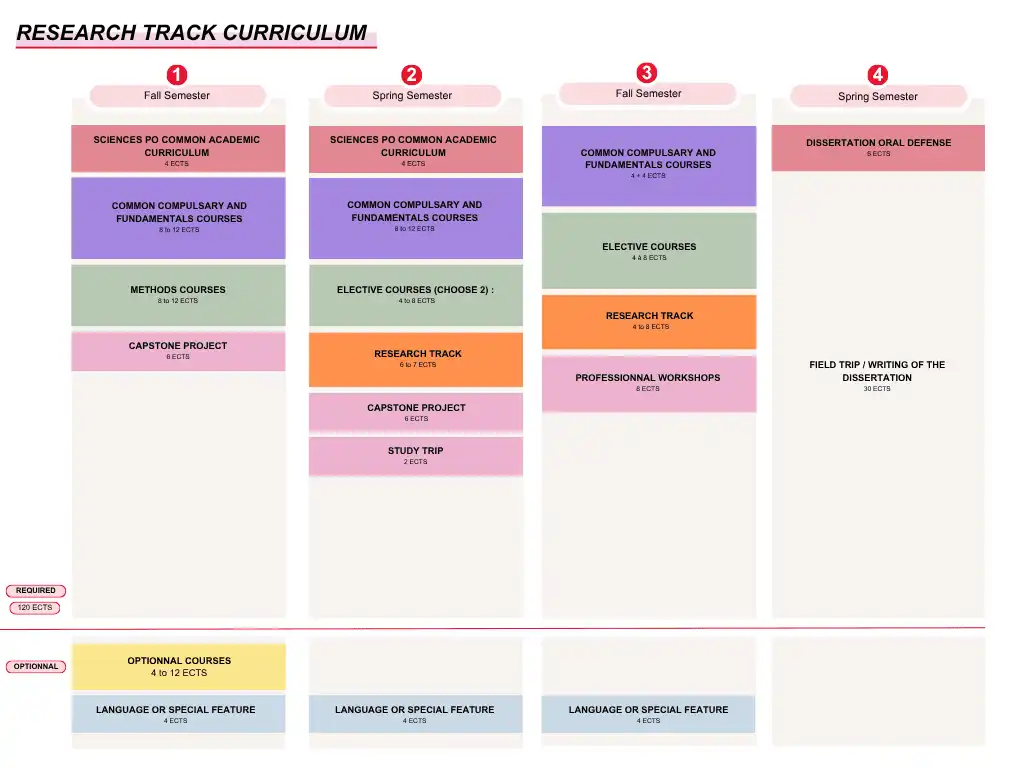
Admitted students follow this track as part of their master's program, with specific courses and requirements in addition to their master's degree requirements:
YEAR 1: preparatory courses
- Semester 1: interested students express their ”declaration of intent” (see “admission requirements” paragraph)
- Semester 2: interested students will take two specific courses:
24-hour course (designed by the Urban School together with the School of Research or a 24-hour course at the Research School according to the discipline);A 12-hour workshop on Research methods. - By early June, students will prepare a short research project.
YEAR 2: Research track curriculum
- Semester 3: Students admitted to the track prepare a thesis and take a seminar course (4 or 5 credits) at the School of Research.
- Semester 4: The semester outside the university consists of completing a research thesis (fieldwork, analysis, writing) at Sciences Po, or, on a case-by-case basis, through an exchange program at a partner university abroad.
- Defence of the thesis, which also validates the Grand’O.

CAREER OPPORTUNITIES
The Research track allows students to apply for a PhD
- at Sciences Po, according to the rules defined by the School of Research
- or at any university worldwide
Around fifty graduates from the Urban School have completed theses at Sciences Po or at universities in France (Université Paris Est, IEP Lyon, EHESS, etc.) and abroad (United Kingdom, United States, Czech Republic, Germany, Italy, Hong Kong, etc.), in various disciplines (sociology, political science, geography, planning, urbanism), with public or private funding.