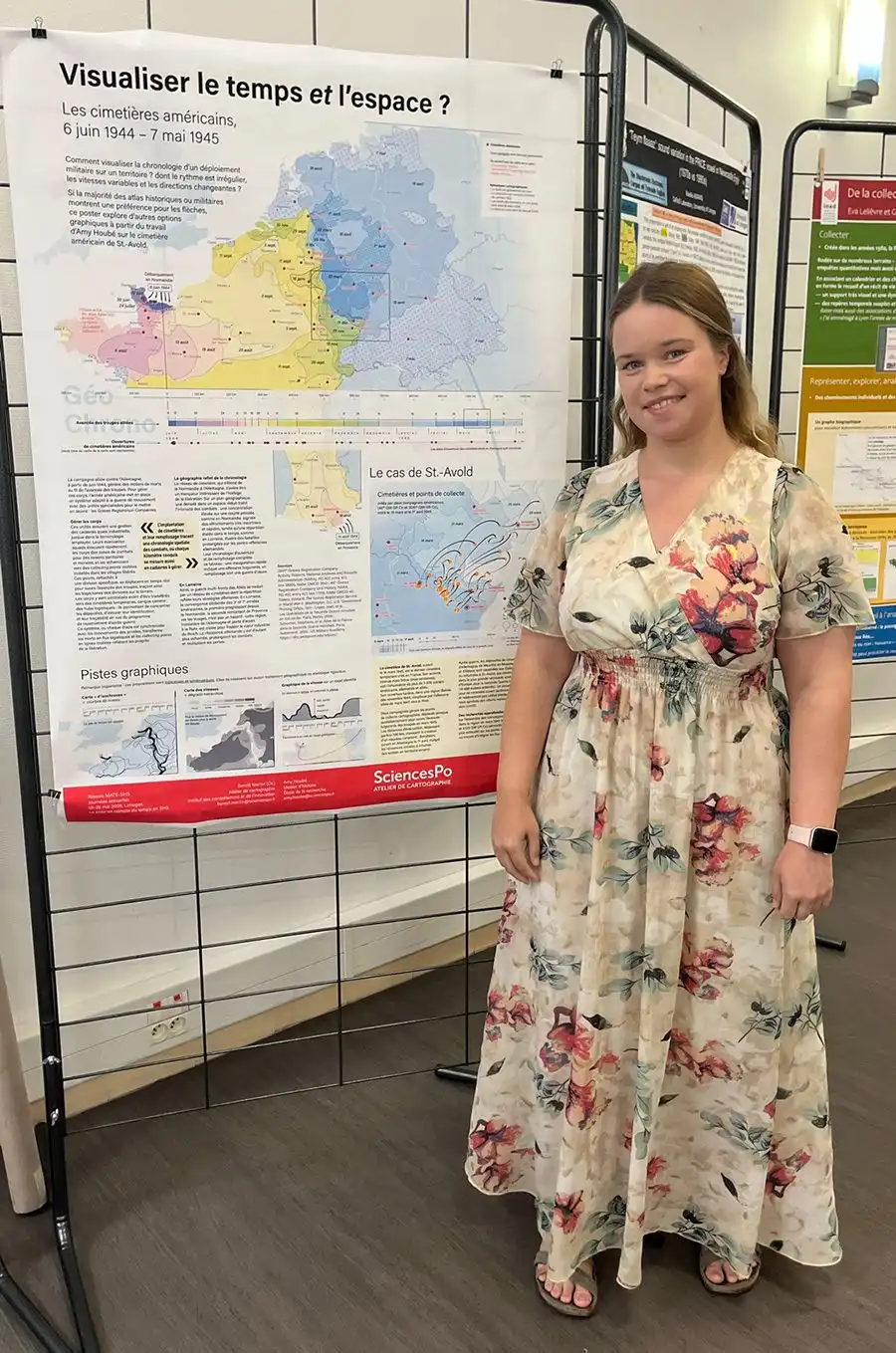
A collaboration born out of the Cartography Workshop
The collaboration between Amy Houbé, a Master’s student in History (supervised by Guillaume Piketty), and Benoît Martin, a PhD holder in Political Science and cartographer at the Sciences Po Cartography Workshop, developed within the framework of the monthly workshops offered to students, lecturers and researchers.
These support sessions aim to assist with data processing and visualisation in ongoing research, by providing methodological tools tailored to the needs of individual projects.
It was within this framework that the idea arose to participate in the annual conference of the MATE-SHS network, dedicated this year to the theme: “The visualisation of time and space”.
“While discussing my topic with Mr Martin, he pointed me towards a call for papers that perfectly matched my chapter and the maps I was developing.”
Amy Houbé, Master’s student in History
A scientific co-production project under tight deadlines
The project was organised within a particularly short timeframe of around two weeks, covering the design of the poster, the structuring of the data and the cartographic production.
“The call for papers arrived shortly before the deadline. It was a very tight schedule, which required intensive and coordinated work.”
Benoît Martin, PhD in Political Science and cartographer at the Sciences Po Cartography Workshop
This tight timeframe led to close collaboration between the student and the Cartography Workshop, going beyond the usual scope of ad hoc support.
Cartography as a tool for historical analysis
The project focuses on the management of bodies and the burial practices of American forces during the Second World War, particularly in the context of the military advance in Western Europe.
The analysis is based on linking two dimensions: the spatial progression of the troops and the temporal sequence of military operations.
“The systems for evacuating and burying bodies directly follow the evolution of the front line and allow us to interpret the spatial and temporal dynamics of the conflict together.”
Amy Houbé
This approach makes it possible to reveal organisational and logistical patterns that are often difficult to grasp from archival sources alone.
“The challenge is to represent both space and time simultaneously, incorporating the variations in the pace of military advance, including both its accelerations and decelerations.”
Benoît Martin
A collaboration between technical workshop and social science research
The creation of the poster and maps was based on a division of tasks between the student and the Cartography Workshop.
Amy Houbé was responsible for structuring the data, building the databases required for cartographic production, and drafting a summary text to accompany the visualisations.
“I built a database and gathered the elements needed to produce the maps, as well as a text presenting my chapter. ”
Amy Houbé
The Cartography Workshop then took charge of the graphic design and the production of the cartographic representations.
“This is a relatively unprecedented co-production on this scale within the framework of the monthly workshops, which usually involve one-off support.”
Benoît Martin
This collaboration is in line with the remit of the Institute for Skills and Innovation (ICI), which encourages cross-disciplinary approaches and supports Sciences Po’s academic communities.
A first participation in a scientific conference
Participating in the MATE-SHS conference marks Amy Hoube’s first experience of scientific communication, ahead of the defence of her dissertation.
“This is my first time presenting at a conference. It is an experience that is both impressive and formative.”
Amy Houbé
This participation also opens up prospects for further research, particularly within the framework of a doctoral project on funeral practices in wartime contexts, with a comparative and international dimension.
Outlook
This experience illustrates the growing role of mapping tools in humanities and social sciences research, not only as a means of dissemination but also as instruments for analysis and knowledge production.
It highlights the value of collaborations between researchers and specialist technical organisations, fostering the emergence of hybrid research approaches at the interface between data, spatialisation and historical timeframes.