


Home>Academics>Two-Year Master's Programmes>The 10 Policy Streams of the Masters>Master, Policy Stream: Social and Health Policies
Master, Policy Stream: Social and Health Policies
Virtual Graduate Open House day – 17 October 2026


Interested in joining a master’s programme at Sciences Po? Come and discover our 30+ master’s programmes across our eight professional schools, as well as the admissions process. Speak with our deans, academic coordinators and students, as well as our admissions teams.
Please note
The Social and Health Policies stream is fully taught in English. It is open to students in both the Master in Public Policy and the Master in European Affairs.
Students already enrolled for the 2026-2027 academic year in one of the merged policy streams (Santé, Global Health, or Social Policy and Social Innovation): the information below applies only to the new curriculum. Please scroll to the bottom of the page to access your specific course outlines.
General objectives of the Social and Health Policies Stream
The creation of the Social and Health Policies stream stems from the recognition that health issues can no longer be addressed independently of social issues, just as social policies cannot be fully understood without taking health policies into account, as they have now become an essential component of social protection systems.
The emergence of new social and health risks, which are often interconnected, now requires us to consider social protection systems, their instruments, their stakeholders, and the reform dynamics shaping them as a whole.
Building on a long-standing tradition of research and teaching in social and health policy, this policy stream offers a broad and integrated approach to social and health policies, in keeping with Sciences Po's interdisciplinary positioning. The Social and Health Policies stream offers:
- A strong focus on major social and health policy challenges, through training centred on the solutions and innovations being considered and implemented, as well as on the role played by new emerging stakeholders.
- A curriculum highlighting the potential and limitations of public policy instruments, whether developed and implemented by the state, the private sector, or civil society organizations.
- Consolidated training in quantitative tools and further development of qualitative approaches and mixed methods, which are particularly relevant to the analysis of social and health policies.
- A curriculum primarily taught in English, reflecting the importance attached to comparative policy perspectives and to the analysis of international policies addressing these issues, while also offering French-language elective courses focusing on France. This will provide students preparing for French civil service competitive examinations (EHESP, EN3S, etc.), as well as those considering national careers across the public and private sectors, with a specific grounding in the French context.
Core Courses of the Social and Health policies stream
Semester 1 - Social Problems, Inequalities, and Social and Health Policies
The first semester will provide an introduction to the main social and health challenges facing contemporary societies, as well as to the public policies developed to address them.
Policy stream courses will focus on understanding the consequences of social, environmental, and economic inequalities for social well-being and population health, as well as on identifying the mechanisms through which these factors produce such effects. They will also examine public responses aimed at reducing these harmful effects and assess the outcomes that these public policies do, or do not, achieve.
Elective courses will complement this approach by offering alternative perspectives drawn from behavioural sciences and sociology, while also critically introducing students to the concepts, indicators, and measurement tools used to identify and assess inequalities and situations of social vulnerability.
Semester 2 – The Three Pillars of Welfare Systems: Health, Employment, and Pension Policies
The second semester will focus on three of the main pillars of social protection systems: health, employment, and pension policies. These courses will draw on a common analytical framework, rooted in economics, to examine the key public policy challenges in each area, the instruments and interventions deployed, and the methods and indicators used to evaluate them.
These courses will provide students with the tools needed to analyze inequalities across these different areas of public policy, as well as the policies designed to address them. They will enable students to identify both the common features of these issues and policies, and the differences, in terms of challenges, measures, and policies, across these three areas of social protection.
Elective courses will broaden this perspective by addressing new social risks, including different forms of discrimination, while introducing innovative methods such as correspondence testing and field experiments to measure unequal treatment and assess the effectiveness of public policies.
Semester 3 – Reforms and Innovation in Social and Health Systems
The third semester will focus on reform and innovation processes in social and health systems. Drawing on the knowledge and analytical tools acquired during the previous semesters, particularly in the field of policy evaluation, students will examine how social protection institutions adapt to demographic, economic, technological, and societal transformations.
Courses in this final semester will highlight the growing role of private actors, civil society organizations, and other agents of change in the design and transformation of public policies.
Elective courses will explore contemporary innovations in public policy, including legal, technological, and organizational innovations. Particular attention will be paid to the involvement of users and citizens in policy innovation and reform. Crisis management, particularly in the field of health, as well as the role of international governance in addressing these issues, will also be covered through dedicated elective courses.
Course Programme of the Social and Health Policies stream
Please note: The information below is provisional and subject to change.
The general structure of the programme

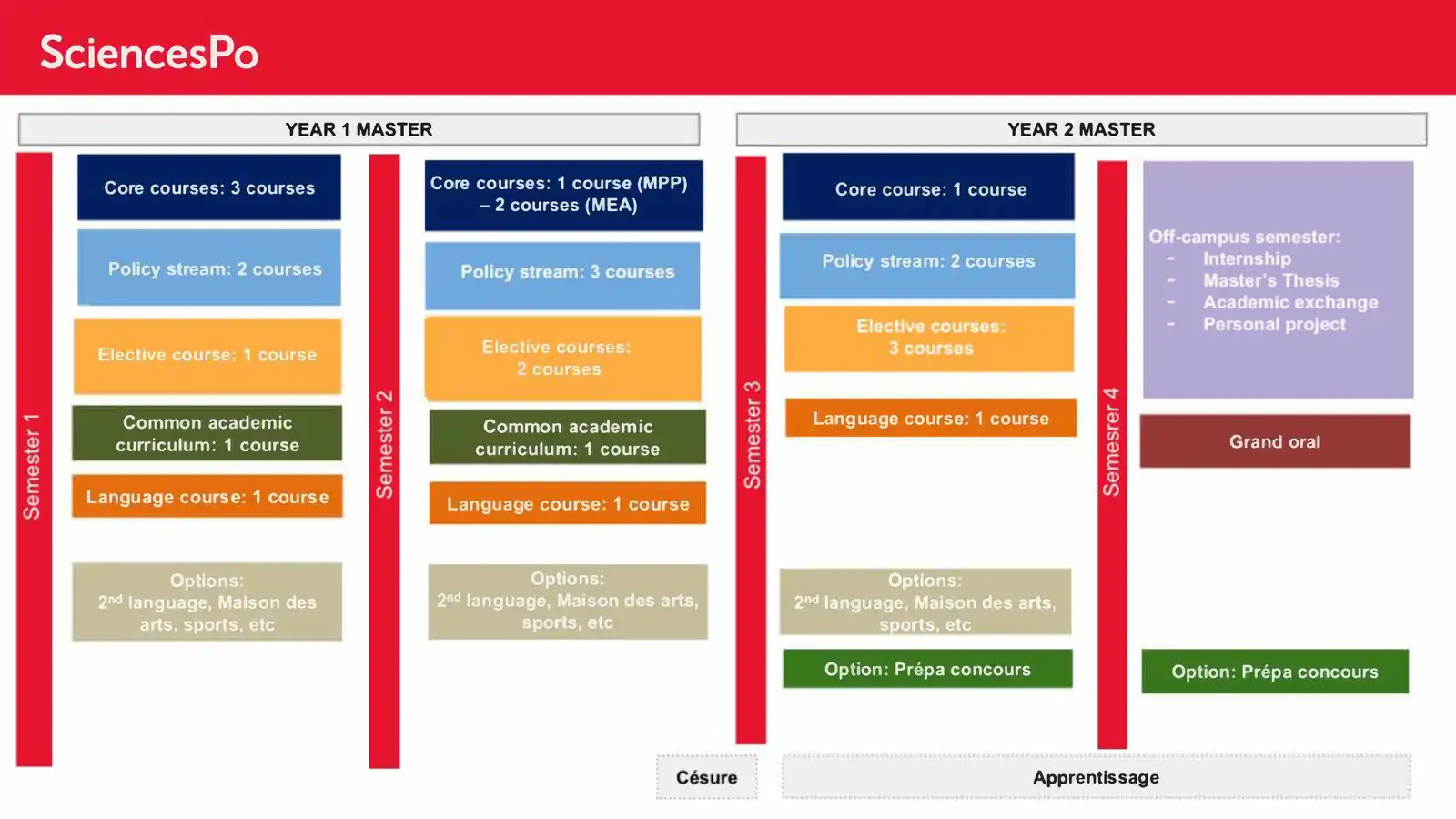
Download the general structure of the programme (PDF)
Policy Stream Courses
| Master 1, semester 1 | Master 1, semester 2 | Master 2, semester 3 |
|---|---|---|
|
|
|
Enseignements électifs
| Master 1, semester 1 | Master 1, semester 2 | Master 2, semester 3 |
|---|---|---|
|
|
|
Career Opportunities After the Social and Health policies stream
This programme aims to prepare students for a wide range of positions in the fields of social and health policy. Graduates will be able to pursue careers in the public sector, through both contractual recruitment and competitive civil service examinations, as well as in private, non-profit, and international organizations (including European agencies working on health and social policy issues).
Potential positions include policy officers, project managers, consultants, policy analysts, programme managers, advocacy officers, and partnership managers.
Graduates of this stream may also find career opportunities in a wide range of organizations, including the OECD, the World Health Organization, European institutions, the City of Paris, Groupe SOS, AP-HP, AP-HM, HCL, GHU hospitals, the French Ministry for Europe and Foreign Affairs, the French Ministry of Labour and Solidarity, and the French Ministry of Health, Families, Autonomy and Persons with Disabilities, among others.
Scientific Advisors


Students admitted in 2026
The course outlines presented above apply only to the new academic offering. Students enrolled or re-enrolled for the 2026-2027 academic year in one of the three former policy streams (now closed to admissions) continue their studies according to their dedicated course outlines below:
Master in Public Policy - Social Policy and Social Innovation stream:
Master in European Affairs - Social Policy and Social Innovation stream:
Master in Public Policy - Santé Policy Stream :
Master in European Affairs - Santé Policy Stream :
Master in Public Policy - Global Health stream:
Master in European Affairs - Global Health stream:
Contacts
- Academic Advisor: Emelyne Grellety
- Academic Assistant: socialpolicy.eap@sciencespo.fr