


Home>Academics>Two-Year Master's Programmes>The 10 Policy Streams of the Masters>Master, Policy Stream: Energy, Environment and Sustainability
Master, Policy Stream: Energy, Environment and Sustainability
Virtual Graduate Open House day – 17 October 2026

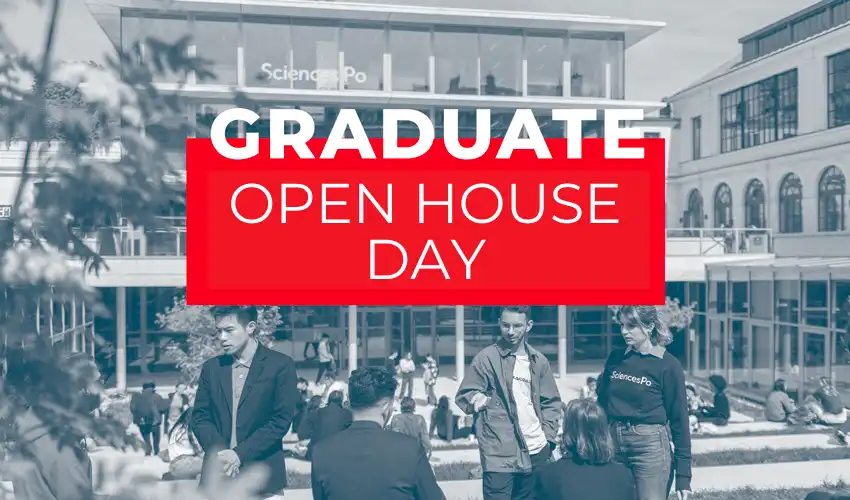
Interested in joining a master’s programme at Sciences Po? Come and discover our 30+ master’s programmes across our eight professional schools, as well as the admissions process. Speak with our deans, academic coordinators and students, as well as our admissions teams.
Overview
- Description and objectives of the programme
- Curriculum programme
- Topics covered in the courses
- Course of the programme
- Replay of the Sciences Po Live
- Career opportunities after completing the policy-stream
- Student profiles
- Testimonials
- Students' works
- Policy Stream events
- Scientific advisors of the energy, environment and sustainability stream
- Contacts
Description and objectives of the programme
The policy-stream "Energy, Environment and Sustainability" is designed to train professionals capable of addressing the complex challenges of energy and socio-environmental transitions. This course encourages students to adopt a pluridisciplinary approach in order to lead these transitions at various administrative and geographical levels by designing policy solutions tailored to current challenges. Upon completing this program, students should be able to analyze and make use of various public policy regulation tools, as well as develop strategies for successful energy and environmental transitions. They will also be prepared to make decisions under uncertainty, anticipate rebound effects, identify key actors from both the public and private sectors, and create new tools for the public good. Energy issues, central to this program, are closely explored in close connection with socio-environmental transition challenges.
This program is taught in English, with some courses in French, and is delivered by professors from Sciences Po and other institutions, as well as practitioners from relevant sectors. No technical prerequisites are required to apply to this program.
All courses and learning activities within the program contribute to the acquisition of six competencies by the end of the course:
- Analyze the interconnections (economic, political, social, environmental) of sustainability issues using a systemic approach in a global context through policy briefs, presentations, and debates.
- Evaluate the economic, social, and environmental impacts of energy and environmental transition policies at various geographical and administrative levels, using both quantitative and qualitative tools with a comparative approach.
- Leverage public policy instruments to promote and regulate energy and environmental transitions at the national and European levels through case studies, policy briefs, and simulations.
- Identify expertise and engage stakeholders in a dialogue to develop original policy instruments through simulations of real-world situations.
- Prepare financing proposals for energy projects and evaluate their economic and environmental sustainability.
- Develop and implement energy transition strategies, including the integration of renewable energy and the management of decarbonization projects through case studies.
The Policy Stream on Video
Curriculum programme
First year of the Master's
At the beginning of the year, students must attempt several catch-up or refresher seminars. This mandatory pre-semester week aims to cover some fundamental concepts useful for approaching the topics addressed in the program: the energy/climate link, planetary boundaries and limits to growth, an introduction to environmental policy-making, and a systemic approach.
The first semester lays the groundwork for both core and policy-stream courses, focusing on energy/climate, environment and associated policies. A mandatory course introduces essential aspects of the energy transition from technical, social, and political perspectives. Students choose between two courses : one explores ecosystem management issues (water, agriculture, fishing, nitrogen and phosphorus cycles), and the other addresses the building sector’s contribution to environmental issues (energy renovation, land artificialization, pollution), both through the lens of public policies.
The second semester focuses on public policy regulation tools to drive socio-environmental transitions, mainly focusing on energy. A mandatory course presents the tools and challenges of energy sector economic regulation and renewable energy support policies. Two elective courses cover the history of regulatory tools for energy transport and distribution, energy supply security, and financing tools from either a national or European perspective. Elective courses from the policy-stream are covering other sectors of activity and regulatory instruments. Core courses explore major public policy issues, alongside more practical exercises such as the "Policy Lab" modules, which include l’Incubateur de Politiques Publiques and European negotiations simulation (MEA).
Second year of the Master's
The third semester aims to apply first-year knowledge of transition challenges and public policy instruments in professional contexts. Students are also expected to challenge established models, propose alternatives, and plan forward on these challenges. Students choose two out of three courses: one on transition scenario development, planning, and organizational transformation strategies, one on energy project financing and one on electricity market regulation.
During the fourth semester, students apply their skills and gain professional experience through an internship, a thesis, a personal project (entrepreneurial, associative, etc.) or study abroad program at a partner university.
This two-year master program is completed by common academic courses, core courses specific to the chosen Master's (Public Policy or European Affairs), elective courses, language classes, and optional courses.
In addition, throughout their studies, students have access to conferences and meetings with professionals from the energy and environment sector, as well as the Policy Lab, where they develop complementary skills (innovation, design, project management, negotiation, etc.) through modules such as the public policy incubator, case studies, or thematic programs (on gender equality and sustainability challenges).
Topics covered in the courses
In a multidisciplinary context, the courses related to this program include:
- Economics and geopolitics of energy, resources, and infrastructure
- Environmental and energy policies
- Sustainability of societal models
- European energy regulation tools
- Energy project and resource financing management
- Environmental economics
- Europe and climate change
- Ecological planification and strategies
Replay of the Sciences Po Live on February 2026
Course of the programme
Please note: the name of the policy stream remains Energy, Resources and Development for students who joined the programme before September 2019.
Master in Public Policy - Energy, Environment and Sustainability stream:
Master in European Affairs - Energy, Environment and Sustainability stream:
Career opportunities after completing the policy-stream
Graduates from this policy stream pursue careers in a variety of key regulatory bodies within the energy sector (government, independent administrative authorities, international and governmental organizations, public agencies). As a result of their deep understanding of public policies, energy, and the environment, others go on to important strategic positions requiring a deep understanding of public policies, energy, and the environment in major companies, consulting firms, think tanks, NGOs, national or international public administrations, and or other professional organizations.
Student profiles
Each year, the program welcomes approximately 45 students in their first year, with 40% enrolled in the Master's in European Affairs and 60% in Public Policy. Students come from diverse geographical and academic backgrounds, with dozens of nationalities represented and a variety of undergraduate degrees (SciencesPo's undergraduate programme, engineering schools, environmental science programs, humanities, international affairs, etc.).
Testimonials


« Through the Energy, Environment and Sustainability stream, I was able to grasp a diversity of themes ranging from the energy transition to agriculture, biodiversity and natural resource management. All in all, it has enabled me to acquire, in addition to a career that up to now had been mainly rooted in political science, the technical skills to better understand the complex mechanisms and interactions of socio-ecological systems. »
Anna Seignovert
Class of 2023, Master in European Affairs, Energy, Environment and Sustainability policy stream, dual degree with Fudan University
Read the testimonial


« Among the most valuable contributions: a solid general understanding of administration that allowed me to evolve in the administrative environment of the CRE, an ability to synthesise and produce effective notes. Also, the specialisation courses in the energy field, and the meetings with professionals in whom one can project oneself. »
Martin Fourdrignier
Class of 2016, Master in European Affairs, Energy, Environment and Sustainability policy stream
Read the testimonial


« The School of Public Affairs, in addition to being a school of "knowledge", has been for me a real school of "know-how". In my opinion, its richness lies in the diversity of the students' profiles and in the exceptional pool of professors with impressive careers. It was at this school that I learned to build a network, to lead large-scale projects, to express myself clearly before a demanding audience and to defend my ideas with conviction. »
Pauline Lego
Class of 2019, Master in European Affairs, Energy, Environment and Sustainability policy stream
Read the testimonial
Students' works
- Environmental law: As part of their coursework, students were invited to step outside the classroom and engage directly with professionals shaping environmental policy and regulation today. From environmental lawyers and NGO advocates to public policy experts, these interviews offered a unique glimpse into the real-world challenges and innovations at the heart of the field. Teachers : Gaspard LEMAIRE & Gabrièle GIEN
- Interview 1 : conducted by Adèle GRIMAULT
- Interview 2 : conducted by Pablo DANGLES
- Policy briefs produced in the Policy-Making Initiative for Sustainability
Policy Stream events
- 27/11/24: Using Social Sciences to Think the Ecological Transition, Masterclass by Sophie Dubuisson-Quellier
- 02/04/25: From a linear to a circular economy : let's rethink (and criticize) EU materials and waste policy, Masterclass by Axel Darut
- 19/02/25: The Cost of Climate Inaction: Are Insurers Fueling an Uninsurable Future? Masterclass by Ariel Le Bourdonnec
Scientific advisors of the energy, environment and sustainability stream


Sébastien Treyer
Executive Director of the Institute for Sustainable Development and International Relations (IDDRI), specialising in foresight and sustainable development.
Biography


Sophie Méritet
PhD, Affiliate Professor at Sciences Po, Assistant-Professor at University Paris Dauphine and researcher at Centre de Géopolitique de l'Energie et des Matières Premières (CGEMP).
Biography
Contacts
- Academic advisor: Léo Houdebine
- Academic assistant: Camille Gouiffes