
Home>Sciences Po students at GPPN annual conference in Singapore!


18 May 2026
Sciences Po students at GPPN annual conference in Singapore!
The School of Public Affairs is a member of the Global Public Policy Network (GPPN). Founded in 2005, the GPPN brings together the public affairs schools of eight world-renowned universities (Columbia, LSE, Hertie, GrasPP, Lee Kuan Yew, Fondaçao Getulio Vargas, Munk School, Sciences Po). The network organises an annual conference during which students and deans of member schools exchange on the main global issues related to public affairs.
The 2026 edition was hosted in Singapore by Lee Kuan Yew School of Public Policy, National University. The theme of this year’s conference was: Reimagining Policy in a Fragmented World. Three groups of Sciences Po students travelled to participate in this conference. One of the teams has qualified for the second round of the competition with a project entitled “Exposure Diversity Score”. Here, Michelle FAIRMAN, Thalia ESHAGHZADEH-BOUCHEHRIAN, Philipp Louis ROLEFF and Filippo VEZZOLI share their experience.


Why did you decide to apply to the GPPN?
We applied to the GPPN because we felt an urgent need to tackle political polarization (the topic of this year’s conference), which is arguably the most critical issue in our society today. It wasn't enough for us to just study this topic from a distance; we wanted to dive deep into the mechanics of especially digital polarization and propose a real solution. Taking part in this conference gave us the perfect push to sharpen our public speaking skills and learn how to communicate complex policy ideas under pressure, helping us grow from students into more effective advocates for the public good.
Beyond the project itself, we were deeply motivated by the honor of representing Sciences Po on a global stage. We take pride in our school’s commitment to evidence-based policy, and we wanted to show how that training translates into action. Most importantly, the GPPN offers a unique network of brilliant peers and mentors from all over the world. We knew that connecting with this community would not only strengthen our specific proposal but also provide us with invaluable relationships and perspectives that we will carry with us throughout our future careers in policy.
Which project did you choose to present, and why did you choose this particular theme?
We chose to present a policy proposal addressing political polarization driven by social media algorithms. At a time when digitalization affects every aspect of our lives, from deciding whether to accept cookies on a website to shaping public discourse, the governance of digital spaces has never been more critical. Drawing on insights from previous research projects, we observed how the digital sphere increasingly shapes political attitudes and fuels fragmentation as online platforms amplify echo chambers, spread misinformation, and enable algorithm-driven content curation. Confronted with these dynamics, we became particularly interested in how digital governance can function as a tool to counteract polarization and reinforce democratic institutions. Especially today, as liberal democracies face increasing strains, governments must regulate digital spaces, hold platforms accountable, and ensure that technology serves the public good. However, striking a balance between necessary regulation and the protection of civil liberties is one of the key challenges of our time. Overregulation risks stifling innovation and limiting free speech, while underregulation leads to unchecked corporate power and the erosion of public trust. Navigating this balance requires an approach to governance that is both adaptive and grounded in democratic principles.
Therefore, our policy proposal addresses the problem of polarization through social media networks in a distinct way: instead of focusing on content removal or top-down moderation, it introduces a user centered transparency obligation for large online platforms, targeting the structural conditions of information exposure that shape how citizens encounter political content online.
Through the Exposure Diversity Score, we aim to require major social media providers to measure and disclose, directly to users, how diverse the content they are exposed to is, based on time spent and interaction patterns across different content categories. Implemented at the EU level through an amendment to the Digital Services Act, the policy places responsibility for technical integration and data provision on very large online platforms. Users receive periodic information about their exposure diversity and can voluntarily adjust their recommendation settings toward a more balanced content mix. In doing so, our proposal seeks to mitigate algorithm-driven echo chambers, reduce digital fragmentation, and support more pluralistic and resilient democratic discourse, all while preserving freedom of expression and respecting individual autonomy.
Your project was selected for the second day of the competition. In what way is it innovative?
The Exposure Diversity Score is a new way to tackle a problem that many people experience in their daily lives without realising it. We often complain about being stuck in 'filter bubbles,' always seeing the same content, yet we lack the tools to change what our algorithms show us, and this shapes the way we think, consciously and subconsciously, about our everyday reality.
Our project is not a traditional ‘startup-style’ initiative. It stems from a willingness to advocate for stronger EU regulation, building on our experience in EU law and policy developed at Sciences Po. Concretely, we crafted our proposal as an amendment to the Digital Services Act (DSA), one of the key pillars of EU digital regulation.
What makes it truly new is the balance between two elements. First, binding rules requiring platforms to classify the content users consume through a multi factor formula, producing a 0-100 score based on viewpoint diversity, source diversity, topic diversity, and diversity across time. This score appears as a pop-up on the user's feed. If you score 10/100, you know your feed is not very varied. From there, you can click a button and set your target score, say 50/100, either for your whole feed or for specific categories like politics, food, or fashion. During elections, for instance, setting a higher score would expose you to more political viewpoints beyond those you already follow.
Second, we go beyond simply categorising content on a left-right spectrum. Using ‘semantic embedding,’ our approach trains the algorithm to identify two layers: first, the topic (migration, taxes, social security), and second, the 'issue position.' In the case of migration, this means distinguishing a humanitarian framing, a security-based one, or an economic perspective. Diversifying your feed therefore means encountering different framings and perspectives, not just different ideologies. In our times of particularly grave political fragmentation, where one side usually does little to know deeply about the other side’s opinion, leading to more and more polarisation and less compromise, we think that proposing this at the social-media level is more than crucial to have the EU unlock its social and political potential.
What skills did you acquire through your participation in the GPPN conference?
Participating in the GPPN conference equipped us with a diverse and valuable set of skills. From a professional standpoint, the experience sharpened our research abilities and solution-oriented thinking, particularly given the competitive nature of the selection process - having our proposal chosen from among many submissions was itself a meaningful achievement. Beyond that, we developed our capacity to work effectively under pressure, collaborate as a team, and present in front of an audience of over 150 people, an opportunity that few students our age have had the chance to experience. We also learned to think on our feet, adapting quickly and responding with confidence to challenging questions from the jury.
On a personal level, the conference offered much more than academic or professional growth. It was an opportunity to discover a new place, engage with a different university system, and forge genuine friendships with peers from around the world. It broadens your perspective in ways that are difficult toreplicate in a classroom setting and stands as one of the most enriching experiences a student can have.
That said, one area that left us wanting more was the question of implementation. It is somewhat disappointing that so many innovative, well developed proposals never move beyond the conference setting. Given the quality of the ideas presented and their genuine potential to drive real change, it would be tremendously valuable to establish pathways that allow the most promising proposals to be developed further and put into practice.
The two other groups from the School of Public Affairs that took part in the conference are also sharing their projects and highlights from the 2026 edition:


Inside the conference with Marina MERZ, Elizabeth FERNANDES and Tomas KOSAREK
Project: “COHERE: Community Housing for Equity, Resilience and Engagement”
Could you give us a brief overview of your project?
In Eastern Europe, the comparatively slower pace of gentrification presents a critical window for proactive intervention. Focusing on Smíchov, a district in Prague facing increasing gentrification pressures, this proposal introduces COHERE (Community Housing for Equity, Resilience, and Engagement). Grounded in a community land trust model and supported through collaboration between local governments and residents, COHERE establishes governance and financing mechanisms including a democratic tripartite board, community bonds, and a structured evaluation process. By prioritizing affordable housing, meaningful community participation, and long-term collective use, COHERE limits rent escalation, reduces the displacement of vulnerable residents, and counters the fragmentation of established communities.
What were the highlights of the conference for you?
Certainly, the panel discussion with deans talking about polarization and fragmentation! And the icebreaker activities we had with other university students from all over the world.

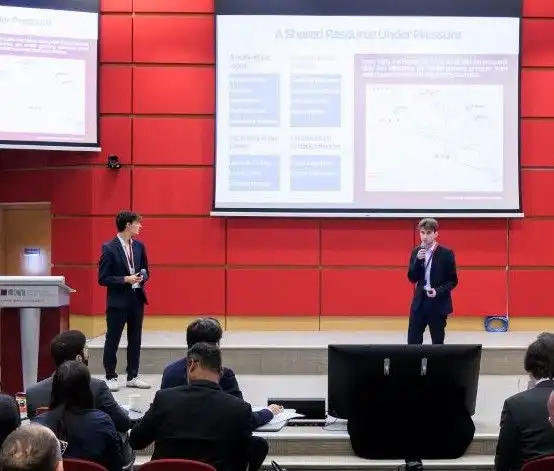
Inside the conference with Hippolyte DANTON and Germinal MONTANE
Project: “Committee for Intercommunity Management of Water in Iraq”
Could you give us a brief overview of your project?
Northern Iraq is a multi-ethnic region (Kurdish, Arab, Assyrian) facing growing water stress. The Tigris River's flow has dropped 33% since 1990 due to Turkish dam construction and climate change, fueling inter-community conflicts over irrigation water and internal migration. The problem with existing approaches is that top-down aid tends to be captured by dominant ethnic groups, reinforcing favoritism and distrust. International agreements with Turkey and Syria have stalled, and rivalry between Iraqi Kurdistan and the central government persists. The proposal is to create Committees for Intercommunity Management of Water in Iraq. Infrastructure funding (drip irrigation, water treatment, drought forecasting) is made conditional on communities governing water jointly through these committees — turning water from a flashpoint into a dialogue tool.
What were the highlights of the conference for you?
The best moment, in our opinion, was the lecture given by some of the jury members. It addressed the challenges facing public policies in today's world, and the need to find new methods to implement them. This lecture gave the entire event a broader significance, and reminded us how important it is today to engage in dialogue in order to rethink public policies, both within an academic and a political framework.
We were so thrilled to meet fellow Sciences Po students who shared this experience with me, all working on truly interesting projects, but also so many talented students from other universities. Getting to know each other during this short yet intense trip, while discovering Singapore together, made it a truly unforgettable experience.
FIND OUT MORE:
Virtual Graduate Open House day, October 2025

On 17 October 2026: meet faculty members, students and representatives and learn more about our 30 Master's programmes.