
Home>Meet the 2025 graduates: Rosa Di Nardo
01.12.2025
Meet the 2025 graduates: Rosa Di Nardo

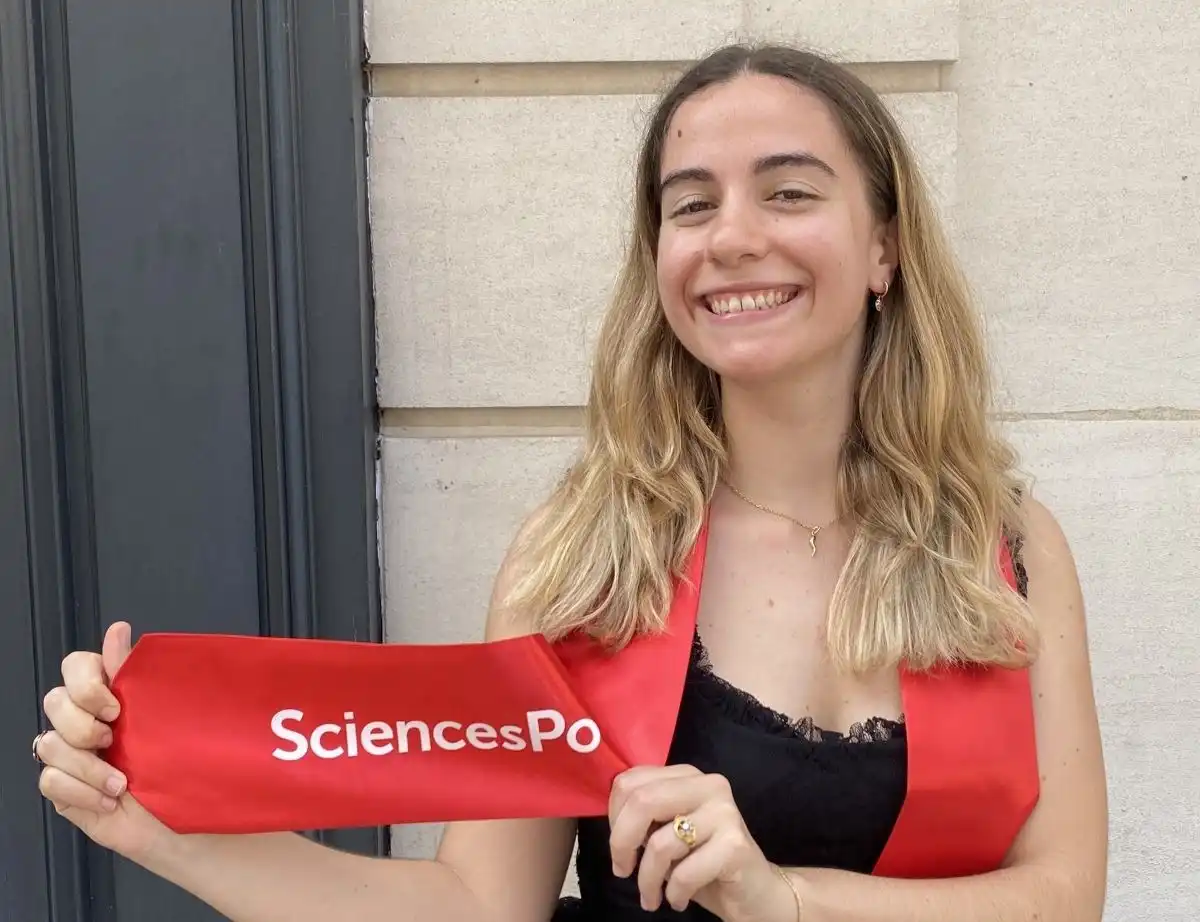
Can you describe your academic and professional background?
My academic journey started at Freie Universität Berlin, where I completed my Bachelor’s Degree in Political Science. At the time, my research focus was the political economy of the European Union. Therefore, I wrote my Bachelor’s Thesis on the role of the European Central Bank (ECB) in the Euro Crisis. More specifically, I focused on the Public Sector Purchase Programme that the ECB launched in 2015.
After completing my studies, I joined the Dual Master’s Degree Affaires Européennes/Political Science at Sciences Po Paris and Freie Universität Berlin, which started in September 2023. I spent the first year in Paris and returned to Berlin in October 2024 to begin the second year. As of right now, I’m writing my Master’s Thesis on how the Mexican government seeks to counteract the recruitment of minors by drug cartels.
Regarding my professional background, I’ve been working as a freelance journalist for the past couple of years and have completed various internships in that field. I’m mostly interested in long-form articles such as portraits, interviews, and reports that are typically found in magazines. I’m also passionate about creative writing and have made various contributions to literary magazines. I see my professional career at the intersection between creative writing and journalism.
Why did you choose to pursue this specific policy stream “Europe in the World”?
I chose to apply for the Dual Degree because I was fascinated by the duality of the French and German approaches to university.
At Sciences Po, I was enrolled in the School of Public Affairs, European Affairs, Policy Stream “Europe in the World”. It was a natural choice, given that back then, my main area of research was the EU. However, at Sciences Po, I expanded my academic interests far beyond the topics I covered during my Bachelor’s. There were more conventional courses such as “Economics of European Integration” or “Advanced EU Law”. But there were also more unconventional ones, such as “Ocean and the Earth Climate”, which was taught by a physicist and a biogeochemist. I enjoyed the diversity.
The second year in Berlin felt overall more academic in nature. I spent much more time discussing the research design of my term papers or critically engaging with literature than I did at Sciences Po.
Both years were valuable and almost incomparable, given that they taught two very different things: One of my professors responsible for organizing the Dual Degree once summarized it by saying that Sciences Po is about learning how to be a politician, and the FU is about learning how to be a political scientist.
How did your training at the School of Public Affairs contribute to get your degree and the position you hold today?
The School of Public Affairs allowed me to explore a lot of different topics, as elaborated above. I’m a creative person, so I’m most thankful for the two cultural courses I took: A course on screenwriting, where I wrote the script for the pilot episode of a series I developed throughout the semester, and a course on how to operate a camera and shoot a short film.
Another memorable course was called “EU Simulation”. Everyone was assigned a role, whether as part of the European Commission, the Council of the European Union, or the European Parliament. Additionally, there were roles such as lobbyists and journalists. We were supposed to negotiate a bill, just as policymakers in Brussels would. I was lucky enough to play a journalist, so I wrote articles that I published on a blog, hosted debates, and recorded a podcast. At the end of the simulation, I had the opportunity to present the process and the final proposal we had managed to adopt to a panel of real Brussels policymakers and my cohort.
I’m positive that the skills I acquired during these courses will be helpful for the creative/journalistic career I envision.
What advice would you give to current and future students?
To stop performing. To stop obsessing over how others perceive you. A lot of Sciences Po students are driven and competitive; they want to shine and excel. Is that an inherently bad thing? No. But the motivation behind it should be explored: Why do I want to be the best at everything? The rush of external validation feels intoxicating, but it’s not sustainable. I think it’s helpful to reclaim your gaze and prioritize your own values and authentic experiences over curating your life to make it appealing to everyone else. I’m not here to make everyone like me. I’m here to look at the world through my own eyes.
Where do you see yourself heading next or what do you see as your next challenges?
My next immediate challenge is finishing my Master’s thesis; the deadline is in November 2025. After that, I would like to do something that might startle a French Sciences Po student, but is very normal for a German: I would like to take a break. A gap year. I would like to do a few internships, for example at a publishing house or a magazine. In addition, I still have to go on some Berlin hipster side quests, such as going on a surf trip or travelling to Latin America.
After the side quests, I see myself becoming a journalist, as I’ve always been passionate about telling stories. Or I’ll become a rock star! We will see.
FIND OUT MORE
Information Sessions: Masters

Find out more about the Masters programs and the wide choice of specialisations offered by the 8 Schools of Sciences Po during our webinars dedicated to applicants.
