
Home>Meet the 2025 graduates: Léa Roubinet
24 March 2026
Meet the 2025 graduates: Léa Roubinet
Can you describe your academic and professional background?

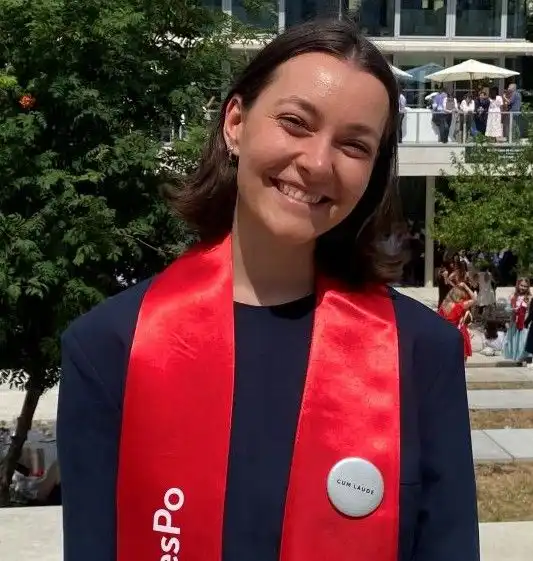
I joined the Undergraduate College of Sciences Po Paris in 2019. I enrolled at the Euro-Latin American campus in Poitiers, where I received a multilingual education in the social sciences (law, history, political science, economics and philosophy), complemented by specialised courses on Latin America. I then chose to complete my third year in Madrid, where I followed the law (LLB) programme at IE University.
I had the opportunity to complement this exchange with a six-month internship with the French Ambassador for Digital Affairs, Henri Verdier, at the Quai d’Orsay. This first internship allowed me to immerse myself fully in the issues surrounding digital diplomacy, in a context marked both by the French Presidency of the European Union and the outbreak of the war in Ukraine. I worked on a wide range of topics, including internet governance, cybersecurity, the fight against the dissemination of violent and terrorist content online, and European support for digital commons.
This experience confirmed my interest in the societal and geopolitical issues linked to digital technologies. In 2022, I therefore joined the Master’s programme in Public Policy – Digital, New Technology and Public Policy at the School of Public Affairs. My academic journey was then further enriched by several professional experiences, notably at Renaissance Numérique, a French think tank studying the impact of digital technology on society, as well as at The Dot, a Tunisian innovation hub.
Finally, I joined Numeum, the leading professional organisation and trade association representing the digital sector in France, as part of a work-study placement as a project officer responsible for monitoring developments in the cybersecurity sector. I currently hold the position of Digital Policy Analyst and work on a broad range of issues, including artificial intelligence, cloud computing, cybersecurity, open source, quantum technologies, support for innovation, and companies’ access to public procurement. Alongside this, I serve as a French Youth Envoy to the International Telecommunication Union (ITU), which enables me to draw on the knowledge I have acquired in recent years while enriching my professional path through an international and diplomatic experience within a leading multilateral organisation.
Why did you choose to pursue this specific policy stream “Digital, New Technology and Public Policy”?
My choice regarding the policy stream became clear following the internship I completed with the French Ambassador for Digital Affairs, Henri Verdier. My interest in the socio-technical issues surrounding digital technologies deepened over the course of those six months, confirming my desire to pursue this path. The term digital is a broad one, referring to a wide range of technologies and everyday uses that affect us all. It is often perceived as a technical field reserved for engineers, whereas there are in fact numerous societal and geopolitical analytical perspectives that can be applied to it. This is precisely where a programme such as that of the School of Public Affairs brings real added value.
During my master’s programme, I took a gap year to gain further professional experience and then chose to return for my second year of the Master’s on a work-study basis. Opting for a work-study arrangement was also an obvious choice: as I already had a clear idea of the sector I wished to enter and several internship experiences behind me, this path appeared to be the ideal way to begin my transition into the professional world. This work-study placement ultimately led to a permanent position as a Policy Analyst working on digital public policy. In my view, work-study programmes are unquestionably a valuable opportunity for students, whether to test their theoretical learning in practice during the second year of the Master’s or to prepare for their entry into the labour market.
How did your training at the School of Public Affairs contribute to get your degree and the position you hold today?
The Master at the School of Public Affairs is rich in many respects. First, it enables students to acquire core foundations in areas such as public economics, law and public policy analysis. The policy streams then offer valuable thematic expertise that is highly relevant to the labour market. In the case of the Digital, New Technology and Public Policy policy stream, we attended courses on a wide range of complementary topics, including artificial intelligence, blockchain, the digital transformation of the state, and digital law. We were also introduced to the Python programming language through practical case studies on generative AI and data analysis. This technical introduction is particularly valuable within a thematic programme such as this one.
The School of Public Affairs also offers considerable flexibility in the choice of electives. This flexibility enabled me to deepen my knowledge of cybersecurity, a topic in which my interest grew significantly during my master’s years. Combined with my involvement in the student organisation Sciences Po Cybersecurity Association, which I joined during my Master’s and later chaired in my second year, these courses provided me with a solid foundation that enabled me to undertake a work-study placement in a position fully dedicated to cybersecurity.
I also chose to join the School of Public Affairs because of the richness of the optional programmes on offer, notably the Public Policy Incubator, which I had the opportunity to join during my Master’s. Receiving training in public policy design and applying these methods to a concrete project in partnership with a public institution proved to be an extremely valuable learning experience, providing analytical tools that I still draw on today.
In summary, the breadth and diversity of the courses allowed me to graduate from Sciences Po with a wide range of skills, a strong understanding of the issues surrounding digital public policy, and the cultural grounding necessary to adopt a critical perspective and properly grasp these technologies. I now draw on this knowledge on a daily basis in my current role.
What advice would you give to current and future students?
I would encourage them not to hesitate to multiply their professional experiences, whether through internships during a gap year or through work-study placements. Such experiences can confirm a career plan, but they can also reveal a lack of interest in a particular sector, profession or management style. These experiences are essential in helping you understand what you do—and do not—want to pursue after graduating. It is far better to realise that you do not thrive in a six-month internship than in your first permanent position.
I would also advise them to become involved in Sciences Po’s student associations. These experiences are rich in both encounters and learning opportunities. They allow students to lead exciting projects while also developing very practical skills such as project management, partnership management, financial management, as well as leadership and team management abilities. And make the most of the events and conferences organised at Sciences Po while you are there—the intellectual stimulation is something you will miss once you have graduated.
Finally, do not hesitate to reach out to alumni working in sectors that interest you. We are all happy to speak with you, answer your questions and do our best to offer advice and guidance.
Where do you see yourself heading next or what do you see as your next challenges?
In the coming months and years, I aim to continue deepening my expertise on issues related to digital and innovation public policy. These topics can be quite complex, so a thorough understanding of the regulatory, political and institutional dimensions is an undeniable asset for pursuing a career in this field. I would also like to continue my professional path through a European or international experience, ideally within a public institution.
FIND OUT MORE
Virtual Graduate Open House day, October 2025

On 17 October 2026: meet faculty members, students and representatives and learn more about our 30 Master's programmes.