
Home>Meet our graduates: Eleonora Bonel, Class of 2024
2 May 2026
Meet our graduates: Eleonora Bonel, Class of 2024
Can you describe your academic and professional background?

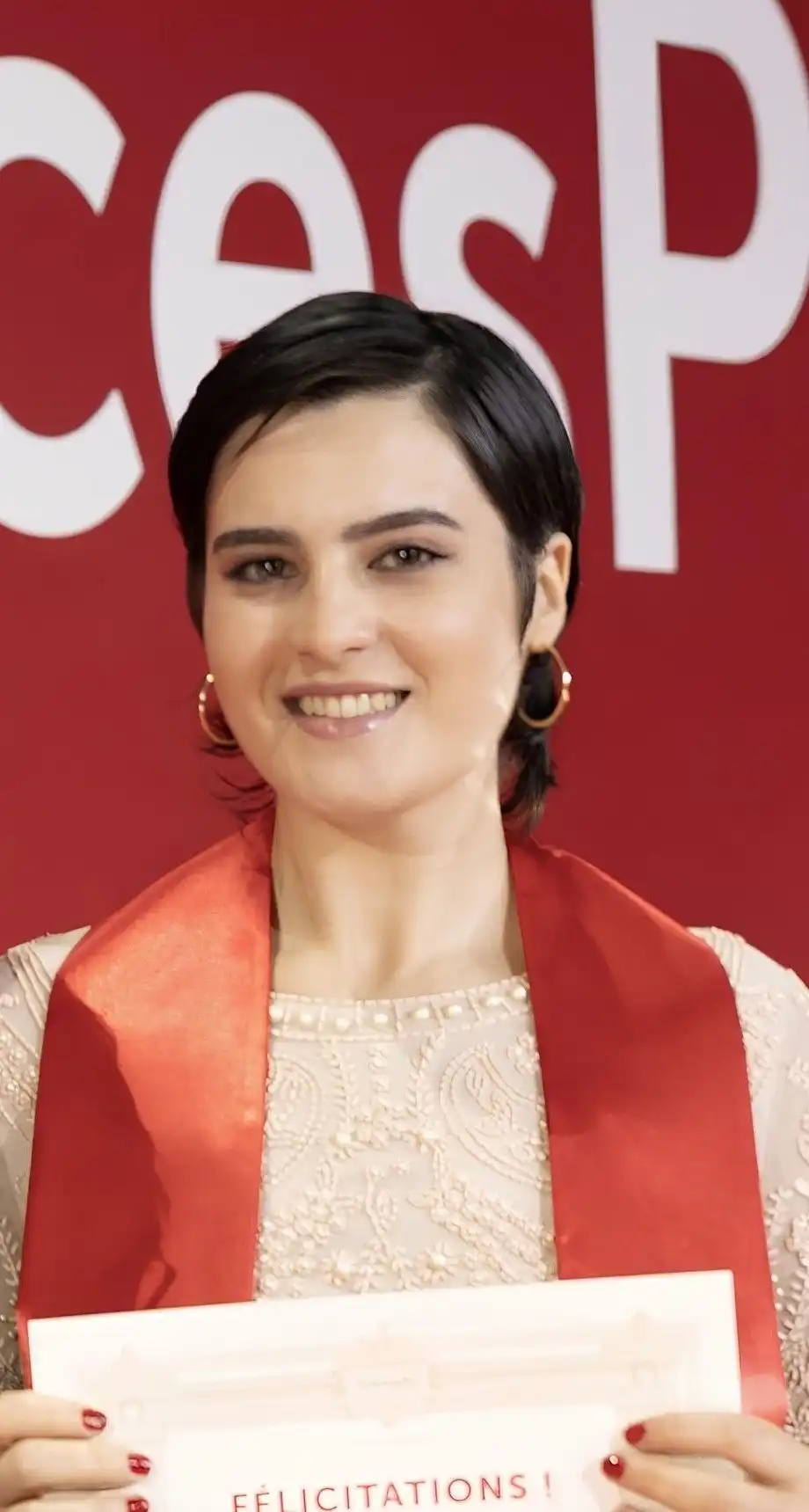
Growing up in Venice, a city suspended between its past and constantly grappling with the future, sparked my early curiosity about how societies navigate change and the role technology plays in that process. In 2017 I began my studies at the University of Warwick in Philosophy, Politics and Economics, following which I completed my master’s programme in 2020 at Erasmus Rotterdam University in International Public Management and Policy. Throughout my studies, I grew interested in the field of public management theory, digital technologies and their impact on society.
In 2021, I decided to pursue these interests further by enrolling at Sciences Po, where I joined the master’s programme in Public Policy – Digital, New Technology and Public Policy at the School of Public Affairs. During my master's I took a professional gap year, pursuing professional experiences at Deloitte Luxembourg in Cyber Risk Advisory, and at the Hertie School of Governance in Berlin, where I completed an exchange programme and worked as a Research Associate for its Centre for Digital Governance. Alongside my studies, I volunteered at an Italian non-profit organisation on digital rights and privacy, where I co-created the first Italian Observatory for AI.
After my professional gap year and returning to Sciences Po in 2024 for my final semester, I completed my studies with a Blue Book Traineeship at the European Commission, working in the unit on Interoperability and Digital Government, in the Directorate-General for Digital Services. I then joined the European Commission as a digital policy adviser in DG DIGIT, where I worked on topics such as AI in public sector, the implementation of the Interoperable Europe Act (Regulation (EU) 2024/903) and supporting the development of Interoperability regulatory sandboxes. I am now furthering my experience in innovation policy as a Policy Officer in the Directorate-General for Research and Innovation, in the Unit for Common Program Analysis and Regulatory Reform.
Why did you choose to pursue this specific policy stream “Digital, New Technology and Public Policy”?
I have always had a clear interest in technology since high school, even though my background was more rooted in the humanities and philosophy. In 2016, I was awarded a scholarship for a data science research project at WebValley, with Fondazione Bruno Kessler, where a team of 15 international students developed a prototype to analyse the chemical composition of fruit using spectrometry. This was my first time encountering topics of Artificial Intelligence (AI), deep learning, neural networks and over time I became increasingly interested about the role of new technologies in today’s world.
After my bachelor’s in the UK, I grew passionate about the management of the res publica, and its interaction with theories of digital governance. I wrote my first master's thesis on the role of administrative culture in digital government implementation, studying the interaction between a pre-existent bureaucratic culture and the adoption of digital technologies in government. Given my interest in this specific topic, I decided to pursue this further through a second master’s at the School of Public Affairs. There I studied more in-depth topics of Artificial Intelligence governance, Digital government and courses in EU law and public policy that allowed me to look at these issues from both a technical and a more policy- oriented perspective. For example, courses exploring the responsible use of decision- making algorithms (ADMs) in the public sector brought the stakes of digital governance to life, making clear just how consequential these design choices can be for citizens.
At the same time, I was drawn to this program at Sciences Po for its practitioner orientation. The Master’s allows several working opportunity arrangements, and after my first year I took a gap year to do different professional experiences. I spent five months in Luxembourg for Cyber Risk Advisory, subsequently I did an academic exchange at the Hertie School in Berlin, where I continued my studies in digital policy taking courses on the Governance of AI, and working as a Research Associate for the Centre for digital Governance. That same year I joined the Master’s, I volunteered part-time in Privacy Network, a non-profit for digital rights, where I co-created the first Italian Observatory for AI, monitoring algorithmic systems in the Italian public administration.
How did your training at the School of Public Affairs contribute to get your degree and the position you hold today?
I graduated cum laude from the Digital, New Technology and Public Policy master’s programme after three years of study, including a professional gap year. My time at the School of Public Affairs and the connections made along the way played certainly a role in shaping my professional path.
For someone passionate about this specific field, the programme allowed me to tailor my academic path based on my interests. The topics covered in the courses throughout the two years motivated me to further develop my own research, leading me to co-author a peer-reviewed article in the AI & Ethics Journal on the impact of the EU Digital Services Act on disinformation, and later to co-publish a position paper at the International Conference on Machine Learning on “Machine learning-powered assessments of the EU Digital Services Act to quantify policy impacts on online harms”.
The combination of theory and analysis of real-world cases in some of the courses, such as assessing the impacts of an algorithmic system and governance approaches for transparency and accountability, provided me with a valuable conceptual foundation and helped refine my interest in the field, which I later pursued through professional experiences.
At the European Commission, I later worked on the Public Sector Tech Watch, the European observatory for technologies in the public sector, and was also invited to speak at a Commission podcast on “Supporting public buyers in procuring AI-enabled solutions that are trustworthy, fair and secure”.
Secondly, the opportunities beyond the classroom played a key role to connect theory to practice during my time at Sciences Po. Being part of that engaged cohort pushed me to engage with real-world policy challenges. For example, I participated to the FuturEU Competition, where I developed alongside three amazing course-mates the European Orientation Strategy, a proposal for youth employment support using a digital platform and an AI-based questionnaire - a sort of job Tinder for young Europeans. Moreover, through my involvement in the AEAP student association, I organised a seminar on e-waste and the future of technology sustainability. The programme consistently encouraged us to concretely engage with policy challenges.
What advice would you give to current and future students?
To future students of the Digital stream, this programme works well if you're willing to go beyond the tracks that feel most familiar. Some of the most valuable insights come from courses that challenge how you think. For me, that meant taking courses such as applying behavioural psychology to public policy or through a data science bootcamp. Also, ask questions, both in and outside the classroom. In my experience, professors and practitioners were genuinely willing to engage, and those conversations often led somewhere useful. Just as importantly, lean on your peers. The relationships you build here go beyond networking; they’re the people who will help you explore your ideas and grow alongside you.
On the other hand, to current students, especially those looking at the job market, I would recommend started building your profile early. Experiences such as the professional gap year, participating in student associations, or joining competitions, help you shape your individual trajectory. It might feel like you’re just trying things out, but those experiences become often the strongest signals of what you can offer or where you find your interest drifting to. If you have any questions or think my experience might be helpful, feel free to reach out on my LinkedIn.
Where do you see yourself heading next or what do you see as your next challenges?
In the coming years, I am excited to continue working at the intersection of innovation and regulation, where there are high stakes for Europe today. I am currently a Policy Officer at the European Commission, DG RTD, in the Unit working on common programme analysis and regulatory reform, where I contribute to efforts aimed at making EU policymaking more innovation friendly. I contribute to preparing legislation that better takes innovation into account, building on my experience in areas such as AI governance, regulatory sandboxes, and interoperability. Looking ahead, I am keen to further deepen my expertise at the intersection of technology and regulation.
FIND OUT MORE
Virtual Graduate Open House day, October 2025

On 17 October 2026: meet faculty members, students and representatives and learn more about our 30 Master's programmes.