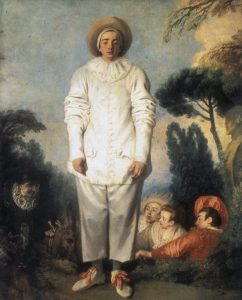
Artworks are part of a long history that speaks not only of art but also of many other things. Marika Takanishi Knowles, a specialist of the Pierrot of the Comédie italienne, offers here her reflections on the character painted by Watteau, held (and recently restored) at the Louvre. Inspired by parisian fairs, the painter’s world—commonly associated with the fête galante—should also, and above all, be linked to the fête marchande in both its theatricalization of social life, and the game of smoke and mirrors that Italian actors played with the crowds. In this context, Watteau’s figure becomes the vehicle for the spirit of consumption in the eighteenth century, where people and things maintained unsettling connections.
Laurence Bertrand Dorléac and Thibault Boulvain
Marika Takanishi Knowles Pierrot marchand and the consumption of social character
Having written a dissertation and now a book on the Comédie Italienne mask Pierrot, I often receive messages with friends’ and colleagues’ photographs of Pierrot sightings. He is everywhere: knotted into the lace curtains of a flat in Lille, plastered to the wall of a square in Avignon, embedded in contemporary self-portraits in chic galleries, and on the counter of boulangeries and patisseries, where the ceramic bust of “Pierrot gourmand” bears a selection of lollipops stuck out of holes in his shoulders (Figure 1). All of these instances intrigue me, but it is the last one that I want to address here. The theatrical character Pierrot has a sweet tooth (as well as a penchant for wine). In his most buffoonish iterations, he is also silly and childish, a gentle “clown blanc.” For these reasons, it makes sense that Pierrot would be the mascot of the eponymous French candy producer, founded in 1892. Yet there is something further transpiring here, which is embedded in the form of the bust itself, a representation of a person that serves as a case (un étal) for the display of merchandise.
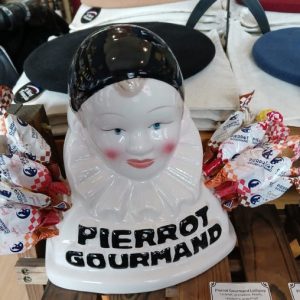
Fig. 1: Lollipop stand shaped like Pierrot. Author’s picture. DR.
From early on in his career as a popular stage character, Pierrot was associated with the marketplace as a site of exchange, sociability, and performance. Pierrot was a mask in the repertoire of the Comédie Italienne, the French version of the commedia dell’arte.1On the many iterations of the commedia dell’arte on the French stage, see Napoléon-Maurice Bernardin, La Comédie italienne en France et les théâtres de la foire et du boulevard (1570-1791), Paris, Éditions de la ‘Revue bleue’, 1902. On the eighteenth century, see François Moureau, Le goût italien dans la France rocaille: théâtre, musique, pienture, Paris, Presses de l’université Paris-Sorbonne, 2011. Around 1697, after the troupe’s expulsion from its official theatre, the Hôtel de Bourgogne, the Italian masks began to appear at the Parisian fairs. These annual marketplaces lasted for several weeks and hosted wholesalers, retailers, cafés, and a wide variety of theatrical entertainment (Figure 2). It was in this context that the young painter Antoine Watteau encountered Pierrot, who Watteau would elevate into one of the vedettes of his painted oeuvre (Figure 3). The influence of the Parisian fairs on Watteau’s work is well known. Thomas Crow has proposed that the fair as a public space – a fête publique – shaped the fête galante as a distinct mélange of rowdy comedy and elite poise.2Thomas Crow, Painters and Public Life in Eighteenth-Century Paris, New Haven, Yale University Press, 1985, p. 45-74. My argument, which I elaborate at length in my recent book, is that the fair must also be conceptualized as a fête marchande.3Marika Takanishi Knowles, Pierrot and his World: Art, Theatricality, and the Marketplace in France 1697-1945, Manchester, Manchester University Press, 2024. This concept was developed in a short article by the sociologist Marie-Claude Groshens, in which she argued that in the context of the fair as a marketplace, theatrical performances acquire an urgent transactional quality.4Marie-Claude Groshens, “La pratique théâtrale foraine: contribution à l’étude de la fête marchande,” Ethnologie française, vol. 17, 1987, p. 53-8.
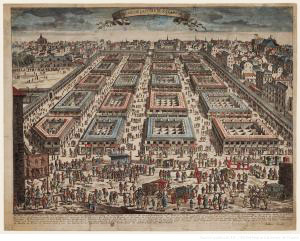
Fig.2: Le Plan de la foire Saint-Germain, Copperplate engraving. Paris, BnF, Département des Arts du Spectacle, FOL-ICO-CIR-17.
At the fairs, the Italian actors found themselves obliged to perform the parade en plein air. Standing on narrow balconies affixed to the theatres, or on trestles set up in front of the theatres, the actors attempted to draw a crowd. The parade forces the body of the performer to market itself to the crowd.5Marika Takanishi Knowles and Christopher Wood, “Editorial: La parade,” RES: Anthropology and Aesthetics, vol. 73/74, no. 1, 2020, p. 1-9. Part of the appeal of this genre lies in the vulnerability forced on the performer, this vulnerability which is a self-abasing tribute to the power of the audience, who experience the right to look or to ignore.6This is an affective structure that has been theorized in performance studies. See Robin Bernstein, “Toward the Integration of Theater History and Affect Studies: Shame and the Rude Mech’s The Method Gun,” Theater Journal, vol. 64, no. 2, 2012, p. 213-30. It is this appeal that Watteau’s very large painting of Pierrot distills into a single figure.7There are too many accounts of this painting to cite all of them. I have found particularly helpful the following: Sarah Cohen, Art, Dance, and the Body in French Culture of the Ancien Régime, Cambridge: Cambridge University Press, 2000, p. 262-70; Dora Panofsky, “Gilles or Pierrot? Iconographic notes on Watteau,” Gazette des Beaux-Arts, vol. 39, 1952, p. 319-40. Donald Posner, “Another Look at Watteau’s Gilles,” Apollo, vol. 117, 1983, p. 97-9; Julie Ann Plax, Watteau and the Cultural Politics of Eighteenth-Century France, Cambridge, Cambridge University Press, 2000, p. 108-53. By pushing the additional figures into the lowered background, Watteau dramatically focuses attention on Pierrot, who faces the viewer with his entire figure, as if he wishes to adopt the same orientation as a piece of stretched canvas. When we ask what is happening in this painting, what is its subject, we are forced into a tautology: its subject is its subject’s presentation of himself in the costume of his role, Pierrot.
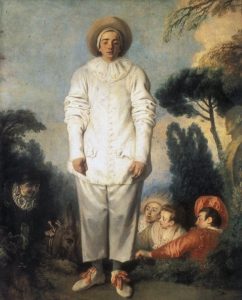
Fig.3: Antoine Watteau, Pierrot, 1718-1719, oil on canvas, 185 × 150 cm. Paris, Musée du Louvre, MI 1121.
Put in the blunt terms of exchange, the painting asks: “do we buy it?” Do we “buy” that this is Pierrot and that he is enough? Enough for a painting, enough for our money? To “buy” a character is to assess as valid the figure’s claim to be the character and therefore to permit the character to accede to his proper state, to enjoy whatever privileges accompanied his role. These privileges could be as simple a thing as being allowed to exist in the guise of the character. It is a form of “giving face.” Pierrot, in Watteau’s painting, is asking for a role; he is asking for his role.
Pierrot gourmand, on the counter of the boulangerie, offers his lollipops, which have been stuck into his body. The ceramic bust merges the buying of character with the buying of sweets. It is at this point that we move from the “vulgar” aspects of the marketplace to more cerebral ones concerned with social life as a form of exchange, mediated through performance, which was learnt in the marketplace and conducted in its wake. 8In thinking about the social aspects of the marketplace, I am hugely indebted to Christophe Agnew, Worlds Apart: The Market and the Theater in Anglo-American Thought, 1550-1750, Cambridge, Cambridge University Press, 1986.While there has been a tendency to decry the marketplace for these kinds of operations, the objectivity and the fungibility of social identity, if accepted, creates a field for play and transformation.9This tension, between Marxist critique of the commodity and an engaged, empathetic elaboration of the commodity’s dream world, is epitomized in the tense dialogue between Theodor Adorno and Walter Benjamin, in response to Benjamin’s initial conception of the Passagen Werk. See Gyorgy Markus, “Walter Benjamin or: The Commodity as Phantasmagoria,” New German Critique, no. 83, Spring-Summer 2001, p. 3-42. Pierrot oversees this play.
As I emphasized in the seminar discussion, I do not want to propose a one-to-one correspondence, as if Watteau’s Pierrot is a piece of merchandise offered for sale. (Nevertheless, Watteau’s Pierrot would rather quickly become just that, in the form of a porcelain figurine.) Different kinds of desire swirl around a painting as magnificent as this one, and I want to point to the way that some of these desires are inflected by the activities of the marketplace as a site for social consumption as well as plain old shopping. Some of the emotions that arise when a figure puts himself forward have to do with the fear that one’s pitch will be refused. No one wants to end up in the bargain bin. And indeed, Watteau’s Pierrot did end up in the bargain bin, at least according to the nineteenth-century accounts of the painting’s “discovery” by Dominique Vivant Denon, who came across it, unwanted, outside the shop of a bric-à-brac seller.10On this account see Marika Takanishi Knowles, “Pierrot’s Silence,” in Andreas Beyer and Laurent Le Bon (eds), Silence. Schweigen. Über die stumme Praxis der Kunst, Paris, Deutches Forum für Kunstgeschichte, 2015, p. 133-46. But was it Pierrot who was unwanted, or Watteau’s painting? The persistent elision between Pierrot the character and the painting by Watteau is a symptom of the way that the activities of the marketplace enable the objectification of character, or the embedding of character within physical, exchangeable objects, like a painting, like a collector’s card.
There is so much wonderful scholarship on the acceleration of consumption in the eighteenth century and the way that consumer demand was met through the creativity of artists, artisans, and merchants.11Two classic sources on this subject: John Brewer and Roy Porter (eds), Consumption and the World of Goods, London, Routledge, 1993; Ann Bermingham and John Brewer (eds), The Consumption of Culture 1600-1800: Image, Object, Text, London, Routledge, 1997. See also the publications of Natacha Coquery. Watteau’s oeuvre has been integrated into this discourse, because of his interest in fashion, as well as the way he adjusted his technical practice so as to produce quickly and sell in quantity.12See, for example, Franziska Windt, Eva Wollschläger, Sylva van der Heyden (eds), Antoine Watteau: l’art, le marché et l’artisanat d’art, trans. Christoph Martin Vogtherr, Potsdam: Stiftung Preussische Schlösser und Gärten Berlin-Brandenburg, 2021. For the most comprehensive discussion of Watteau’s relationship to Parisian fashion, see Axel Moulinier, Le discours de l’étoffe: Antoine Watteau: mode, arts visuels et culture vestimentaire à Paris, 1700-1730, thèse de l’École du Louvre, 2021. On Watteau’s technical process, see Oliver Wunsch, A Delicate Matter: Art, Fragility, and Consumption in Eighteenth-Century France, University Park: Pennsylvania State University Press, 2024, p. 13-32. I am interested in what I would describe as the erotics of consumption as well as the relationship between Watteau’s experimentation with theatrical masks and market-based practices that objectify human identity with results that range from prejudicial to liberating. In the attention that Watteau paid to the masks of the Comédie Italienne, he accessed a new range of emotions accruing to human character as it was crafted, performed, and assessed in the context of a consumer society. The Pierrot gourmand bust is a vestige of these affective politics, as well as a reminder of their lively persistence.
Notes
[1] On the many iterations of the commedia dell’arte on the French stage, see Napoléon-Maurice Bernardin, La Comédie italienne en France et les théâtres de la foire et du boulevard (1570-1791), Paris, Éditions de la ‘Revue bleue’, 1902. On the eighteenth century, see François Moureau, Le goût italien dans la France rocaille: théâtre, musique, pienture, Paris, Presses de l’université Paris-Sorbonne, 2011.
[2] Thomas Crow, Painters and Public Life in Eighteenth-Century Paris, New Haven, Yale University Press, 1985, p. 45-74.
[3] Marika Takanishi Knowles, Pierrot and his World: Art, Theatricality, and the Marketplace in France 1697-1945, Manchester, Manchester University Press, 2024.
[4] Marie-Claude Groshens, “La pratique théâtrale foraine: contribution à l’étude de la fête marchande,” Ethnologie française, vol. 17, 1987, p. 53-8.
[5] Marika Takanishi Knowles and Christopher Wood, “Editorial: La parade,” RES: Anthropology and Aesthetics, vol. 73/74, no. 1, 2020, p. 1-9.
[6] This is an affective structure that has been theorized in performance studies. See Robin Bernstein, “Toward the Integration of Theater History and Affect Studies: Shame and the Rude Mech’s The Method Gun,” Theater Journal, vol. 64, no. 2, 2012, p. 213-30.
[7] There are too many accounts of this painting to cite all of them. I have found particularly helpful the following: Sarah Cohen, Art, Dance, and the Body in French Culture of the Ancien Régime, Cambridge: Cambridge University Press, 2000, p. 262-70; Dora Panofsky, “Gilles or Pierrot? Iconographic notes on Watteau,” Gazette des Beaux-Arts, vol. 39, 1952, p. 319-40. Donald Posner, “Another Look at Watteau’s Gilles,” Apollo, vol. 117, 1983, p. 97-9; Julie Ann Plax, Watteau and the Cultural Politics of Eighteenth-Century France, Cambridge, Cambridge University Press, 2000, p. 108-53.
[8] In thinking about the social aspects of the marketplace, I am hugely indebted to Christophe Agnew, Worlds Apart: The Market and the Theater in Anglo-American Thought, 1550-1750, Cambridge, Cambridge University Press, 1986.
[9] This tension, between Marxist critique of the commodity and an engaged, empathetic elaboration of the commodity’s dream world, is epitomized in the tense dialogue between Theodor Adorno and Walter Benjamin, in response to Benjamin’s initial conception of the Passagen Werk. See Gyorgy Markus, “Walter Benjamin or: The Commodity as Phantasmagoria,” New German Critique, no. 83, Spring-Summer 2001, p. 3-42.
[10] On this account see Marika Takanishi Knowles, “Pierrot’s Silence,” in Andreas Beyer and Laurent Le Bon (eds), Silence. Schweigen. Über die stumme Praxis der Kunst, Paris, Deutches Forum für Kunstgeschichte, 2015, p. 133-46.
[11] Two classic sources on this subject: John Brewer and Roy Porter (eds), Consumption and the World of Goods, London, Routledge, 1993; Ann Bermingham and John Brewer (eds), The Consumption of Culture 1600-1800: Image, Object, Text, London, Routledge, 1997. See also the publications of Natacha Coquery.
[12] See, for example, Franziska Windt, Eva Wollschläger, Sylva van der Heyden (eds), Antoine Watteau: l’art, le marché et l’artisanat d’art, trans. Christoph Martin Vogtherr, Potsdam: Stiftung Preussische Schlösser und Gärten Berlin-Brandenburg, 2021. For the most comprehensive discussion of Watteau’s relationship to Parisian fashion, see Axel Moulinier, Le discours de l’étoffe: Antoine Watteau: mode, arts visuels et culture vestimentaire à Paris, 1700-1730, thèse de l’École du Louvre, 2021. On Watteau’s technical process, see Oliver Wunsch, A Delicate Matter: Art, Fragility, and Consumption in Eighteenth-Century France, University Park: Pennsylvania State University Press, 2024, p. 13-32.
Bibliography
Agnew, Christophe, Worlds Apart: The Market and the Theater in Anglo-American Thought, 1550-1750, Cambridge, Cambridge University Press, 1986.
Bernardin, Napoléon-Maurice, La Comédie italienne en France et les théâtres de la foire et du boulevard (1570-1791), Paris, Éditions de la ‘Revue bleue’, 1902.
Bernstein, Robin, “Toward the Integration of Theater History and Affect Studies: Shame and the Rude Mech’s The Method Gun,” Theater Journal, vol. 64, no. 2, 2012, p. 213-30.
Bermingham, Ann and John Brewer (eds), The Consumption of Culture 1600-1800: Image, Object, Text, London, Routledge, 1997.
Brewer, John and Roy Porter (eds), Consumption and the World of Goods, London, Routledge, 1993.
Cohen, Sarah, Art, Dance, and the Body in French Culture of the Ancien Régime, Cambridge, Cambridge University Press, 2000.
Crow, Thomas, Painters and Public Life in Eighteenth-Century Paris, New Haven, Yale University Press, 1985.
Groshens, Marie-Claude, “La pratique théâtrale foraine: contribution à l’étude de la fête marchande,” Ethnologie française, vol. 17, 1987, p. 53-8.
Knowles, Marika Takanishi, Pierrot and his World: Art, Theatricality, and the Marketplace in France 1697-1945, Manchester, Manchester University Press, 2024.
Knowles, Marika Takanishi and Christopher Wood, “Editorial: La parade,” RES: Anthropology and Aesthetics, vol. 73/74, no. 1, 2020, p. 1-9.
Knowles, Marika Takanishi, “Pierrot’s Silence,” in Andreas Beyer and Laurent Le Bon (eds), Silence. Schweigen. Über die stumme Praxis der Kunst, Paris, Deutches Forum für Kunstgeschichte, 2015, p. 133-46.
Markus, Gyorgy, “Walter Benjamin or: The Commodity as Phantasmagoria,” New German Critique, no. 83, Spring-Summer 2001, p. 3-42.
Moulinier, Axel, Le discours de l’étoffe: Antoine Watteau: mode, arts visuels et culture vestimentaire à Paris, 1700-1730, thèse de l’École du Louvre, 2021.
Moureau, François, Le goût italien dans la France rocaille: théâtre, musique, pienture, Paris, Presses de l’Université Paris-Sorbonne, 2011.
Panofsky, Dora, “Gilles or Pierrot? Iconographic notes on Watteau,” Gazette des Beaux-Arts, vol. 39, 1952, p. 319-40.
Plax, Julie Ann, Watteau and the Cultural Politics of Eighteenth-Century France, Cambridge, Cambridge University Press, 2000.
Posner, Donald, “Another Look at Watteau’s Gilles,” Apollo, vol. 117, 1983, p. 97-9.
Windt, Franziska, Eva Wollschläger, and Sylva van der Heyden (eds), Antoine Watteau: l’art, le marché et l’artisanat d’art, trans. Christoph Martin Vogtherr, Potsdam: Stiftung Preussische Schlösser und Gärten Berlin-Brandenburg, 2021.
Wunsch, Oliver, A Delicate Matter: Art, Fragility, and Consumption in Eighteenth-Century France, University Park: Pennsylvania State University Press, 2024.
__________________________________________________________________
Marika Takanishi Knowles is Assistant Professor in the History of Art at the University of St Andrews. Her research on Pierrot, published in English in 2024, will soon be published in a French Version, Le monde de Pierrot: Art, Théâtratlité et Marché en France, 1697-1945, by Les Presses du Réel.