
Home>AI in the public sphere: rethinking democracy in the age of AI
26 June 2026
AI in the public sphere: rethinking democracy in the age of AI
Sciences Po’s Open Institute for Digital Transformations, created as a part of TIERED, hosted, alongside the European Polarisation Observatory, financed by CIVICA, the first edition of a two-day conference exploring the implications of artificial intelligence for democracy and the public sphere (May 18-19 2026).
The event brought together members of the extended international research networks of which Sciences Po is a part, allowing researchers to come together to discuss the unique challenges AI brings to our society in an environment of sustained engagement with both public and private actors.

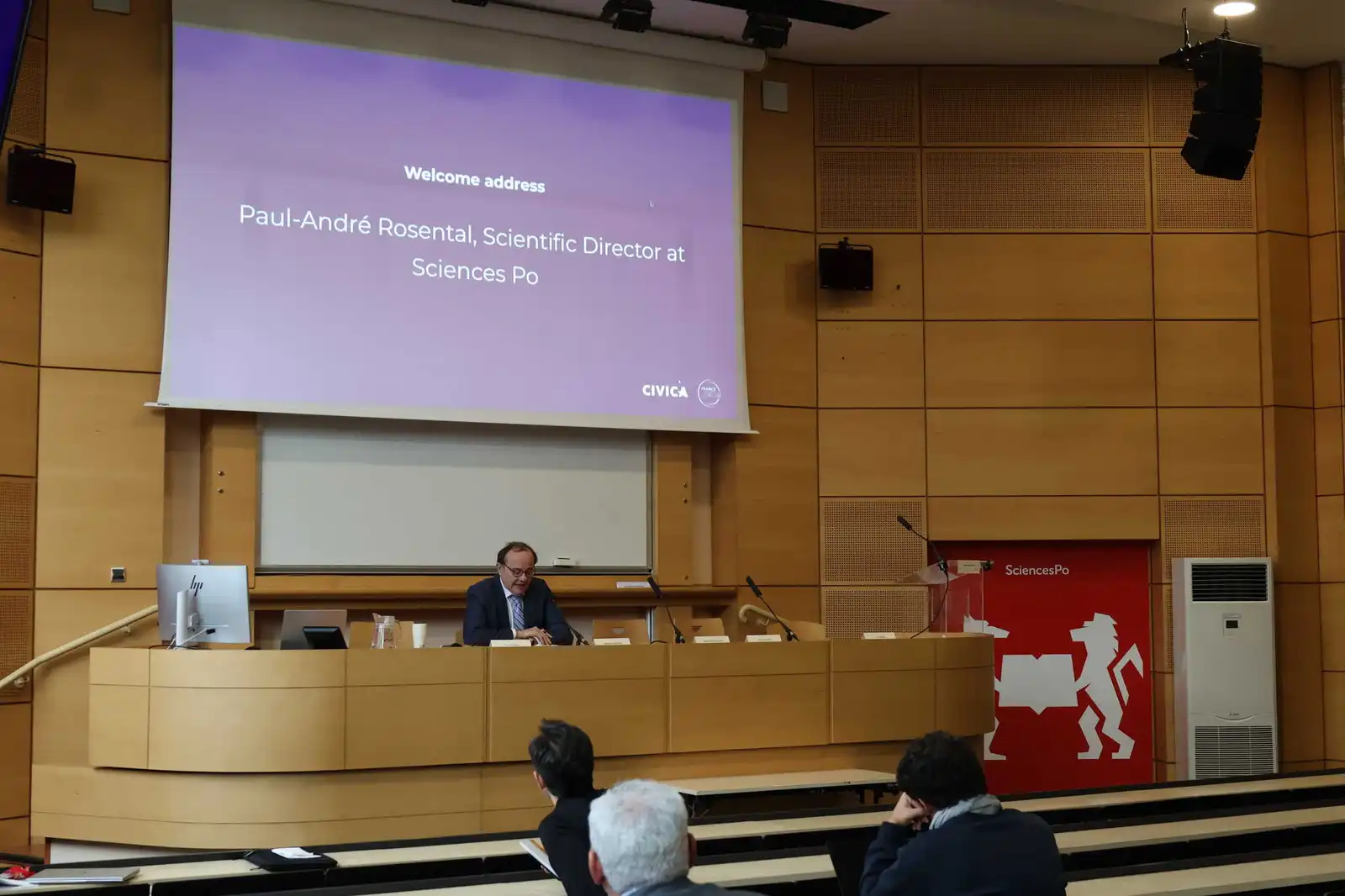
The first day of the event focused on the social, linguistic, and political dynamics of digital platforms. Research presented by scholars affiliated with the European Polarisation Observatory, hailing from the Hertie School, Central European University, and IE University, explored how individuals cognitively process information online, how linguistic patterns reveal broader social inequalities, and how platform environments shape political attitudes and behaviour. The speakers emphasized the need for methodological renewal through the use of more experimental and iterative approaches in social science research, while also highlighting the limitations of existing datasets. Participants argued that diversifying data sources and critically reassessing collection methods may help uncover more subtle mechanisms of belief formation, polarisation, and online engagement.
Questions of platform governance and technological power formed the basis of the conference’s evening session, “Interrogating Platform Power.” Discussions examined the growing influence of search engines and social media companies in the context of rapid AI adoption. Panelists, including Andrew Perrin from Johns Hopkins University, debated the limits of platform sovereignty and the risks associated with public institutions’ reliance on privately owned digital infrastructures. These concerns were framed within broader tensions between the democratizing potential of digital technologies and the concentration of economic and political power they may simultaneously reinforce.


The evening session was closed by University of Massachusetts’ Ethan Zuckerman’s keynote address, which shifted attention to the structural biases embedded within large language models (LLMs). Zuckerman argued that because these systems are trained primarily on digitized knowledge produced in Western contexts, they risk reproducing existing global inequalities through the underrepresentation of non-Western languages, cultures, and perspectives. Rather than viewing this as an inevitable limitation, Zuckerman presented multilingual and multicultural model development as a critical research and policy challenge.
The second day examined AI’s relationship with politics from both behavioural and computational perspectives. Researchers presented their recent work, with discussions then taking place over roundtables focused on the practical implications of AI-generated political content and the practical challenges of regulation. The first session of the day examined how AI-generated political content - including targeted advertisements and short-form social media videos - can influence voter perceptions, emotions, and evaluations of political actors. Several presentations suggested that AI and human political behaviour may evolve together through complex feedback loops, requiring new theoretical frameworks for democratic oversight.

The second session of the day focused on the political biases encoded within AI systems themselves. Findings indicated that LLMs exhibit consistent ideological patterns across languages, reflecting characteristics of their training data. Researchers also presented evidence that models can encode sensitive personal attributes about its users, including political orientation and nationality, raising significant questions for privacy regulation and the interpretation of model weights under existing legal frameworks. Notably, studies suggested that transparency measures, such as labeling AI-generated content, may not sufficiently mitigate AI’s persuasive effects.
The conference concluded with reflections on AI’s growing influence on education and academic publishing, underscoring a broader consensus: while AI offers significant opportunities, understanding and governing its societal consequences remains an urgent and evolving research agenda.