
Home>Xinyuan LIANG, Master’s in Political Science (Class of 2020)
1 July 2026
Xinyuan LIANG, Master’s in Political Science (Class of 2020)

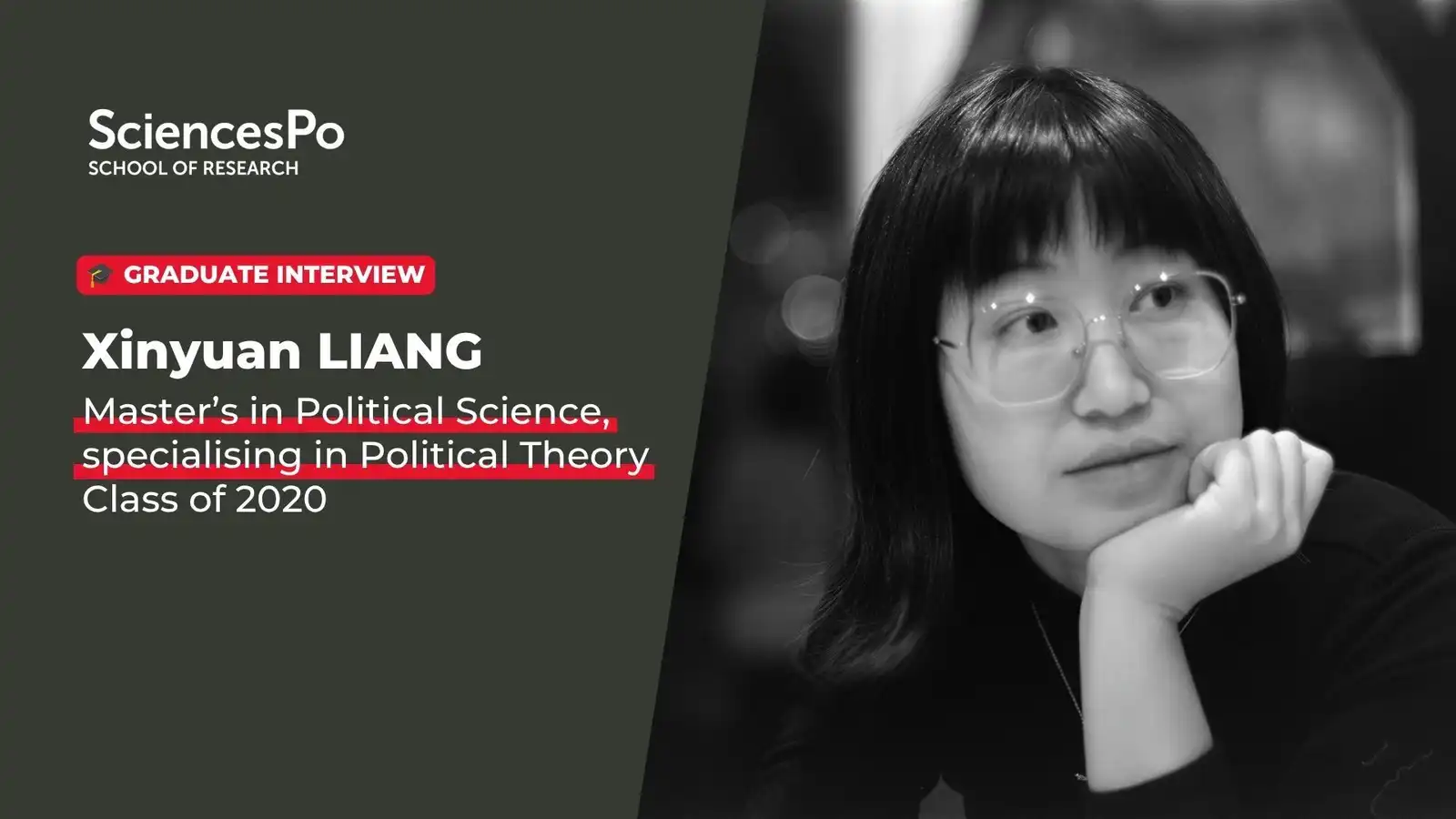
From philosophy to political theory, and from the creative industries to higher education, Xinyuan Liang (Master’s in Political Science, Class of 2020) has forged a career at the crossroads of research, culture and creativity. She looks back on the years that shaped her thinking at the School of Research, the lasting influence of her education, and the way in which she now applies the social sciences to artistic, educational and cultural projects.
Could you tell us about your academic background? How did your interest in political science come about?
Before joining Sciences Po, I studied Philosophy during my undergraduate studies in China. One course that particularly influenced me was a year-long class on the History of Western Political Thoughts, where we studied thinkers from Aristotle and Plato to modern liberalist philosophers.
This course expanded my understanding of human existence into broader questions about society: how institutions are built, how power is organized, and what makes a social system fair, legitimate, and constructive.
This intellectual transition, from reflecting on the individual to questioning collective structures, naturally led me to pursue a Master's degree in Political Theory at Sciences Po, where I hoped to deepen my understanding of political philosophy within a rich international environment.
What did you gain from your years of study at the School of Research? What memories do you have of your school and your year group?
My years at the Ecole de la Recherche brought me much more than academic knowledge. They shaped the way I think, research, write, and engage with complex questions.
The training I received strengthened my rigor in reading, analysis, and argumentation. But beyond that, studying in France gave me a much more multicultural perspective. I learned to confront different intellectual traditions and to see social issues from multiple angles.
One of my strongest memories happened during my first year. Some students organized a strike and occupied classrooms and the library because of their social and political convictions. Since it happened close to the final exams, it created difficulties for many students.
The school organized a vote to ask whether students supported this action. Most students did not. However, the administration still chose dialogue and negotiation rather than simply imposing authority, and eventually the occupation ended peacefully.
This experience gave me a very concrete understanding of the balance between procedural justice and outcome-based justice in a democratic society.
Another very meaningful period was my Master's thesis research, where I studied street art, political movements, and equal access to cultural resources. Interviewing European street artists and cultural professionals, and discussing ideas with my supervisor, was an extremely enriching experience that connected theory with real social practices.
Which teacher made the biggest impression on you?
Professor Annabelle Lever particularly influenced me.
Her courses were extremely dynamic, combining classical theoretical texts with contemporary and original perspectives.
The discussions were always intellectually stimulating. Her seminars on feminism, modern rationality, and the relationship between social structures and gender issues encouraged me to think more deeply about topics such as housework, reproduction, and women's rights.
Her teaching also influenced my artistic practice, because it encouraged me to connect creative expression with social reflection.
What extracurricular projects were you able to undertake during your time at university?
During my studies, I was also involved in artistic and curatorial projects.
As a young artist and curator, I organized three visual art exhibitions at Jardin Denfert, an independent artist residence at Paris 14eme. The exhibitions explored themes such as self-awareness, women's rights, and cultural diversity.
Although these projects were outside the academic framework, they were deeply connected to the questions I was exploring at Sciences Po: identity, society, culture, and the relationship between individuals and their environment.
What is your current role?
Today, I work in Paris at the intersection of higher education, creative industries, and cultural development.
I teach fashion culture and luxury-related subjects in English at Ecole Conte, and I also teach as a guest lecturer for the Culture de Luxe program at Elysees Marbeuf.
In parallel, I work as a fashion photography project manager at Dashi Scope, an independent creative studio, where I help develop visual projects that allow people to express their identities, creativity, and perspectives through fashion and photography.
I also accompany students and young professionals at SciencesPo Club Chine in their career development, especially international students navigating questions of professional positioning and career transitions.
What were the key stages in the development of your career?
My professional path was built progressively through different experiences rather than following a completely linear trajectory.
My background in political theory trained me to analyze society, culture, and human behavior. Later, my experience in creative industries allowed me to explore how ideas, aesthetics, and identity can be expressed through fashion and visual culture.
Teaching became a natural bridge between these worlds. I realized that education is not only about transferring knowledge, but also about helping people understand themselves, develop confidence, and find their own direction.
Today, my professional project is centered around connecting creativity, culture, and personal development.
How has your education helped you in the role you hold today?
My Sciences Po education continues to influence my work every day.
The analytical skills, intellectual curiosity, and ability to understand complex social dynamics that I developed there are essential in my current activities.
Whether I teach fashion culture, guide students, or participate in creative projects, I always try to look beyond the surface and ask deeper questions: What does this object, image, or industry say about society? What values does it carry? How can creativity contribute to personal and collective development?
This interdisciplinary approach is one of the most valuable things I gained from my education.
Do you have any advice for a student who is interested in pursuing a career in the sector in which you currently work?
My first advice would be: be confident with your ideals, but learn to transform them into concrete actions.
For people who are passionate and ambitious, it is important not to wait for the perfect path before starting. Progress often comes through small experiments, practical experiences, and the willingness to make mistakes.
Another piece of advice that deeply resonates with me comes from an interview I once watched with G-Dragon, a Korean pop-star I admire a lot. He said that we should not focus only on finding answers, but continue searching for meaningful questions.
I believe curiosity is one of the most important qualities in creative industries. Staying open, questioning the world, and exploring different possibilities is what allows us to continue growing and becoming more interesting people.
Find out more about:
Virtual Graduate Open House day, October 2025


On 17 October 2026: meet faculty members, students and representatives and learn more about our 30 Master's programmes.