
Home>A testimonial from Eirini Tsoumani, a CIVICA postdoctoral fellow at the EUI
10 September 2026
A testimonial from Eirini Tsoumani, a CIVICA postdoctoral fellow at the EUI

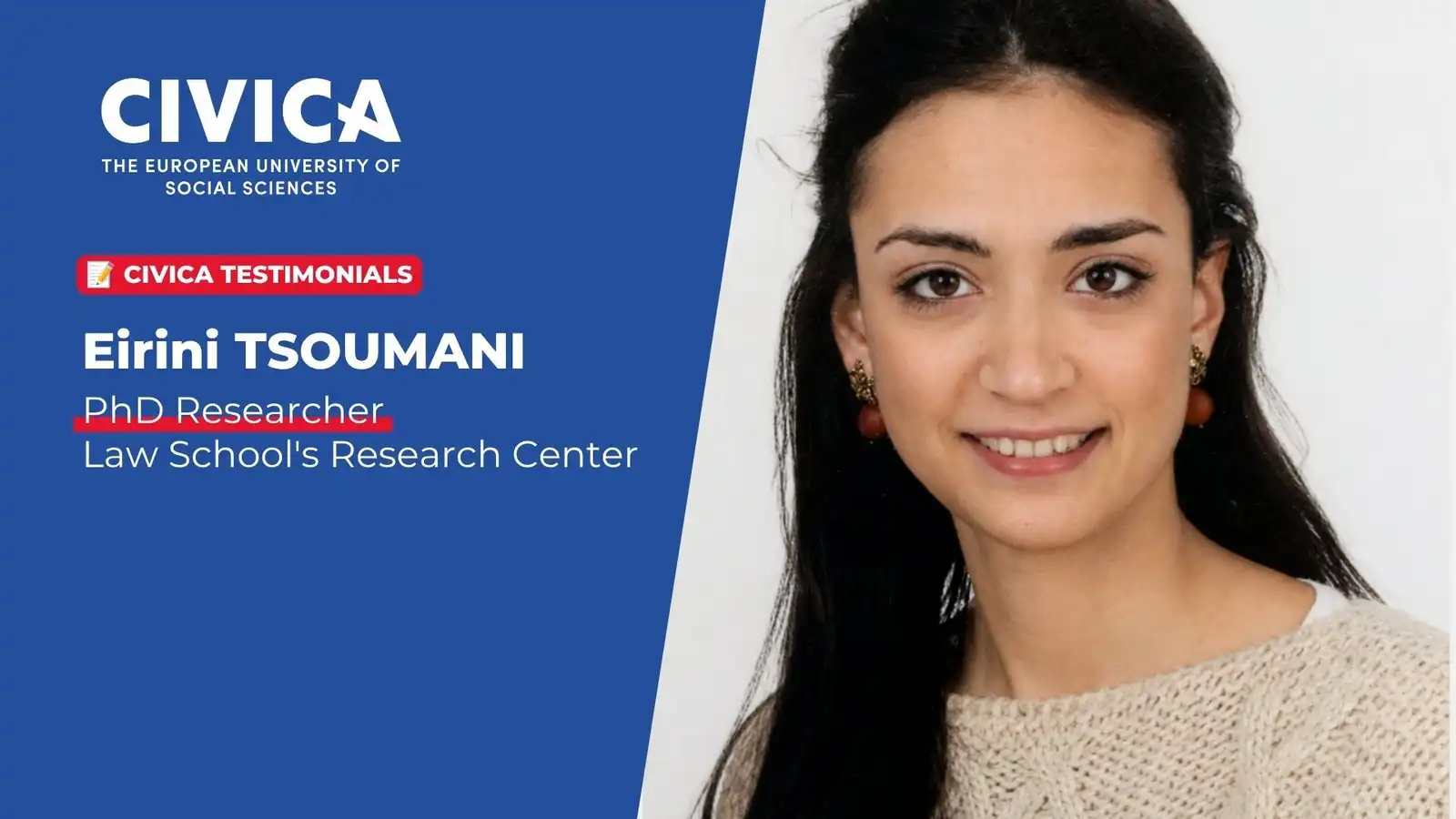
After completing her PhD in law at Sciences Po in 2025, Eirini Tsoumani joined the European University Institute (EUI) as a postdoctoral fellowship through the CIVICA programme. Her research, at the intersection of European Union public law, legal theory and legal semiotics, focuses in particular on the transformations in European judicial culture. In this interview, she reflects on her career path, her research experience at the EUI and the contribution that the CIVICA mobility programme has made to her academic and professional development. In the autumn term of 2026, she will continue her career in the United States as an Emile Noël Fellow at the Jean Monnet Centre for International and Regional Economic Law and Justice at NYU.
Can you tell us a bit about your academic background and research interests?
I am a legal scholar working at the intersection of EU public law, legal theory, and legal semiotics. I completed my PhD in Law at Sciences Po Law School, where my dissertation examined the constitutional case law of the Greek Council of State during the Greek sovereign debt crisis (2009-2019), as a way of analysing judicial reasoning under constraint.
My research does not approach constraint only as an external political or economic pressure. It focuses instead on the constraints internal to legal discourse itself: the argumentative repertoires, doctrinal techniques, institutional roles, and “legal characters” through which judges produce legal meaning. In my thesis, I developed a semiological methodology to study how these argumentative and behavioural repertoires structured the reasoning of the Greek Council of State during the crisis, while also showing how judges, by mobilising them, contributed to transforming the national legal culture itself.
More broadly, my current research interest is to extend this methodology beyond the Greek case and apply it to the study of European judicial culture. I am interested in how judicial actors, across national and European legal orders, inherit, circulate, and reshape legal repertoires, and in how this process contributes to the formation of a specifically European way of reasoning about the State, public interest and sovereignty.
What motivated you to apply for the CIVICA postdoctoral fellowship and why did you choose EUI for your stay?
I applied for the CIVICA postdoctoral fellowship because it offered a valuable opportunity to develop my research in an international and interdisciplinary academic environment. CIVICA’s emphasis on collaboration between leading European institutions was particularly attractive to me, as my work is situated at the intersection of public law and European legal culture, and broader questions of governance and institutional transformation.
I chose the European University Institute because of its exceptional intellectual environment and its strong tradition in law and the social sciences. For a project concerned with the genealogy of judicial reasoning and the relationship between national and European legal cultures, the EUI was an ideal place to work. It offered both the academic resources and the scholarly community needed to further develop my research.


« I applied for the CIVICA postdoctoral fellowship because it offered a valuable opportunity to develop my research in an international and interdisciplinary academic environment. »
Eirini Tsoumani
A young doctor from the Law School’s Research Centre
How would you describe your experience as a CIVICA postdoctoral fellow at the EUI?What were the most meaningful academic activities you took part in during your stay or were there any collaborations with faculty or other fellows that stood out to you?
My experience as a CIVICA postdoctoral fellow at the EUI has been intellectually enriching and professionally very valuable. I was able to participate actively in the academic life of the institution by attending seminars and workshops, which helped me situate my work within broader scholarly debates.
One of the most meaningful moments of my stay was my participation in the Visiting Fellows and Academics Seminar, where I presented my paper entitled “Judges Under Constraint: Genealogies of Judicial Reasoning from Greek to European Legal Culture.” The discussion that followed was extremely constructive. I received thoughtful feedback from researchers and faculty members, which helped me refine both the structure and the central arguments of the paper. I am currently developing this work further with a view to publication.
Beyond this presentation, the regular exchanges with academic staff and other researchers were particularly important. These conversations helped me clarify the direction of my project, strengthen my methodological approach, and think more strategically about the next stages of my academic career.
Would you say that the CIVICA postdoctoral programme contributed to your professional development and if so, how?
Yes, the CIVICA postdoctoral programme contributed to my professional development in several ways. First, it gave me the time and institutional setting to advance my research after the completion of my PhD. Second, it allowed me to present work in progress to an international academic audience and to receive high-quality feedback. This was especially valuable at a stage where I was transforming doctoral research into new publications and broader research projects.
The fellowship also helped me consolidate my academic profile. Being integrated into the EUI’s research environment gave me access to new conversations, perspectives, and networks. It encouraged me to think more comparatively and more explicitly about the European dimensions of my work. Finally, the programme offered important guidance regarding my broader academic trajectory and future career development. In the academic year 2026-2027, I will be an Emile Noel Fellow at Jean Monnet Center for International and Regional Economic Law and Justice in NYU.
What advice would you give to someone hesitating to apply to a CIVICA mobility scheme?
I would strongly encourage them to apply. A CIVICA mobility scheme is not only an opportunity to spend time at another institution; it is also a chance to become part of a wider intellectual community. For early-career researchers in particular, this kind of experience can be extremely valuable. It allows you to test your ideas in a new environment, receive feedback from scholars working in different traditions, and build academic relationships that can continue well beyond the fellowship itself.
My advice would be to approach the mobility period with openness and curiosity. The value of the programme lies not only in the formal academic activities, but also in the informal exchanges, conversations, and encounters that help you see your own work differently. For me, the CIVICA fellowship at the EUI has been a deeply rewarding experience, both intellectually and professionally.
Find out more:
Virtual Graduate Open House day, October 2025


On 17 October 2026: meet faculty members, students and representatives and learn more about our 30 Master's programmes.