
Home>Teaching With CIVICA: Matthew Winkler’s Testimonial
22 July 2026
Teaching With CIVICA: Matthew Winkler’s Testimonial

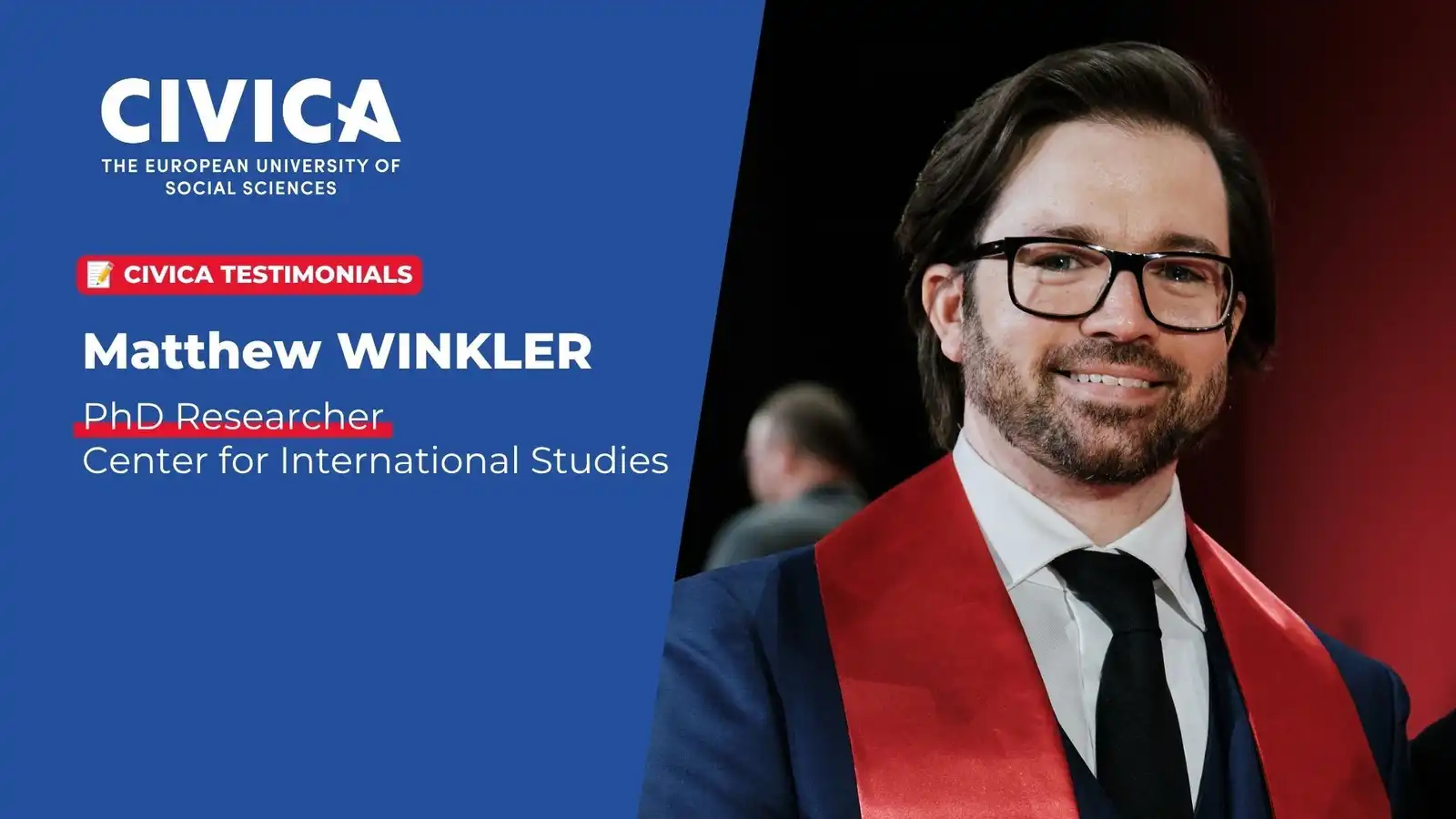
Matthew Winkler, a PhD researcher at Sciences Po's Center for International Studies (CERI), is one of the first PhD students to have obtained the certificate from the teacher development programme (TDP) of CIVICA, our European university alliance. He reflects on this experience, the teaching skills he has developed and his involvement in the alliance’s multi-campus courses.
You are among the first doctoral researchers from Sciences Po to receive the CIVICA Teacher Development Programme certificate. Could you tell us what motivated you to join the programme and which courses you attended?
Honestly, I’m still deciding whether an academic career is the right path for me. But I knew that if I ever stand in front of a classroom as a professor, I owe it to my students to have done my best to learn how to teach. Many of us have sat through courses led by brilliant researchers who were never given the tools to teach well, and the doctoral pathway offers few opportunities to deliberately build that skill. The Teacher Development Programme was a chance to fix that. I completed Foundations of Teaching in Higher Education at the Yehuda Elkana Centre of Central European University (CEU), Online Teaching: Creating Connection at the European University Institute (EUI), and Designing Teaching to Meet Different Learning Styles at the Stockholm School of Economics.
What was your general experience with these courses? Are there any main skills or perspectives you gained and have shaped your approach to teaching?
Very positive. The CEU course was the anchor: over a semester, each participant designs a complete session from first principles, working through their teaching values, learning outcomes, backward design, and discussion planning, with peer and instructor feedback at every step. It culminates in delivering the session and observing a peer.
Mine was a compressed international climate negotiation simulation, with students as negotiating blocs whose proposals were fed live into a climate model to see whether they had collectively kept warming below 2°C (Spoiler: reaching agreement is harder than it looks, which was the point.)
Two things stuck with me. First, backward design: start from what students should be able to do, then build the session to get there. It sounds obvious until you notice how much teaching is built forward from content instead. Second, the discipline of justifying every design choice in writing. Both carried directly into my teaching assistant (TA) work, from designing a mid-semester exam where every question had to trace back to a learning outcome, to structuring tutorials around student-led presentations rather than content delivery.
Your involvement with CIVICA also includes your experience as TA for two multi‑campus courses for master students. Could you tell us more about these courses?
I was a TA for The Road to the Green Transition (Spring 2025 and 2026), the second Europeanship Multi-Campus course, coordinated by Alexandros Kentikelenis at Bocconi University with instructors from across the alliance, and for The Future of Europe (Fall 2025), where I ran the Sciences Po tutorials. The format is genuinely distinctive: students learn from leading scholars at several institutions in a single course, and capstone teams bring together students from at least three universities who may never meet in person. Watching those teams deliver real cross-institutional outputs, such as 45-minute podcasts on green transition policy, was the most rewarding part of the role. My work spanned the full teaching cycle: designing and delivering tutorials, writing assessments, supervising capstone teams, and grading.
The challenges are the flip side of the same coin. Nine institutions mean nine academic calendars, grading scales, and campus norms, so a TA spends real effort translating between systems and making sure local students aren’t disadvantaged by decisions made elsewhere. Cross-campus teams also need structure to work: clear expectations, scheduled supervision meetings, and early intervention when coordination falters. It was excellent training in exactly the kind of institutional coordination that collaborative European teaching requires.
Was any of the two courses related to your doctoral research and if so how has your involvement in these CIVICA teaching activities influenced your broader academic trajectory?
My dissertation examines how developing countries’ engagement in UNFCCC climate negotiations shapes the bilateral climate aid they receive, so The Road to the Green Transition sits squarely in my field, and my TDP teaching session was a climate negotiation simulation informed by my own fieldwork at UN climate conferences. Teaching the material forced me to explain my research area to non-specialists, which sharpened the framing of my own work. More broadly, the combination of the TDP and the TA roles means I will finish the PhD with a genuine teaching portfolio: designed courses and assessments, supervised group projects, and a documented teaching philosophy.
What would you say to other doctoral researchers considering the Teacher Development Programme?
Do it, and do it early in the PhD while you have the time. The investment is modest, and the return is concrete: structured teacher training that most doctoral programmes simply don’t provide, plus a network of peers across nine institutions facing the same questions. I would have taken more of the ESR catalogue if my schedule had allowed, and I hope to stay engaged with the CIVICA community after graduating.
Find out more:
Virtual Graduate Open House day, October 2025


On 17 October 2026: meet faculty members, students and representatives and learn more about our 30 Master's programmes.