
Home>The School of Research's Cultural recommendations
22 July 2026
The School of Research's Cultural recommendations

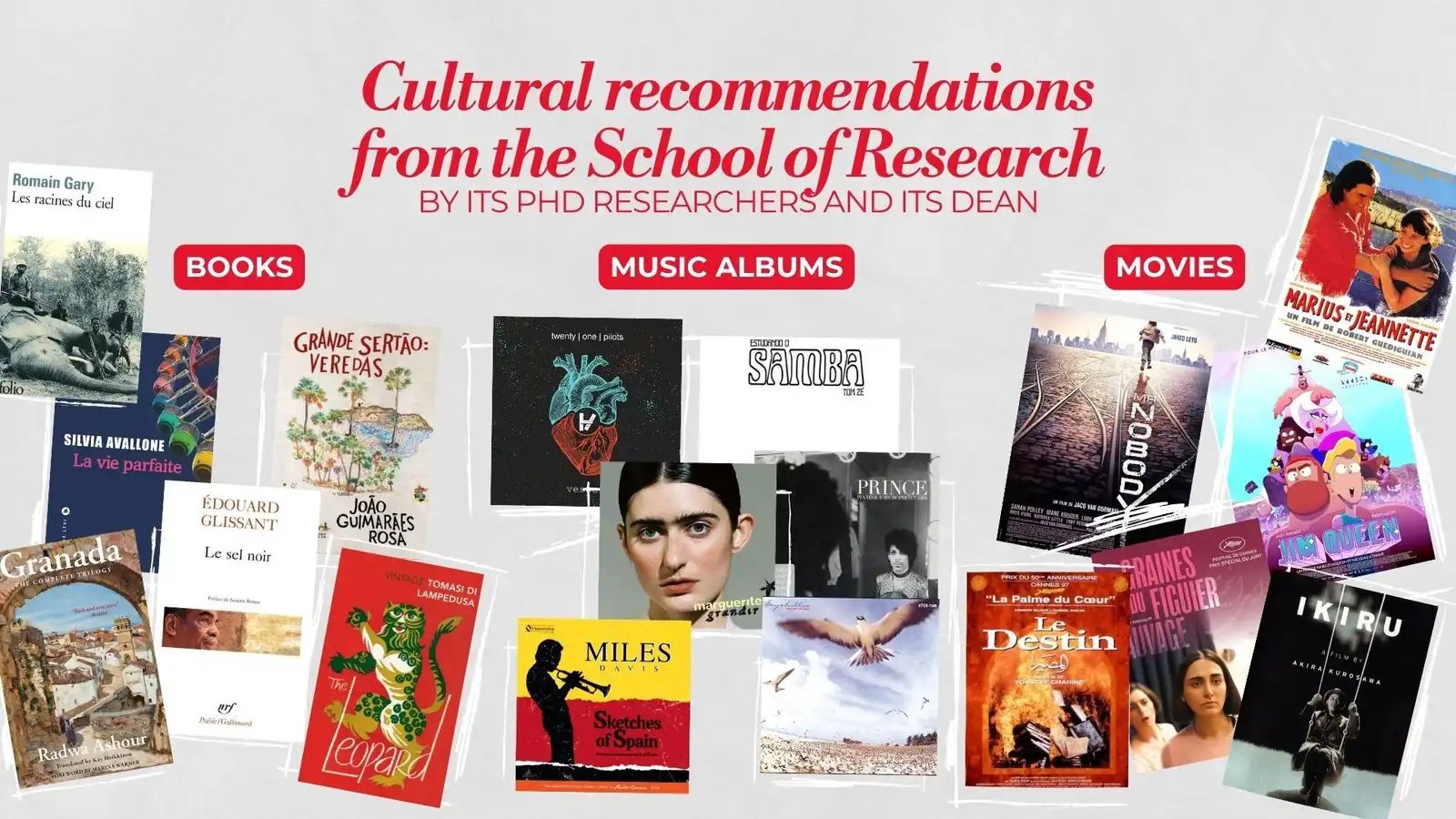
This summer, let our PhD researchers and our Dean guide you with their cultural recommendations! They have each carefully selected a movie, a book and an album to spark your curiosity. Their suggestions promise you a wonderful summer, combining thought-provoking moments with pure enjoyment.
The selection of our PhD researchers
Gabriela Berbert-Born (PhD researcher in law)
Book: Grande Sertão: Veredas by João Guimarães Rosa
Movie: Mr. Nobody by Jaco Van Dormael
Album: Estudando o Samba by Tom Zé
Maxence Dutilleul (PhD researcher in sociology)
Book: Le sel noir by Édouard Glissant
Movie: Marius et Jeannette by Robert Guédiguian
Album: Piano & A Microphone 1983 by Prince
Alexandra Koroleva (PhD researcher in history)
Book: The Leopard by Giuseppe Tomasi di Lampedusa
Movie: Ikiru by Akira Kurosawa
Album: Seychelles by Masayoshi Takanaka
Paloma Peligry (PhD researcher in economics)
Book: La vie parfaite by Silvia Avallone
Movie: Jim Queen by Marco Nguyen & Nicolas Athane
Album: Vessel de Twenty One Pilots
Théodore Tallent (a young doctor of political science)
Book: Les Racines du Ciel by Romain Gary
Movie: Les Graines du Figuier Sauvage by Mohammad Rasoulof
Album: Grandir by Marguerite
Our Dean’s selection
Dina WAKED (Dean of the School of Research)
Book: Granada (trilogy) by Radwa Ashour
Radwa Ashour, the Egyptian novelist, critic, and scholar of comparative literature, wrote the Granada trilogy following a family across three generations in the years after the fall of the last Muslim kingdom in Spain in 1492, tracing forced conversion, the Inquisition, and the slow erasure of a civilization under a new order. Ashour skilfully weaves a history of Granada rule and an Arabic world into a novel that evokes cultural loss and the disappearance of a vanquished population. Widely regarded as one of the major achievements of modern Arabic literature, it won Ashour international recognition.
The novel follows the family of Abu Jaafar, the bookbinder. As the triumphant new masters of Granada burn books, Abu Jaafar, a bookseller by trade, quietly moves his rich library out of town, while preparing for the marriage of his granddaughter Saleema to his apprentice Saad. Over the hundred years that follow, spanning three generations, Abu Jaafar's family and community struggle to maintain faith and hope in a possible future, even as they are forced to reckon with the slow vanquishing of their life in Andalusia: confiscations, forced conversions, and expulsions.
Movie: Destiny (Al-Massir) directed by Youssef Chahine
This year marks the centennial of Youssef Chahine's birth (1926), one of Egypt's most celebrated filmmakers and a defining figure of Arab cinema. In 1997 Destiny (Arabic: Al-massir), was screened at the Cannes Film Festival where Chahine won the 50th anniversary Lifetime Achievement Award.
Destiny portrays the preservation of knowledge as a central struggle, dramatizing the historical threats to Ibn Rushd (Averroes)' philosophical works in 12th-century Andalusia. Fundamentalist opponents, seeking to suppress rationalist interpretations of Islamic texts, orchestrate public burnings of Averroes' commentaries on Aristotle and religious jurisprudence, symbolizing broader assaults on intellectual inquiry and freedom. Despite these efforts, the narrative emphasizes resilience through clandestine copying of manuscripts by Averroes' disciples, ensuring the transmission of ideas across generations and regions.
I recommend it, in his centennial year, for the clarity of its central question: what happens to a society when it turns against its own thinkers? The film has obvious resonance for anyone studying censorship, academic freedom, or the long historical rivalry between critical thinking and the fundamentalist orthodoxy — questions that recur across centuries.
Album: Sketches Of Spain by Miles Davis
One of the most celebrated fusions of jazz and orchestral composition, built around Spanish and Andalusian musical material, most notably a reworking of Joaquín Rodrigo's Concierto de Aranjuez. Miles Davis and Gil Evans do not imitate Spanish music so much as refract it through jazz idiom, creating something that belongs fully to neither tradition.
All three recommendations, the book, the movie and the music album return to the memory of Al-Andalus, but from different centuries and different angles. Together they raise the same question from three directions: who gets to hold, defend, and remake the memory of a world once it is gone.
Each displays an act of resistance to the erasure of culture, the burning of books, and the silencing of memory. Reading, watching, and listening to them together is a way of attending to what official histories, often written by the winners, omit — to what survives only in fragments, translations, and refusals to forget.
Virtual Graduate Open House day, October 2025


On 17 October 2026: meet faculty members, students and representatives and learn more about our 30 Master's programmes.