
Home>Naomi Cohen, Master's and PhD in Economics
7 January 2026
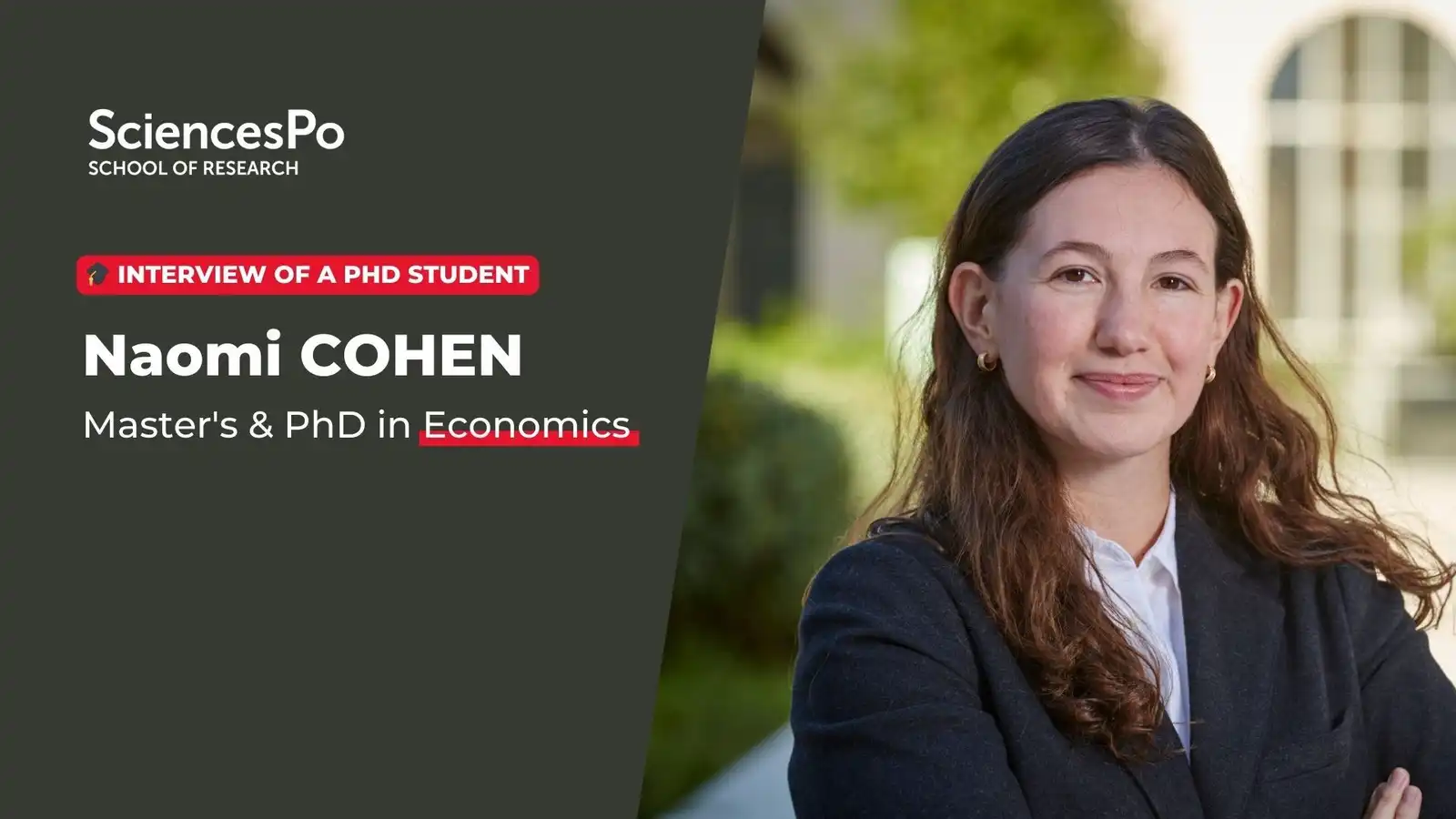
Naomi Cohen, Master's and PhD in Economics

CAN YOU TELL US ABOUT YOUR ACADEMIC BACKGROUND? HOW DID YOUR INTEREST IN ECONOMICS BEGIN?
I have always been drawn to economics and social sciences. In secondary school, I chose to study economics and mathematics, before going on to Paris-Dauphine University after my baccalaureate. However, at the time, I never imagined becoming an economics researcher: it seemed very abstract to me, and mathematics was not my favourite subject at university.
It was thanks to a few teachers that things changed. Marin Ferry, then a doctoral student at Dauphine, passed on his passion for macroeconomics to me. In my third year, I chose to specialise in economics and social sciences, where I discovered econometrics with Régis Bourbonnais and broadened my horizons thanks to Renaud Dorandeu's political sociology course. These courses gave me a taste for research.
I then went on to do a Master's degree in International Economics and Development at Dauphine, where I had the opportunity to be taught by Baptiste Venet and Richard Dutu. But at the time, the economics department at Dauphine was very focused on development economics, whereas my interests lay more in macroeconomics and public policy. This led me to join Sciences Po's School of Research in order to further my education.
WHAT DID YOU GAIN FROM YOUR YEARS OF STUDY AT THE SCHOOL OF RESEARCH? WHAT MEMORIES DO YOU HAVE OF YOUR SCHOOL, YOUR CLASS, AND YOUR TEACHERS?
My two years at the School of Research were not easy: they began with the RATP strike, then continued with a year and a half of online classes due to COVID. Despite these conditions, I have fond memories of my time there. The spirit of mutual support and collaboration, particularly through group problem sets, marked those years. I think in particular of Mattis Gilbert, with whom I worked on econometrics exercises in the first semester of the first year, and who is now one of my co-authors. Many Master's students are now pursuing PhDs, at Sciences Po or elsewhere, and it is always a pleasure to meet up at conferences.
The courses, structured around three main areas (econometrics, microeconomics and macroeconomics), gave me the rigour and tools essential for research. At the time, it sometimes felt like we were doing more maths than economics, but looking back, you realise that these foundations are essential for any research project you might undertake later on.
WHICH TEACHER OR SUBJECT MADE THE BIGGEST IMPACT ON YOU?
First, I would mention Xavier Ragot, who taught the macroeconomics course on heterogeneous agents, and Nicolas Coeurdacier, who offered a course in international economics (at the time, in partnership with Thierry Mayer). These two courses were decisive for my education and the rest of my thesis. I also have fond memories of Julia Cagé's course on The Price of Democracy, which introduced me to political economy, a field I knew little about before Sciences Po.
HOW HAS YOUR EDUCATION CONTRIBUTED TO YOUR RESEARCH CAREER?
The master's degree programme in research is particularly robust: the first three terms are devoted to acquiring the tools essential for pursuing a PhD. The macroeconomics courses, covering neo-Keynesian models and national accounting, as well as learning software such as R and Julia, are still useful to me today.
The dissertation is a key moment: it allows you to tackle a real research project, to confirm your desire to pursue a PhD and often to confirm your choice of thesis supervisor.
Why did you decide to pursue a DOCTORATE?
I already had this goal in mind when I enrolled in the research master's programme at Sciences Po. My previous internships at the Banque de France and the French Treasury, which focused on European issues, reinforced my desire to continue in the field of research, particularly in macroeconomics.
When I recently reread my cover letter for Sciences Po, I noticed that I mentioned my desire to work alongside Xavier Ragot and Nicolas Coeurdacier on macroeconomic imbalances. That is ultimately what I am doing today: Xavier is my thesis supervisor, Nicolas is on my committee along with Isabelle Méjean, and my main paper focuses on the link between inequality and capital market integration in the eurozone.
WHAT IS THE SUBJECT OF YOUR THESIS?
My thesis focuses on macroeconomics and international finance.
All of my projects focus on the importance of taking into account heterogeneity in various aspects of macroeconomic policy-making, whether at the individual or country level. My main paper examines how financial market integration redistributes risk within a monetary union exposed to asymmetric shocks. Using microeconomic data on household portfolios and macroeconomic data on cross-border equity assets, I highlight significant disparities in financial participation within countries, as well as persistent asymmetries in portfolio diversification between them. Using a heterogeneous agent model, I show that financial integration stabilises macroeconomic aggregates but redistributes welfare unevenly, both between and within countries.
YOU HAVE BEEN AWARDED A BANQUE DE FRANCE DOCTORAL SCHOLARSHIP. COULD YOU TELL US ABOUT THIS SCHOLARSHIP?
The Banque de France doctoral scholarship (€10,000) provides additional funding for the fourth year of doctoral studies, alongside an assistant teaching and research position or postdoctoral fellowship. Beyond financial support, it offers genuine integration into a research team: I was affiliated with the European relations team, in line with my work on the capital markets union, and I had the opportunity to present my work and exchange ideas with many economists. Each winner is also assigned a mentor: I was fortunate to be mentored by Giulia Sestieri, whose professional and personal advice has been invaluable to me.
DO YOU HAVE ANY ADVICE FOR A STUDENT WHO WANTS TO PURSUE A DOCTORATE?
I would strongly recommend taking advantage of every opportunity for mobility and presentations. I was fortunate enough to do internships at the International Monetary Fund, the European Central Bank, and the Federal Reserve Bank of St. Louis, and to spend a few months at the University of Chicago.
Sciences Po offers numerous opportunities for partnerships and funding for these stays, as well as for participating in conferences abroad. These stays and conferences are essential: they not only allow you to present your work in an international setting, but also to gain confidence in your research and feel fully part of the scientific community.
Find out more
Virtual Graduate Open House day, October 2025


On 17 October 2026: meet faculty members, students and representatives and learn more about our 30 Master's programmes.