
Home>Jean-Baptiste BONNET, Master's & Doctorate in Political Science
5 March 2026
Jean-Baptiste BONNET, Master's & Doctorate in Political Science
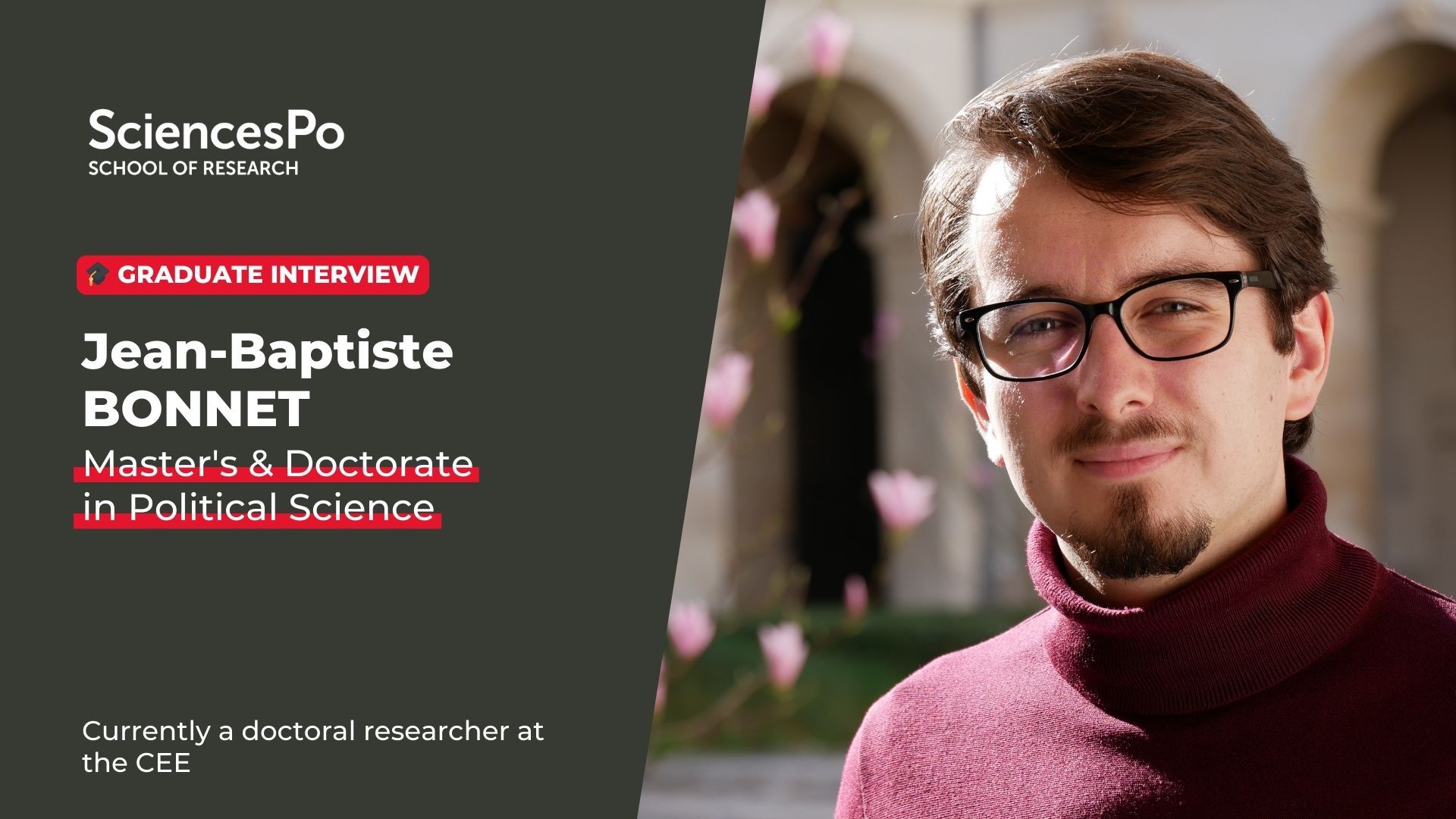
Can you tell us about your academic background, from your master's degree in political science, specialising in public policy, to your entry into doctoral studies?
I completed almost all of my studies at Sciences Po, from undergraduate to master's level, with a detour to the Freie Universität in Berlin as part of a dual degree programme with the Nancy campus. It was in Berlin, where I studied for a bachelor's degree in political science, that I discovered my passion for this discipline and decided to pursue a master's degree in political science at Sciences Po.


« Discovering the Erasmus+ mobility programme through CIVICA opened the door to an enriching experience at the Hertie School of Governance, where I sought to conduct extensive research fieldwork. I stayed there five months from January to June 2025. During those five months, I conducted interviews that are crucial to my PhD thesis. Additionally, it allowed me to present my research, receive feedback, and connect with new scholars. For doctoral researchers considering mobility, I wholeheartedly recommend seizing this opportunity, it’s a great occasion to gain a fresh perspective on your field and to grow intellectually. The key issue is to prepare accordingly by identifying the scholars and interviewees you want to get in touch with beforehand and to calibrate the duration of the stay to balance between being productive and having time to enjoy the stay »
Jean-Baptiste BONNET
Master's & Doctorate in Political Science
What role did your training at the School of Research play in your decision to pursue a PhD?
I began my Master's degree specialising in Political Behaviour before switching to Public Policy in my second year. I think this change reflects the appeal of this research-based Master's degree, where you can explore many different areas of political science and sometimes take advantage of opportunities to switch between them. This allowed me to explore many ideas before choosing public policy and political economy for my Master's thesis. It was the experience of writing my thesis, spending six months conducting in-depth research on a subject, that convinced me to pursue a PhD.
Which lectures, seminars or lecturers have had the greatest influence on you in developing your doctoral project?
There are many! First and foremost, my master's thesis supervisor, Cyril Benoît, who supported and inspired me greatly during my master's programme and while writing my master's thesis. I also owe a great deal to Philippe Bezes, who is currently co-supervising my PhD thesis with Cyril and who also manages the public policy specialisation. It is thanks to their teaching and advice that I discovered my interest in public policy and political economy, that I was able to produce a high-quality thesis and that I succeeded in putting together a PhD application that was accepted. I must also thank all the teachers I had during my Master's degree. It was the diversity and quality of their courses that enabled me to make an informed choice about my future path and to be accepted for a PhD.
What is your current research focused on, and how does it tie in with your master's degree?
I am working on the transition of the European automotive industry to electric vehicles. More specifically, I am seeking to understand the role of governments in this transition and the role that political and economic actors play in the pace and form that these transitions take. My work therefore lies at the intersection of political economy and public policy. In addition, I use mixed methods, combining qualitative and quantitative approaches, which reflects the excellent training in various social science methods that we receive during the Master's programme.
Which skills from your master's degree are most useful to you today in your doctoral work?
The Master's programme provides excellent training in two crucial aspects of doctoral work: intellectual openness and methodology. Writing a thesis is not simply a matter of applying a framework of thought constructed by others to your subject. You have to know how to construct your own thinking by drawing on a variety of works, and in this respect, the diversity of specialisations and subjects covered during the Master's programme, as well as the quality of the teaching staff, provide excellent preparation for this intellectual construction work. In addition, the Master's programme offers intensive and relevant methodological training, particularly in quantitative methods, which opens up new ways of practising social sciences at the highest level.
What advice would you give to a Master's student considering pursuing a PhD?
Surround yourself with the right people! Doing research means spending long periods of time alone with your subject. To make the experience enjoyable, you need to find your sparring partner(s), people with whom you can have fruitful intellectual exchanges, who challenge your assumptions and push you to give your best. This is true of your dissertation and thesis supervisors, as well as your fellow Master's students.
Find out more:
Information Sessions: Masters
Find out more about the Masters programs and the wide choice of specialisations offered by the 8 Schools of Sciences Po during our webinars dedicated to applicants.