
Home>Charles HOUDANT, Master in Political Science, Programme in Public Policy (Class of 2025)
8 April 2026
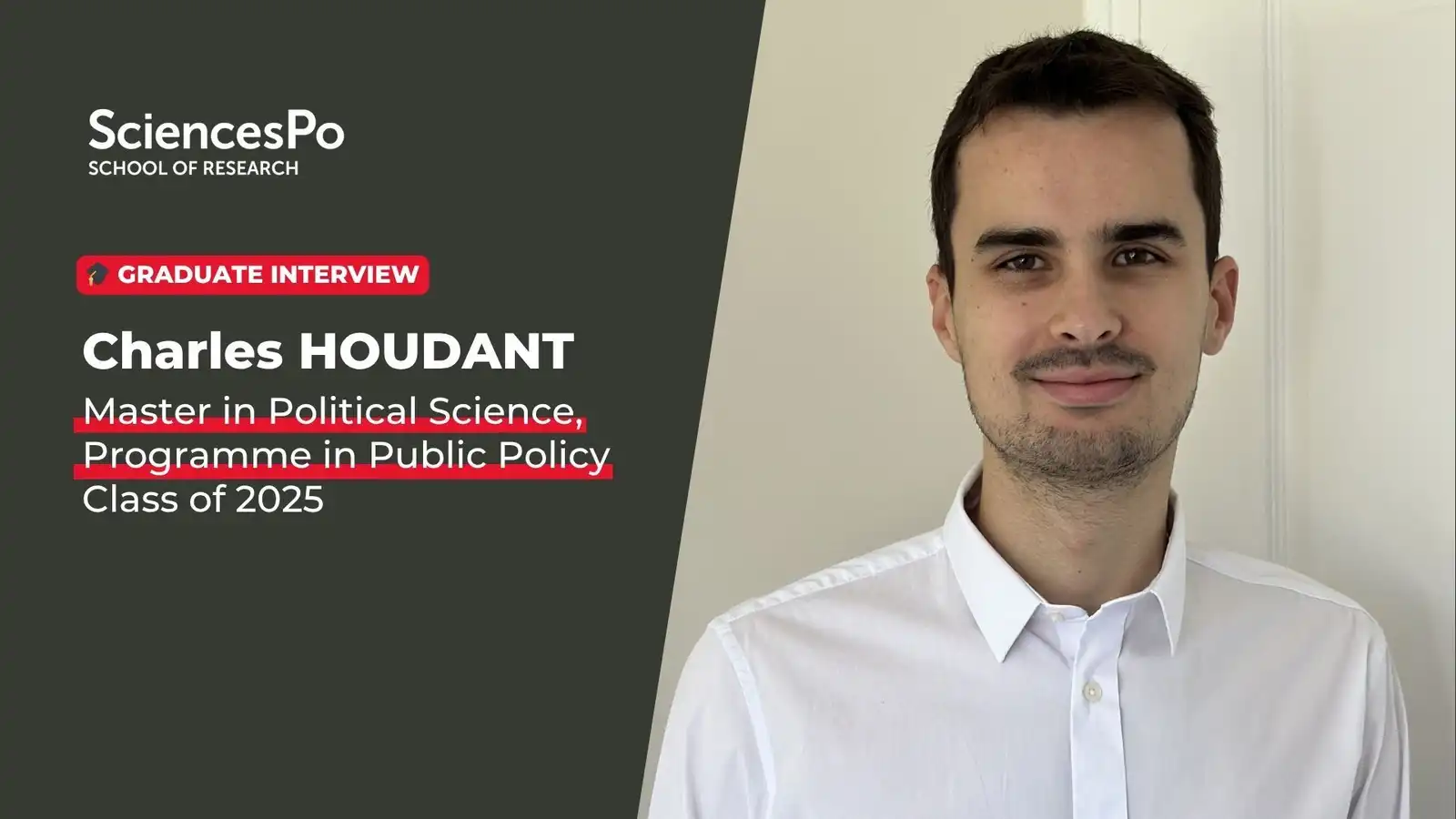
Charles HOUDANT, Master in Political Science, Programme in Public Policy (Class of 2025)

Could you tell us about your academic background? How did your interest in political science – and, more specifically, in public policy – come about?
I joined Sciences Po straight after my Bachelor’s degree, following the Euro-American programme in Reims. My interest in political science developed quite quickly, largely thanks to the teaching of young researchers.
Then my third year in Budapest opened up a field of study that had previously been unfamiliar to me. I quickly realised that I wanted to deepen my understanding of Hungary, particularly from the perspective of industrial policy, which naturally led me towards the research-based Master’s programme. The Public Policy programme was a good fit for my interests in political economy and the analysis of the diversity of capitalist systems.
What did you gain from your years of study on the Master’s in Political Science, specialising in Public Policy, at the School of research? What memories do you have of your cohort and your time as a student?
The Master’s programme was a demanding and stimulating course, particularly the modules on quantitative and qualitative methods.
My most vivid memory remains my dissertation, especially the fieldwork in Hungary. Conducting interviews with executives from companies or professional organisations, especially abroad, can be intimidating at first. But it is a highly formative experience. More generally, undertaking a long-term research project is an experience marked by doubts but, above all, by genuine satisfaction.
Taking part in the numerous research seminars at Sciences Po also provided an opportunity to engage in stimulating academic discussions.
Was there a teacher, a course or a teaching experience that made a particular impression on you during your training? Why?
I have very fond memories of Philippe Bezès’s course on the transformation of the state and public administrations. It covered a wide range of issues: digital transformation, relations with users and decision-makers, policy implementation… Furthermore, Cyril Benoît, my thesis supervisor, played a vital role: his advice, support and enthusiasm gave me confidence throughout the various stages.
Did you undertake any extra-curricular projects or activities during your studies (volunteering, work placements, group initiatives, etc.) that have played a significant role in your career path?
Outside of Sciences Po, I volunteered as a tutor. It was quite different from my academic work, but it allowed me to develop teaching skills whilst taking a break from the abstract nature of my studies.
You are currently preparing for the INSP entrance exams. Could you explain what this preparation involves and what motivated you to choose this path? What were the key steps in shaping your career plans and in your decision to pursue a career in the senior civil service?
At first, I was torn between pursuing a PhD and preparing for the civil service entrance exams. I eventually chose the latter path, driven by a desire to play a practical role in the design and implementation of public policy. The preparation focuses heavily on analysing real-world issues in public administration and formulating operational recommendations. It is also an opportunity to consolidate my foundations in public law and public finance, subjects I was less familiar with previously.
Alongside the Institut National du Service Public (INSP), I am preparing for a civil service exam that is, unfortunately, less well-known: that of the Ecole nationale supérieure de Sécurité sociale (EN3S), which offers interesting careers in the field of social protection.
How does your background in political science and public policy help you today in preparing for competitive examinations and in understanding the challenges of public policy?
Firstly, it helps me approach topics: I find it easier to get to grips with administrative reports or articles that can sometimes be rather dry. Secondly, it enables me to develop a more structured line of thought. I’m able to produce more analytical essays with original personal insights and a slightly different angle, which is valued to a certain extent in competitive examinations.
What advice would you give to a student who is considering preparing for civil service entrance exams or pursuing a career in the senior civil service?
I would advise capitalising on your strengths to maximise your performance in the exams, whilst gradually addressing your weaknesses in other subjects. Above all, do not view a background previously focused on research as a hindrance. On the contrary, the ability to look beyond the obvious and a critical mind are valuable assets for a career in the senior civil service. Now more than ever, the state needs people who can take a step back and see the bigger picture.
Find out more
Virtual Graduate Open House day, October 2025


On 17 October 2026: meet faculty members, students and representatives and learn more about our 30 Master's programmes.