


Home>Studio>Programmes
Studio Programmes
The Studio offers three programmes to understand, imagine, design, and experiment with innovative solutions that incorporate impact criteria: the Impact Project, the Impact Entrepreneur Pathway, and Research in Action.
A Pedagogical Approach Focused on Experimentation

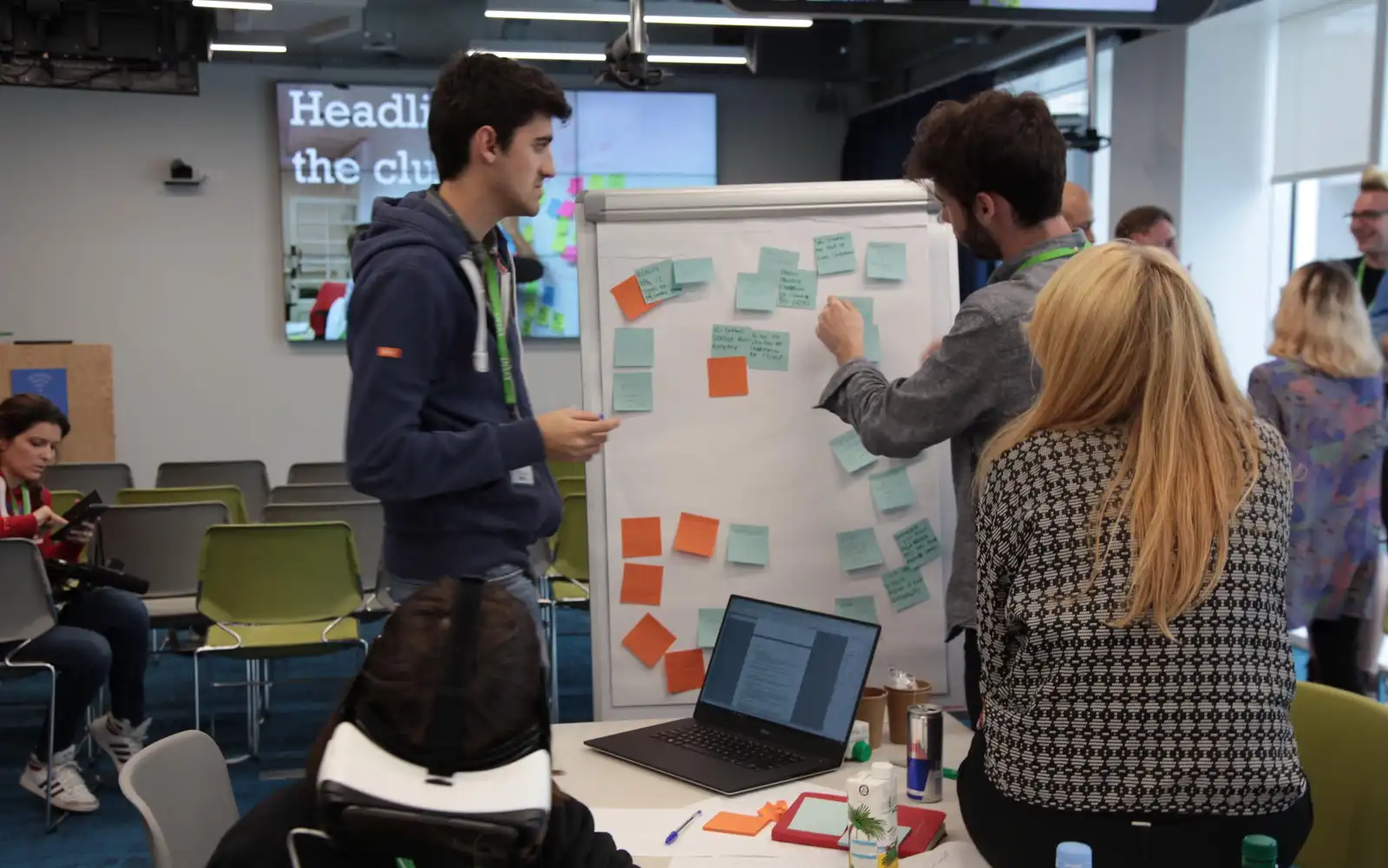
Co-founded by the School of Management and Impact and the Center for Entrepreneurship, The Studio offers a teaching method that combines the development of entrepreneurial skills with experimentation. We firmly believe that this combination is the most effective for training students to play an active role in the necessary transformations for society and the world.
Our Programmes are offered to students who will respond in groups to a problem from an impact perspective. The approach: 1. study and analysis, 2. proposal of solutions, 3. prototyping and testing, allows students to experience innovative project management and entrepreneurship. Being immersed within partner structures enables them to face the concrete realities of the professional world.
The Impact Project // The Tech Project
The Projects offer students the opportunity to work in groups to address issues proposed by our partners from an impact perspective, in collaboration with a mentor from Sciences Po.
For students, this optional module offered in the first year of the School of Management and Impact allows them to develop skills in innovative project management and entrepreneurship, while confronting their ideas with the realities of the professional world. Consult the course syllabus.
For partners, it is a unique opportunity to explore creative and responsible solutions that strengthen their commitments to social responsibility. Whether to improve existing systems or create new ones, the proposals from Sciences Po students bring a fresh perspective, enriched by their knowledge in social sciences, their management training, and their engagement.
Examples of ambitious Impact Projects:
- Advens for People and Planet – Mobilize companies for democracy
- Bayard – Embody diversity
- BNP Paribas – Preserve the oceans and promote a regenerative blue economy
- Centre de musique baroque de Versailles – Develop and apply multi-capital accounting
- Croix-Rouge – Develop a new model for the social-solidarity textile sector
- CMA CGM Foundation – Scaling the Solidarity Warehouse Model Across the Île-de-France Region
- Ingenico – Build a carbon-neutral payment terminal
- Kering – Develop CSR ambition within the future luxury industry
- L'Oréal for Women – Maximize the impact of the endowment fund’s call for projects
- Natixis Investment Managers – Advance responsible investment management and reinforce stewardship on ESG issues
- We Fundia – Impact assets, tokenisation/blockchain
The Impact Entrepreneur Pathway
The Impact Entrepreneur Pathway offers first-year master's students an immersive experience to develop innovative solutions to current environmental and social challenges.
In teams, they must identify a general interest issue, design an impactful solution, and create a prototype.
This pathway is structured in three phases:
- Exploratory Phase: identification of the issue, study, and diagnosis
- Structuring Phase: idea generation, identification of a solution, business model
- Production Phase: construction and prototyping of the solution
Throughout this pathway, students alternate between training sessions and group work, guided by an entrepreneurial mentor. They follow eight educational modules covering key skills such as research methodology, impact strategy, quantitative and qualitative studies, business model transformation, creativity methods, impact measurement, graphic and video production, and pitching.
This approach allows them to apply theoretical concepts to concrete and complex situations while developing practical skills in project management and entrepreneurship.
Research in Action: Applied Research Project
Research in Action offers students the opportunity to experience the full journey of an applied research project, from exploring a research question to producing actionable insights in collaboration with a researcher and a partner organization.
Through this immersive programme, students learn how to connect academic knowledge with real-world challenges. Working in teams, they investigate a concrete topic, collect and analyze field data, and develop a research paper that brings together theoretical perspectives, empirical evidence, and practical implications. For more information, consult the course syllabus here.
Students move from theory to practice through a three-step approach:
- Understanding and exploring: Students analyze existing research, identify key concepts, and develop a strong understanding of the topic they will investigate.
- Investigating real-world contexts: Students collect and analyze empirical data through interviews, observations, documents, datasets, or digital sources, working closely with their partner organization.
- Developing and sharing insights: Students transform their findings into an applied research paper that connects academic perspectives with practical challenges.
For the 2026–2027 edition, students will investigate the emergence and diffusion of the Model Context Protocol (MCP), an interoperability standard shaping the generative AI ecosystem. They will analyze adoption patterns, identify key actors and incentives, and explore how standards influence innovation, competition, and governance.
By combining research, collaboration, and real-world investigation, Research in Action equips students with the ability to understand complex transformations and contribute to informed decision-making.