
Home>Meet the 2026 graduates: Veronika Prikrylova
17 September 2026
Meet the 2026 graduates: Veronika Prikrylova
Can you describe your academic and professional background?

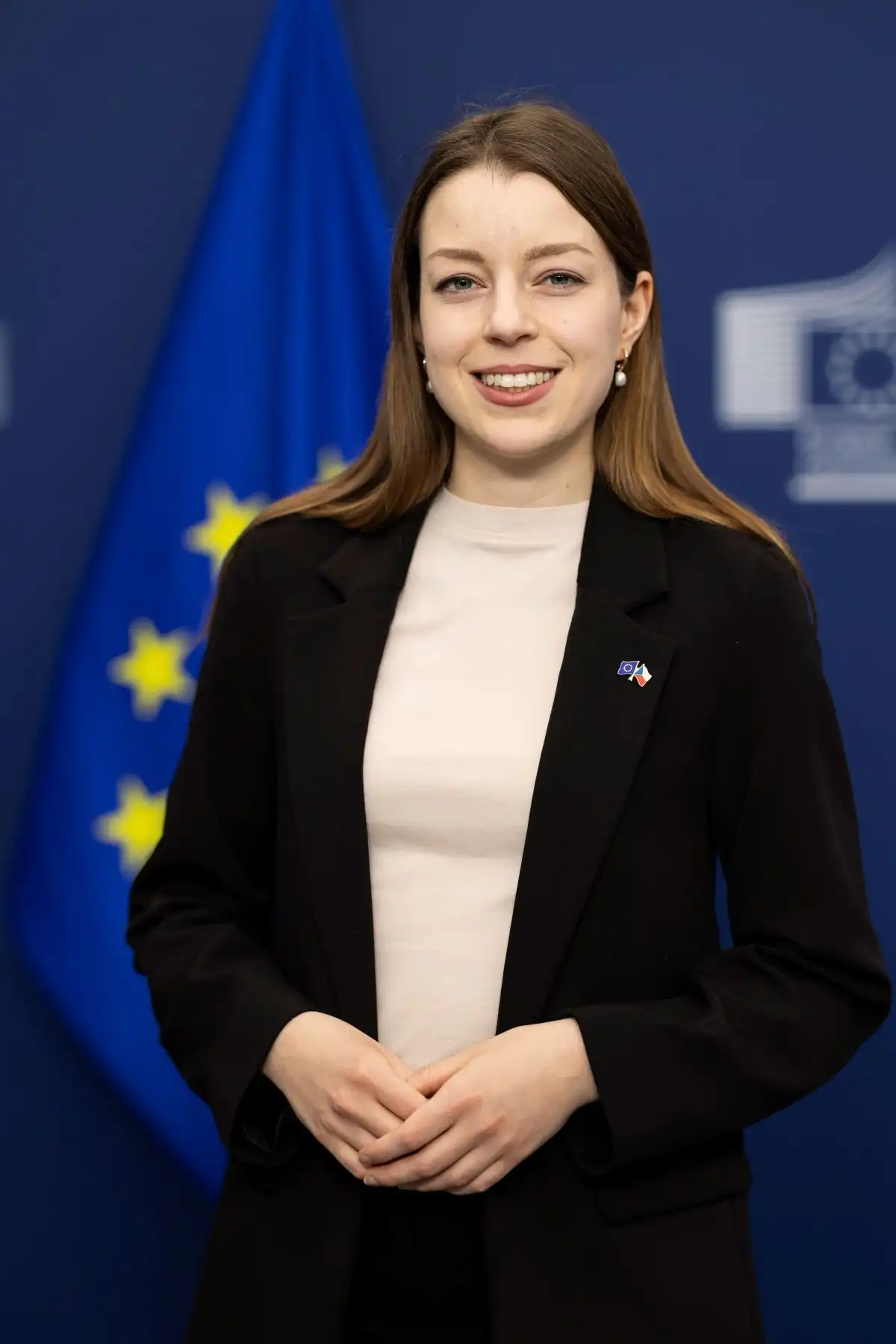
I am a graduate with a Bachelor's Joint Honours Degree in International Politics and Spanish at Aberystwyth University (UK), with a specialisation in European Security, and now also a Master's graduate in European Affairs, with a focus on EU External Affairs.
My professional background spans public governance, diplomacy and research. I have started in regional governance at Suffolk County Council, then worked for a Member of the Senedd in the Welsh Parliament and gradually moved towards politics at the international level through my traineeship at the Embassy of the Czech Republic in Madrid and my work in the David Davies Memorial Institute (research institute), where I researched patterns of EU sanctions circumvention following Russia’s invasion of Ukraine.
I dedicated my last semester to Blue Book Traineeship at the European Commission; I worked in the Cabinet of the Commissioner for International Partnerships, Jozef Sikela. Currently, I am an intern in the Operations Department of the EU Rule of Law mission in Kosovo.
Why did you choose to pursue this specific policy stream “Politics and Public Policy”?
Having studied, worked and lived in six different countries, I became convinced that I wanted to work for the EU project. Throughout my academic and professional journey, I gradually discovered that regardless of the policy area I was working on, I kept coming back to the same conclusion: for the EU not to lose its voice in the ever more geopolitical international arena, it cannot act alone. The EU needs strong long-lasting strategic partnerships - this is where I wanted to personally contribute; the Europe in the World stream was therefore for me a clear choice.
How did your training at the School of Public Affairs contribute to get your degree and the position you hold today?
My Master’s degree, with its specific focus on the EU’s external affairs, was certainly one of the factors that helped me when applying to the Cabinet of the Commissioner for International Partnerships and, subsequently, the CSDP mission in Kosovo.
The programme has provided me with a strong theoretical but also practical foundation. It gave me a comprehensive understanding of EU institutional and legal frameworks as well as of the relevant EU policies and initiatives. Just as importantly, it equipped me with practical skills for my day-to-day work: preparing briefings under tight deadlines, communicating with various stakeholders and understanding the nuances and complexities of EU-level negotiations.
What advice would you give to current and future students?
The field of international relations is a highly competitive environment, and it can feel overwhelming at times. My main advice would be to trust the process and remember that, by choosing Sciences Po, you are already on the right track.
Where do you see yourself heading next or what do you see as your next challenges?
Having worked in the European Commission, in the Cabinet - i.e. at the top of EU decision-making - and now gaining more on-the-ground experience through the EU Rule of Law mission in Kosovo, I have had the opportunity to get an insight into both sides of the policy cycle: how priorities are negotiated and defined at the political level and how they are implemented on the ground.
My next goal is to bring these two perspectives together and contribute to informed policymaking within the European Commission.
FIND OUT MORE
Virtual Graduate Open House day, October 2025

On 17 October 2026: meet faculty members, students and representatives and learn more about our 30 Master's programmes.