
Home>Meet the 2026 graduates: Erinrose Ryder
10 July 2026
Meet the 2026 graduates: Erinrose Ryder
Can you describe your academic and professional background?

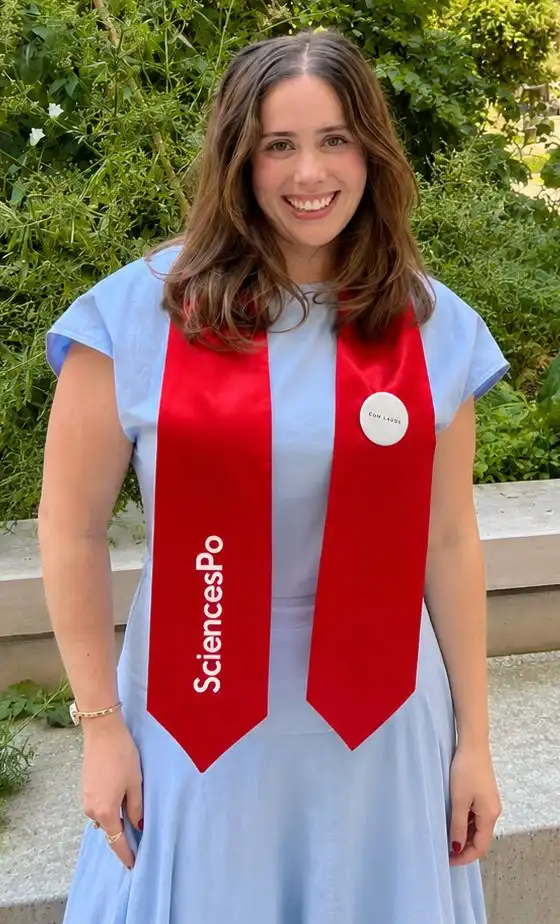
My academic and professional background has been shaped more by curiosity than certainty.
After growing up in a small town in Texas, I moved to Chicago to study International Relations and French at DePaul University. These early years were marked by a broad intellectual growth in international law and politics, but also an unsureness of what to do with these fascinations, or my new-found language skills.
I let French guide my first professional experiences, interning with the French and Québec government offices of Chicago. It was also French that led me to an exchange year at Sciences Po during which I grappled with citizen politics and European law and unearthed an aspiration to return to France for my master’s degree and pursue a not-yet-defined
transatlantic career.
After graduating, I joined Publicis Groupe in a marketing role and while I gained valuable agency experience, I also spent these years networking, auditing courses, and deciphering how I could reconnect with the academic interests and international perspective that had first inspired me. Such exploration brought me back to Sciences Po to begin the Master of Public Policy in 2024.
Alongside my coursework, I found several roles that gave my career path clearer shape. In an internship with the European American Chamber of Commerce, I supported our members’ institutional relations and transatlantic advocacy work, organizing conferences with senators, think tanks, and U.S. Embassy officials. Building on that experience, I then joined L'Oréal
Groupe as an apprentice in strategic communications, helping write the company's global messaging on tech topics including AI, data governance, and sustainability.
Together, these roles demystified what had once felt like a mysterious middle ground between private and public sector work and help me find my place in transatlantic affairs.
Why did you choose to pursue this specific policy stream “Politics and Public Policy”?
I chose the Politics and Public Policy stream because I wanted a practical understanding of how governments, policymakers, and other stakeholders shape public decision-making. With the goal of pursuing a career in public affairs, I was particularly interested in understanding the distinct roles that civil society organizations, businesses, lobbyists, and associations play in the policymaking process.
My choice was also deeply personal. Growing up in a conservative environment before later living in politically diverse cities such as Chicago and Paris sparked my curiosity about why people engage with politics differently and how those experiences shape political participation and voting behavior. I wanted to better understand the patterns I had observed in
my own life.
Courses such as Media and Politics, Being a Politician, and Democratic Innovation in the Age of AI to go beyond surface-level assumption and see that policymaking is not simply a technocratic process or a matter of institutions and power. It is also deeply about understanding that public policy is designed, implemented, and evaluated by people with vastly differing values and incentives.
How did your training at the School of Public Affairs contribute to get your degree and the position you hold today?
The Master in Public Policy gave me a strong analytical foundation while also helping me better understand how to navigate complex institutions. Throughout the program, I developed practical skills in primary data research, data visualization, and coding, as well as the ability to translate complex analyses (econometric findings, impact evaluations, etc.) into clear, concise memos, policy briefs, and presentations. Such skills have proved to be powerful not only as a competitive edge in my roles but also as a source of greater confidence in my work.
Beyond technical skills, the program also deepened my understanding of the French and European political landscape. This knowledge proved especially valuable during my time at the European American Chamber of Commerce, where I was expected to map stakeholders across institutions and propose ways to engage them effectively. In my current role, I also
regularly analyze emerging political and regulatory developments, and need to anticipate their implications with consideration for my company’s position.
Finally, Sciences Po’s School of Public Affairs has been positively challenging. From serving as a student representative to the rigorous coursework alongside internship commitments, the program equipped me well to manage competing priorities as well as work efficiently under pressure.
What advice would you give to current and future students?
One lesson we often joked about in the stream was that sometimes no result is a result.
Meaning that in research, not finding the answer you expected is still valuable because it helps you better understand the question and challenge your initial assumptions.
I would encourage future students to keep this in mind. I believe it translates equally well to not being afraid of testing new paths and making mistakes whether it be in choosing courses, internships, or career opportunities. As both students and young professionals, we are navigating an increasingly competitive and AI-perfected world. In response, I would encourage curiosity and for future students to value the process of unfolding your academic and/or career path over perfection.
Where do you see yourself heading next or what do you see as your next challenges?
While I am currently in the recruitment process for a full-time position at L'Oréal following the completion of my apprenticeship, I am also exploring opportunities in public affairs across Paris, Brussels, and Washington, D.C.
Looking ahead, my biggest challenge (and priority) is to continue building a career that remains as open and dynamic as it was at the beginning, while steadily developing my deeper expertise. Equally important will be finding opportunities that that allow me to engage with my deep roots in the United States alongside growing professionally and personally in France and Europe.
FIND OUT MORE
Virtual Graduate Open House day, October 2025

On 17 October 2026: meet faculty members, students and representatives and learn more about our 30 Master's programmes.