
Home>Meet the 2026 graduates: Daan Pierson
13 July 2026
Meet the 2026 graduates: Daan Pierson
Can you describe your academic and professional background?

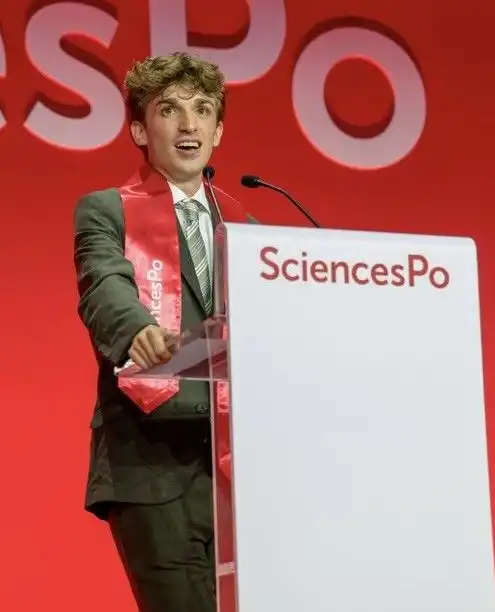
I started studying Political Science at the Vrije Universiteit Brussel (VUB), in my home country, Belgium. During my bachelor’s, I spent an Erasmus semester at Dublin City University (DCU), which was an important step in becoming more comfortable studying in English.
After graduating, I did a summer internship at the Cabinet of the Belgian State Secretary for Asylum and Migration. What started as an internship became a job offer, and I stayed on as a Communication Officer while beginning a Master’s in International Relations at VUB. For two years, I combined studying with working in a ministerial cabinet. It was intense, but it also gave me a very concrete view of politics. During that time, the Belgian Presidency of the Council of the European Union was an important moment for me. Being involved in the cabinet’s work made European policymaking feel much closer and more tangible. It confirmed that I wanted to focus more seriously on Europe.
That is what brought me to Sciences Po, where I pursued a second Master’s in European Affairs. The “Europe in the World” policy stream felt like the right fit for me since it connected my interest in European institutions, international affairs and the ambition to work within the EU system.
During my final semester at Sciences Po, I completed a Blue Book traineeship at the European Commission and passed the CAST exam. This was exactly the kind of opportunity I had hoped for when coming to Sciences Po, as it helped me take a concrete step towards working within the European institutions.
Why did you choose to pursue this specific policy stream “Europe in the world”?
The “Europe in the World” policy stream felt like the most natural continuation of both my academic background and my professional experience. After studying international affairs during my first Master, I wanted to look more specifically at how international relations play out in the EU context: how the Union defines its interests, works with partners, responds to
crises and positions itself in a changing world.
My work at the cabinet for Asylum and Migration also made this choice feel very relevant. Migration policy is often discussed as a domestic issue, but in practice the EU’s external role is increasingly central to it. During my time at the cabinet, it became clear that questions of cooperation with third countries, border management, diplomacy and global instability all shape what happens at European and national level. I wanted to understand that connection better.
How did your training at the School of Public Affairs contribute to get your degree and the position you hold today?
What I appreciated most about the School of Public Affairs was how practical-minded the School is. Many courses were taught by practitioners who often talked about what was actually happening at that moment in the EU institutions, NGOs, consultancies or advocacy
organisations. The assignments also reflected that reality: writing policy briefings, working through EU law cases, preparing advocacy letters, or thinking through concrete policy problems.
Another aspect that I valued was the level of discussion in class. Students were expected to engage, challenge each other and bring their own perspectives to the topic. That made the learning experience much richer, especially in a programme where people come with very different backgrounds and interests.
For me, the best example of this practical and engaging approach was the European Simulation.
Over the course of a semester, we simulated the legislative process of a real EU proposal. It was one of the most interesting courses I took, because it helped us to understand EU decision-making from the inside: drafting amendments, negotiating with others, understanding interinstitutional dynamics and defending a position. These are things I actually used later, during my Blue Book traineeship.
Lastly, one of the things that was of most value for me was the fact that many teachers were very engaged with students. Several of them were willing to give advice, share opportunities, write recommendations or help us think about the next steps in our careers. That kind of support makes a real difference when you are trying to find your way into the European policy world.
What advice would you give to current and future students?
My advice would be to really make the most of the two years, not only by being present at the lectures, but also by actively taking part in everything around them. Speak up in class, talk to teachers, discuss with other students, go to events, and use the fact that you are surrounded by passionate and intelligent people who are genuinely interested in helping one other move forward.
For me, engaging in class made my two years at Sciences Po much richer. You learn a lot from talking to teachers, but also from the questions and perspectives of other students. Additionally, when people see that you are motivated and curious, they are often more willing to give advice, share opportunities or support you later on.
So, I would say, do not treat the programme as something you only need to complete. Treat it as an environment to be part of. The more you put into it, the more you get out of it.
Where do you see yourself heading next or what do you see as your next challenges?
The main objective is to keep working in a place where I feel I can contribute to something larger than myself. For me, that means trying to build a career within the European institutions and, in my own way, doing my part in shaping policies that matter.
After my Blue Book traineeship, the next challenge is to turn that first experience inside the EU into a more long-term position. I know that this is not always a straightforward path, and that it takes patience and a bit of resilience. However, the traineeship confirmed that this is the environment in which I would like to continue growing professionally.
FIND OUT MORE
Virtual Graduate Open House day, October 2025

On 17 October 2026: meet faculty members, students and representatives and learn more about our 30 Master's programmes.