

Home>Congratulations to Théodore Tallent on his thesis exploring support for the green transition in rural areas


8 July 2026
Congratulations to Théodore Tallent on his thesis exploring support for the green transition in rural areas
Théodore Tallent just defended his PhD thesis, “Putting Climate Policy in its Place: How Distributive and Symbolic Conflicts Shape Discontent with the Green Transition in Rural Europe”, which he wrote under the supervision of Florence Faucher and Davide Luca (University of Cambridge). The defence committee also included Federica Genovese (University of Oxford), Emiliano Grossman (Sciences Po, CDSP & CEE), Sarah de Lange (Leiden University) and Simon Persico (Sciences Po Grenoble).

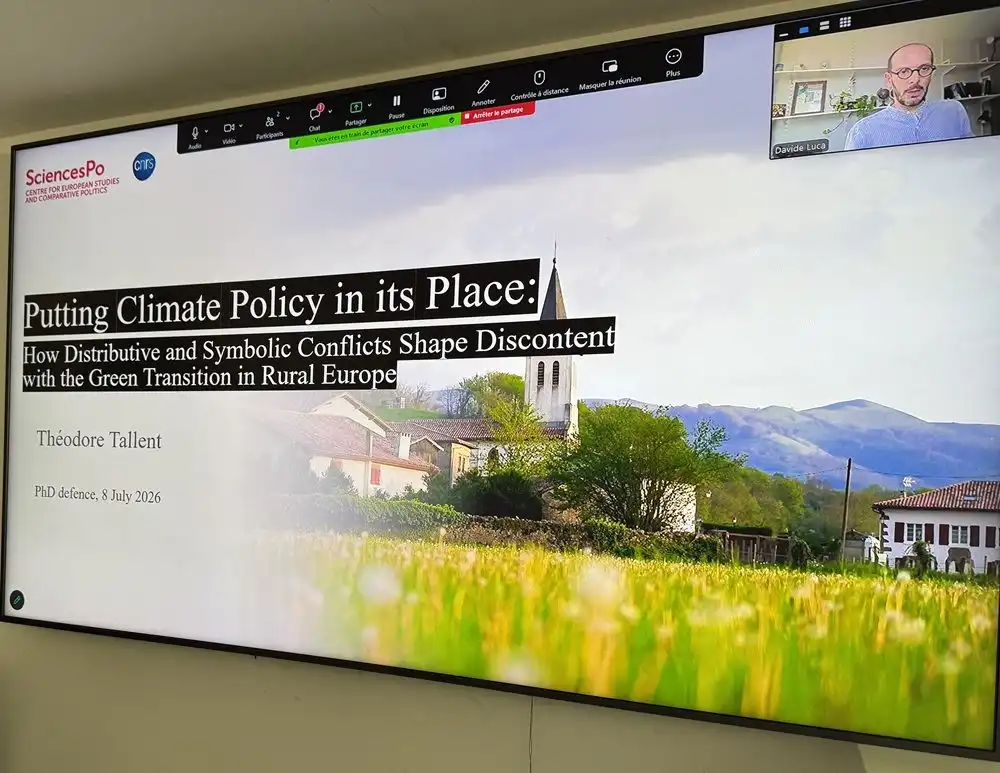
The thesis begins with a central question: is support for climate policies weaker in rural areas in Europe and, if so, why? It seeks to shift the focus away from individual variables alone (income, level of education, ideology, etc.) towards the places where people live, work, move about, and make sense of public policy. These places are, in fact, characterised by structural constraints (from the lack of certain infrastructures to a reliance on carbon-intensive jobs and industries), but also by shared representations, and both of these shape attitudes towards the green transition, as Théodore Tallent demonstrates in his thesis.
This thesis is based on a mixed-methods design, combining data from European and French surveys, survey experiments and interviews conducted in three rural areas in France.
It begins by highlighting a rural-urban divide in support for a range of climate policies in Europe, which is not solely a matter of social structure but rather of a potential contextual effect.
It then identifies two place-based sources of resistance to the green transition: on the one hand, distributive conflicts concerning the repercussions of climate policies – with some measures proving more costly or burdensome in rural areas, while also potentially coming into conflict with the local collective identity and sense of belonging. On the other hand, symbolic conflicts relating to the meaning of these policies: the way in which climate action is framed, conceived and formulated is perceived as distant, unfair and judgemental (ignoring or dismissing certain experiences, forms of knowledge and lifestyles).
Finally, the thesis shows that this symbolic dimension can be mobilised to strengthen support for climate action, for instance by signaling shared burden between the “people” and the elites.

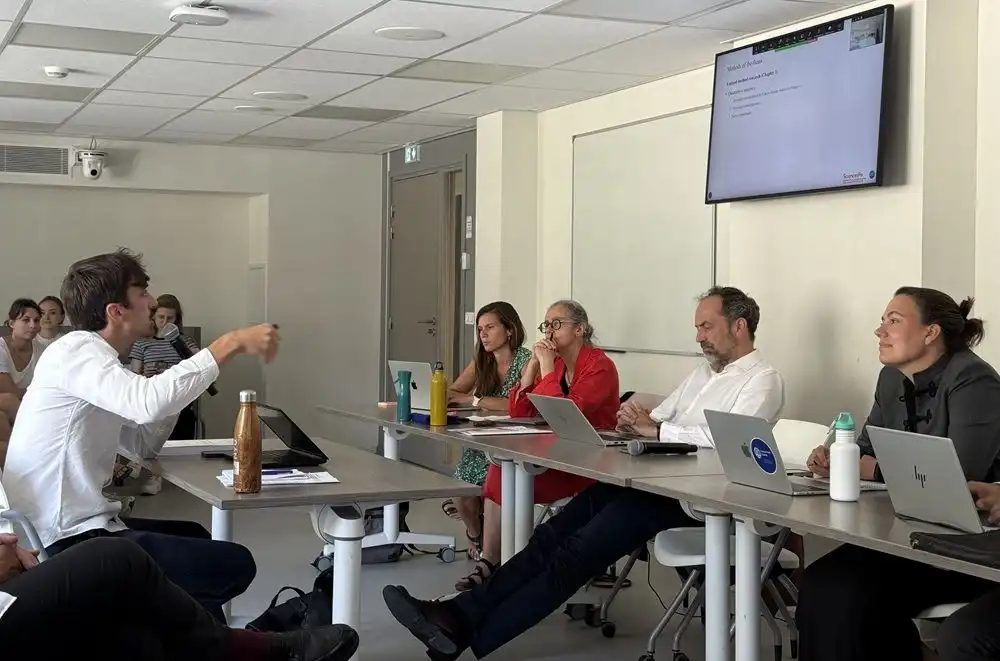
Théodore Tallent completed this thesis under a joint supervision arrangement between Sciences Po and the University of Cambridge, funded by a “Cifre” grant. During his PhD, he was committed to disseminating his research findings and the contributions of political science to inform the public debate on climate policies and the green transition. In addition to numerous media appearances, he also served as an expert adviser to a range of organisations, including various environmental NGOs.
Currently a Postdoctoral Research Associate at the Hertie School, in Berlin, he has been awarded a three-year postdoctoral fellowship from the Research Foundation - Flanders (FWO) to lead his own research project, entitled “The Politics of the Climate Backlash in Europe: Policy Vulnerability and the Politicisation of Discontent”, at the University of Antwerp (Belgium), starting in November 2026.