

Home>Congratulations to Luis Sattelmayer, new PhD graduate in political science


1 April 2026
Congratulations to Luis Sattelmayer, new PhD graduate in political science
Luis Sattelmayer just defended his PhD thesis, “Competition Between Equals: Mainstream Party Decline, Far-Right Evolution, and the Transformation of Party Competition in Western Europe”, which he wrote under the supervision of Jan Rovny. The defence committee also included Caterina Froio (Sciences Po, CEE), Etienne Ollion (CNRS & École polytechnique), Jae-Jae Spoon (University of Pittsburgh), and Markus Wagner (University of Vienna).
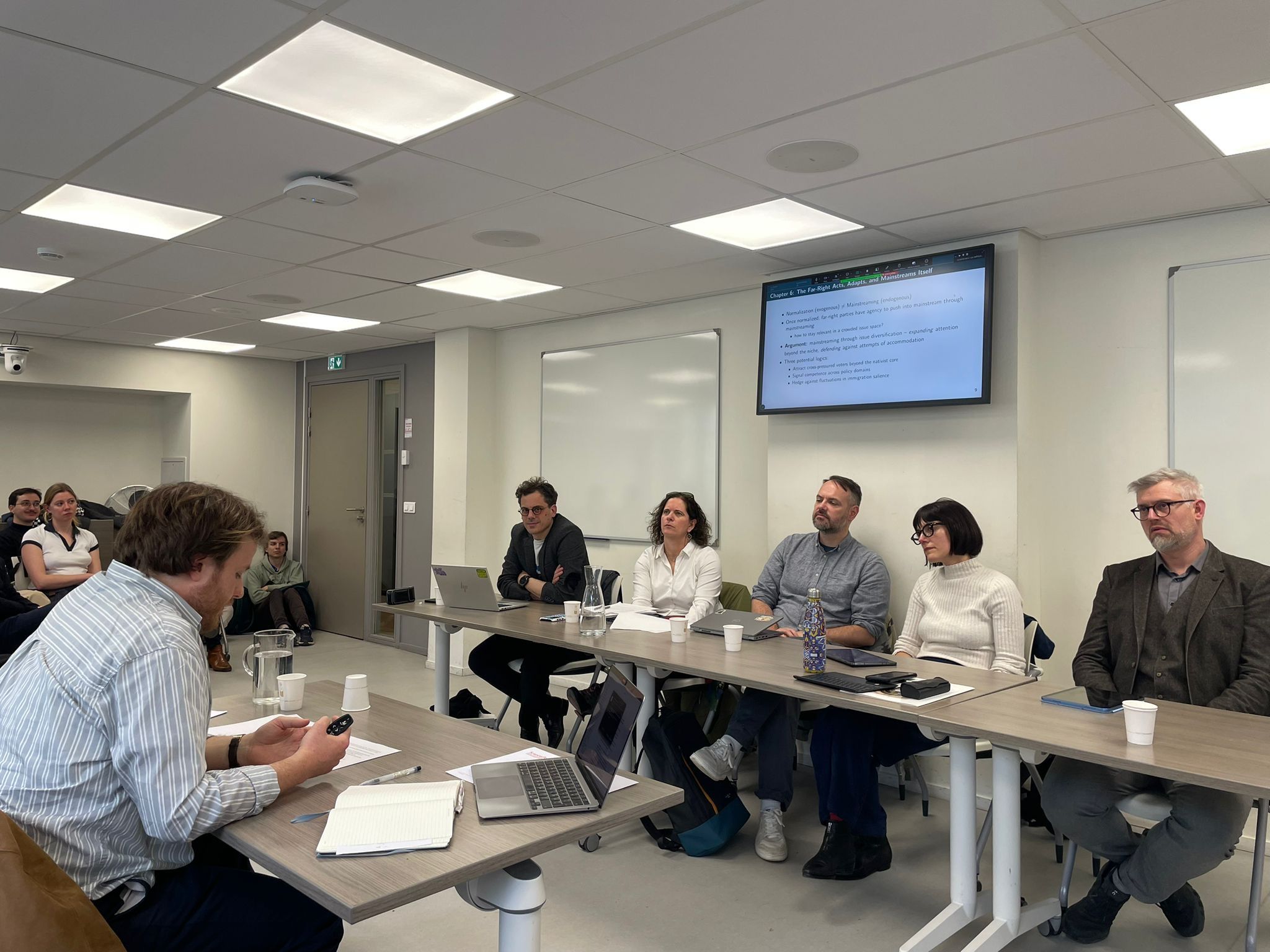
Luis Sattelmayer’s dissertation develops a supply-side account of mainstream party decline and far-right ascent in Western Europe. While existing explanations address the question of why far-right parties rise, less is known about how mainstream parties contribute to their own decline.
Luis Sattelmayer investigates this issue through the lens of party competition on immigration. He used cutting-edge computational social science methods and a novel dataset of party social media communication that he assembled with his fellow doctoral student Malo Jan (PartySOME) along with over one million tweets from German members of parliament and more traditional sources, such as the Chapel Hill Expert Survey and the German Longitudinal Election Study.
Across three empirical chapters, he shows that Western European party systems are shifting from a competition between unequals (where far-right parties were considered as niche actors) to a competition between equals.
First, he first demonstrates that mainstream parties’ divergent responses to the far-right’s core issue of immigration sustain high issue salience and drive vote switching to far-right competitors, thereby eroding mainstream support at the system level.
He then reveals that many mainstream parties are structurally ill-equipped to compete on cross-cutting cultural issues such as immigration. By conceptualising and measuring party positions as distributions rather than point estimates, he shows that mainstream parties’ communication on this issue is ambiguous and inconsistent, which depresses public support over time.
Turning to the far right, the third chapter reveals that, once normalised, these parties strategically diversify their issue agendas, broadening their appeal, increasing public support, and effectively transforming them into equal competitors to mainstream parties.
During the course of his PhD, Luis Sattelmayer was also involved in the European research project AUTHLIB. He has served as a doctoral representative at the centre’s board meetings and was a visiting doctoral researcher at the Centre Marc Bloch and at the WZB Berlin Social Science Center. He also co-authored an article in APSR with his fellow PhD students Théodore Tallent and Malo Jan and a dataset in Party Politics together with Malo Jan. He recently developed two new research agendas: one on visual descriptive representation that examines how parties strategically use images to signal inclusivity; another on the agency of political parties — that is, which aspects of their behaviour are strategic and which are accidental.
He will soon take up a postdoctoral position at the University of Innsbruck (Austria), within the “Group Appeals in Electoral and Parliamentary Debates” project, under the supervision of Hauke Licht.