The Art of Limits
In Un coup de hache dans la tête (2022), Professor Raphaël Gaillard demonstrates how psychological suffering does not fuel creation, even if, working through the gaps in their pain, it does not prevent some artists from creating major works. Following a similar approach—one that avoids romanticism while still acknowledging the unprecedented experiences born of constraint—Anne Picq and Thomas Schlesser present the proceedings of a symposium where physical disability is no longer an unspoken aspect of art history. Instead, it is examined as a decisive element of the creative process, a privileged lens through which to understand artists and the strenght derived from their limitations. They remind us that these issues are essential to our discipline, shaped as it is by a concern for beings and how they are represented.
Laurence Bertrand Dorléac et Thibault Boulvain
Thomas Schlesser and Anne Picq Art and disability
In an essay published in 2025 titled Sois un monde à toi-même, the writer Dominique Fernandez puts forward a bold idea in his final chapters. He examines the cases of four creators who became deaf—a poet, Ronsard; two musicians, Beethoven and Smetana; and a painter, Goya—and questions whether this deafness was truly a hardship they endured, or if they might have “welcomed it with a kind of gratitude,” or even “provoked it, deeming it essential to their work.” 1Dominique Fernandez, Sois un monde à toi-même, Philippe Rey, 2025, p. 108
Fernandez rightly emphasizes how the most powerful part of their work coincides with their experience of disability. He writes, for example: “Goya needed to isolate himself to achieve his greatest masterpieces, needed to become deaf to devote himself entirely to them.” 2Ibid, p. 111-112.
Among the late “greatest masterpieces” of the Spanish painter, art history naturally remembers above all the “Black Paintings”—those created in the “House of the Deaf” (with a surprising confusion: the house owed its name to the disability of its former owner, not to Goya himself). Among these “Black Paintings”, let us focus specifically on The Pilgrimage to the Hermitage of San Isidro 3See an analysis of the work in English and Spanish on the Museo del Prado website. Goya lost his hearing in 1792–1793, at the age of 46–47, and remained deaf until his death in 1828, at 82.. This fascinating work depicts a hallucinatory procession winding its way along the ridges of steep hills. What is meant to be a festive and religious moment is transformed, through Goya’s imagination, into a vision of extraordinary power and almost critical intensity. This crisis might be that of the tinnitus, the ringing in the ears that Goya suffered in addition to his deafness—an intrusive, piercing presence within the very silence.
It should be noted that the perspective proposed by Dominique Fernandez —desiring disability for creative purposes, invoking it as a poetic solution—must not lead us to a romanticized view of disability. We must avoid this perilous pitfall. Why? Simply because yielding to this romanticized view would render invisible the daily struggles of people who live with disabilities and who neither transcend nor transform them in any way through art.
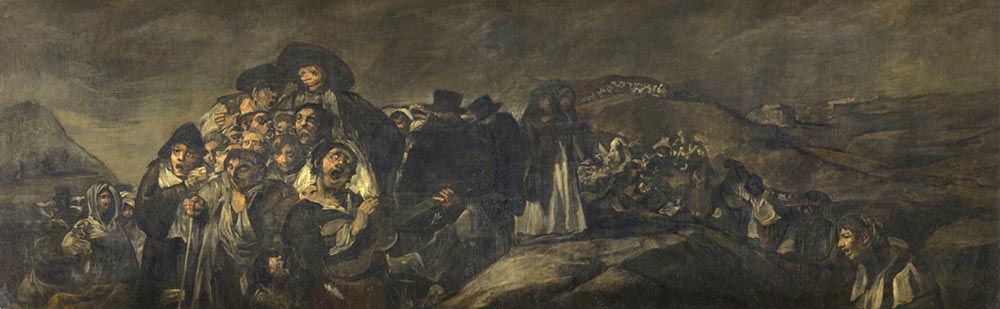
Fig. 1: Francisco de Goya y Lucientes, The Pilgrimage to San Isidro, 1820 – 1823, Mixed method on mural transferred to canvas, 436 cm x 138.5 cm, © Museo Nacional del Prado, Madrid.
Nonetheless, being aware of this risk should not deter us from an intellectual ambition: to understand how disability, in the diversity of its experiences, can contribute to the creative process.
Shifting validist narrative lines
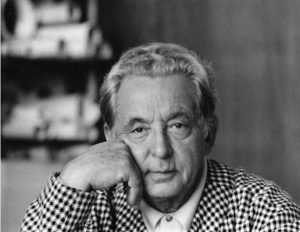
Fig.2.: Portrait of Hans Hartung. Caption: Portrait of Hans Hartung, 1971. Photograph by Anna-Eva Bergman. Archive of the Hartung-Bergman Foundation.
Exploring the connections between art and disability is a delicate balancing act, much like Goya’s Procession. The conference Art and Disabilities – Creation, Perception, and Representations from the Renaissance to the Contemporary Period 4See the full program of the Art and Disabilities conference on the Hartung-Bergman Foundation website.— held on December 3 and 4, 2025, in Paris—organized by the Hartung-Bergman Foundation in partnership with the National Institute for Blind Youth and the National Institute of Art History, initiated a collective effort aimed at uniting diverse energies in all their richness.
By taking this precarious path, we have attempted to shift the dominant narratives, particularly those that structure the history of art. These narratives are, as we know, hegemonically ableist 5Le Robert: “A system that makes able-bodied people the social norm. By extension, discrimination against people with disabilities.” Validism—or ableism—is a translation of the English term ableism. On this subject, see, for example, Paccaud, Laurent, “Validisme,” in B. Andrieu and G. Boetsch, Les mots de demain: Un dictionnaire des combats d’aujourd’hui (471-476), Atlande, 2024, or the resources from the exhibition En Dehors presented at CRAC Occitanie from 5 October 2024 to 5 January 2025 and all too often silence the ways in which some creators have integrated their disabilities into their artistic practice. Clearly, the major currents in art history do not sufficiently emphasize these decisive dimensions.
Fig.3. Hans Hartung’s Work. Caption: Hans Hartung, T1989-A7, 1989, acrylic on canvas, 185 x 300 cm. Collection of the Hartung-Bergman Foundation.
We are attempting to extend, deepen, and enrich the furrows that, however thin, already exist. In the Anglophone world since the 1970s, of course, with the emergence
of Disability Studies 6For a definition of Disability Studies, see Justine Madiot, Marion Doé, Charlotte Puiseux, Aurélie Damamme, and Patricia Paperman, “Disability Studies/Études critiques du handicap,” Dictionnaire du genre en traduction, May 24, 2021 : https://worldgender.cnrs.fr/notices/disability-studies-etudes-critiques-du-handicap/.—a field still too little known in France. In France, we must mention the extensive study published in 2021 under the direction of Nadeije Laneyrie-Dagen and Caroline Archat, Art at the Risk of Age, which included, among other case studies, a chapter on the historiography of infirmity in the work of Nicolas Poussin. Mickaël Szanto highlighted a major turning point in the 1990s, when Poussin’s hand tremors were finally recognized as a decisive element in understanding his work7See Nadeije Laneyrie-Dagen and Caroline Archat (eds.), L’art au risque de l’âge, CNRS Éditions, 2021..
Such revelations are far from trivial. They show that, throughout human history, many individuals with disabilities—especially in the arts, but beyond as well—have been extraordinarily visible for their achievements, while their disabilities have often been erased from the narratives constructed around them.
Making the Invisible Visible
Creating art history, whatever the means of dissemination— conferences, essays, exhibitions, documentaries, etc.—involves giving visibility to actors in the field of creation, actors who themselves prioritize making things visible. Consider Louis Marin, who questions the meanings of “representation” and speaks of a “redoubling” and an “intensification” of presence 8Louis Marin, “Le pouvoir et ses représentations,” Noroit, no. 249, May 1980, pp. 10–11..
Representation, in this sense, is obviously a tremendous factor in empowerment. “Representation and power are perhaps of the same nature,” Louis Marin asserts. In other words: art history gives visibility to those who work to make visible beings, things, facts, feelings, or concepts, because they believe these deserve more than what society ordinarily grants them.
Paul Cézanne understood this issue well; in 1867–1868, at the beginning of his career, he created a famous masterpiece. Cézanne painted a man with frail limbs, clearly atrophied in terms of muscle, seated facing forward; his left hand trembling 9Paul Cézanne, Achille Emperaire, 1867–1868, oil on canvas, 201.0 x 121.0 cm, Musée d’Orsay, Paris.. The model’s musculoskeletal disability is depicted through vigorous brushwork and thick impasto. Clearly, the armchair resembles a throne, similar to the one painted by Ingres for Napoleon I. And since Cézanne added a titulus at the top of the canvas with the model’s name, we read “Achille Emperaire Peintre,” a surname that, through paronomasia, evokes the word “emperor.” This portrait thus becomes a tribute to the creative strength of Achille Emperaire10Unfortunately, very few works by Achille Emperaire are known; see some examples preserved at the Musée Granet in Aix-en-Provence..
Looking at the portrait of Emperaire, how can one not think of the photographs of Hans Hartung in his studio? Hartung, who lost his leg on the front lines in 1944 while fighting for the Allies, and who was the author of a highly gestural body of work, spent the last years of his life in a wheelchair. Through the use of numerous tools—similar to prostheses—crafted with extraordinary ingenuity, he produced abstract works of remarkable expressiveness and intensity. When the scenography of the Hartung-Bergman Foundation in Antibes was designed for its public opening in 2022, there was significant reluctance to openly disclose the painter’s disability. This resistance, though well-intentioned, persisted in rendering the disability invisible. We, on the contrary, believed it was important to restore this truth, giving the wheelchair a central, tutelary place, or by showing the painter’s wooden leg.
“A wide variety of positive futures”
The conference on December 3 and 4, 2025, was founded on a core ambition: to consider disability as a creative force, rather than a limitation, obstacle, or hindrance. Organized around three axes—the poetic (in the original sense of creative transformation), the iconographic (its representations), and the aesthetic (the perception and reception of works)—it raised numerous critical questions, including: Can we reassess the work of an artist in light of their disability(ies)? How has disability been represented in the arts from the Renaissance to the present day, and how has this contributed to its visibility in and through society? How can we change current practices to better account for physical, sensory, mental, and psychological diversity in the presentation, interpretation, and reception of artworks, for example by engaging the senses and encouraging the participation of artists and audiences? How can we address the major challenges of accessibility and the promises of the aesthetics of access? 11For a definition of Access Aesthetics, see Diversity Arts Culture.
With the speakers and the audience present at the conference, we were able to identify inevitable gaps, blind spots, and avenues for further exploration. All of this will feed into the two-year interdisciplinary research program led by the Hartung-Bergman Foundation in 2026–2027.
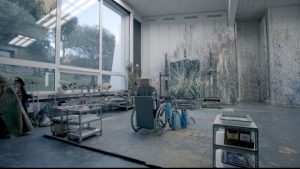
Fig. 4: Hartung’s Studio Caption: View of Hans Hartung’s studio, Antibes, Hartung-Bergman Foundation © Stanislas Valroff.
By allowing ourselves the necessary freedom and audacity, let us dare to draw an analogy between Hans Hartung and the contemporary American artist Christine Sun Kim 12Christine Sun Kim: All Day All Night exhibition at the Whitney Museum of American Art, New York, February 8–September 28, 2025. Born deaf, she seeks to materialize the physical and social perceptions of sound in plastic forms that combine gestural transcription of sign language, explanatory diagrams, musical scores, and abstract expressiveness. One can be struck by certain similarities with Hartung, despite a 50-year gap: similarities found in the depiction of minimalist semicircles or open arcs extending from a central axis, like geometrized bird wings 13Drawing on Aby Warburg’s concept of Nachleben, one could see a form of survival where two artists, facing different alterations—bodies that do not experience the same issues but share the experience of a world shaped by disability—develop graphic dynamics that sometimes seem to respond to each other..
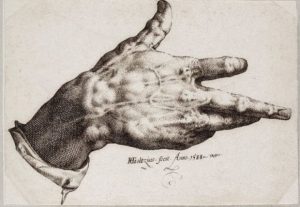
Fig.5: Hendrick Goltzius, Right Hand. Caption: Hendrick Goltzius, Goltzius’s Right Hand, 1588, pen and brown ink on paper, 23 x 32.2 cm, Teylers Museum, Haarlem.
In American Sign Language, the future is typically drawn with a fine line; Christine Sun Kim reinvents this line, giving it a thickness that immediately suggests it can carry far more meaning and affect than usual. She notes: “Thinking too much about the future can be overwhelming, especially in an uncertain political climate,” she explains, but doing so can offer a reminder “that there are a wide variety of positive futures for everybody to dive into.”
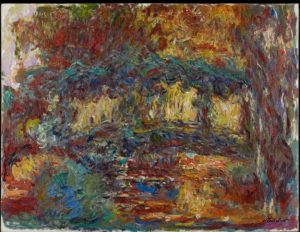
Fig.6: Monet The Japanese Bridge. Caption: Claude Monet, The Japanese Bridge, c. 1923–1925, oil on canvas, 89 x 116 cm, Minneapolis Institute of Art.
Again and always, the precarious path: a future that can sometimes be intimidating—but one that we can also expand and open up. It is up to us to transform this “too much future” into a shared space of possibilities and thought.
Notes
[1] Dominique Fernandez, Sois un monde à toi-même, Philippe Rey, 2025, p. 108.
[2] Ibid, pp. 111–112.
[3] See an analysis of the work in English and Spanish on the Museo del Prado website. Goya lost his hearing in 1792–1793, at the age of 46–47, and remained deaf until his death in 1828, at 82.
[4] See the full program of the Art and Disabilities conference on the Hartung-Bergman Foundation website.
[5] Le Robert: “A system that makes able-bodied people the social norm. By extension, discrimination against people with disabilities.” Validism—or ableism—is a translation of the English term ableism. On this subject, see, for example, Paccaud, Laurent, “Validisme,” in B. Andrieu and G. Boetsch, Les mots de demain: Un dictionnaire des combats d’aujourd’hui (471-476), Atlande, 2024, or the resources from the exhibition En Dehors presented at CRAC Occitanie from 5 October 2024 to 5 January 2025
[6] For a definition of Disability Studies, see Justine Madiot, Marion Doé, Charlotte Puiseux, Aurélie Damamme, and Patricia Paperman, “Disability Studies/Études critiques du handicap,” Dictionnaire du genre en traduction, May 24, 2021 : https://worldgender.cnrs.fr/notices/disability-studies-etudes-critiques-du-handicap/.
[7] See Nadeije Laneyrie-Dagen and Caroline Archat (eds.), L’art au risque de l’âge, CNRS Éditions, 2021.
[8] Louis Marin, “Le pouvoir et ses représentations,” Noroit, no. 249, May 1980, pp. 10–11.
[9] Paul Cézanne, Achille Emperaire, 1867–1868, oil on canvas, 201.0 x 121.0 cm, Musée d’Orsay, Paris.
[10] Unfortunately, very few works by Achille Emperaire are known; see some examples preserved at the Musée Granet in Aix-en-Provence.
[11] For a definition of Access Aesthetics, see Diversity Arts Culture.
[12] Christine Sun Kim: All Day All Night exhibition at the Whitney Museum of American Art, New York, February 8–September 28, 2025.
[13] Drawing on Aby Warburg’s concept of Nachleben, one could see a form of survival where two artists, facing different alterations—bodies that do not experience the same issues but share the experience of a world shaped by disability—develop graphic dynamics that sometimes seem to respond to each other.
Bibliography
Dominique Fernandez, Sois un monde à toi-même, Philippe Rey, 2025.
Yves Sarfati, De l’inconscient à l’abstraction – Le cas Hartung, Les presses du réel, 2025.
Pierre Wat, Hans Hartung, La peinture pour mémoire, Hazan, 2019.
Andreas Beyer, Le Corps de l’artiste. L’empreinte oubliée de la vie dans l’art, Actes Sud, 2024.
Emma Cauvin, Matthieu Léglise, and Pierre Wat, Les Nymphéas de Claude Monet – Une anthologie critique, CNRS Editions, 2021.
Eva Fotiadi (ed.), Exhibiting for Multiple Senses: Art and Curating for Sensory-Diverse Bodies, Valiz, 2025.
Ann Millett-Gallant and Elizabeth Howie, Disability and Art History from Antiquity to the Twenty-First Century, Routledge, 2022.
Amanda Cachia, Creative Access: Disability Art Activism and Curating Accommodation, Routledge, 2022.
Sarah Heussaff, “Disability Arts − Arts handicapés. Définitions d’histoires en mouvement(s),” Multitudes, 2024.
Thomas Schlesser is the Director of the Hartung-Bergman Foundation and a professor at École Polytechnique. A specialist in Gustave Courbet, to whom he has devoted numerous works, he is also the author of several essays and biographies, including L’Art face à la censure (Beaux-Arts éditions, 2011, reissued 2019), L’Univers sans l’homme – les arts contre l’anthropocentrisme (Hazan, 2016), Faire rêver – du rêve des Lumières au cauchemar publicitaire (Gallimard, 2019), and Anna-Eva Bergman – Vies lumineuses (Gallimard, 2022). He is also a documentary filmmaker and exhibition curator. His second novel, Les Yeux de Mona, earned him the “Author of the Year” award in 2025.
Anne Picq works at the intersection of art, education, and social innovation. She was deputy editor-in-chief of Beaux-Arts Magazine and then Head of Audiences at the Musée du Quai Branly-Jacques Chirac in Paris. She now teaches at the university and in continuing education, and as an independent professional, she develops projects aimed at making art accessible to new audiences. With Thomas Schlesser, she co-directed the international conference Art and Disabilities (December 3–4, 2025) and is leading the research program conducted in 2026–2027 by the Hartung-Bergman Foundation on this theme. She co-authored New York, au cœur de la création contemporaine (Les Ateliers Henry Dougier, 2022) with Aude Adrien.