
Home>Overcoming Policy Fragmentation: Towards Increased Policy Coherence Through the European Green Deal?


31 August 2026
Overcoming Policy Fragmentation: Towards Increased Policy Coherence Through the European Green Deal?
By Marius Wallstein
Abstract
The European Green Deal was shaped by the European Commission as an integrated agenda for a climate neutral economy, breaking up the formerly isolated (‘siloed') mentality of policymaking and promoting policy coherence across connected fields. Employing a text-as-data approach, this paper conducts two related keyword frequency analyses on data from National Energy and Climate Plans, as well as Environment Council Conclusions on UNFCCC COP negotiation mandates. The findings show that Green Deal-related issues have become increasingly salient in the climate policy of EU Member States following the publication of the European Green Deal, hinting towards a more integrated climate policymaking. This paper contributes to research on policy coherence and policy fragmentation, as well as on the implementation of EU sustainability policy.
Introduction
On 11 December 2019, the European Commission published the “European Green Deal” (EGD), a communication outlining pathways to combine climate neutrality while promoting economic prosperity and environmental sustainability (EC, 2019). While it is unremarkable for political leaders to undertake large-scale key projects, the EGD is unique in its comprehensive and cross-sectoral nature. It integrates climate, environmental protection, agriculture, energy, finance, and social justice into one overarching framework. In doing so, it represents not only a new policy agenda, but also a profound shift in the logic of policymaking in the European Commission (EC). Its implementation depends on a broad range of actors, including the distinct efforts of national administrations (Hustedt & Seyfried, 2015, p. 890).
Yet, improving policy coherence in these areas is beneficial for addressing their interdependencies and promoting livelihoods within the EU and beyond, especially since climate change and environmental degradation are widely recognized as drivers of conflicts (Froese & Schilling, 2019; Paleari, 2024; Rasmus et al., 2024; Stefanis et al., 2024; Weitz et al., 2017). In this context, it is a timely inquiry to ask: “How have references to key policy areas covered by the European Green Deal evolved in climate action strategies of EU Member States (EUMS) after the publication of the EGD?”
To address this question, I examine the EGD in relation to the literature on policy coherence and policy fragmentation in European and national administrations. Methodologically, I employ a text-as-data approach, tracing changes in keyword salience in National Energy and Climate Plans (NECPs) as well as Environment Council Conclusions on UNFCCC COP negotiations to identify how the discourse has changed over time. The findings of this analysis suggest that, following the publication of the EGD, Green Deal-related policy issues have become increasingly salient in EUMS’ climate strategies, although to differing degrees. Overall, this blog post contributes to research on policy coherence and policy fragmentation, as well as the implementation of EU sustainability policy.
Theoretical Background: Overcoming Policy Coherance
In the overarching field of environmental policy, the EC traditionally pursued a ‘siloed approach’, treating issue areas such as biodiversity, climate change and circular economy as separate spheres (Paleari, 2024). Prior to the EGD, the EC’s policymaking in these areas resembled national bureaucracies by operating in a form of “negative coordination”, where the responsible unit initiates the coordination process by circulating a draft to affected units for comments and amendments in their respective field of competence (Bürgin, 2023; Hustedt & Seyfried, 2015). Hence, policies are scoped in substance by the dominant view of the lead organizational unit and subsequently narrowed down, making them typically limited in scope. Because of this bureaucratically enacted 'narrow-down' effect, large grand-scale reform plans to overhaul complete policy areas were rare (Hustedt & Seyfried, 2015).
In the literature, siloed structures in public administrations are regarded as central obstacles to policy coherence efforts, both horizontally across ministries and agencies, as well as vertically between European, national and subnational levels. At the European level, this includes difficulties stemming from fragmented Directives and their uneven implementation across EUMS. Nationally, siloed decision-making arises from sector-specific accountability systems, competing priorities among ministries and agencies, and limited incentives for cross-sectoral cooperation. Contrarily, institutional champions and robust enforcement mechanisms are regarded as crucial drivers of policy coherence. Yet, in the absence of external intervention through, for instance, public initiatives, EU Directives, or committed policymakers, the constraints in (national) government action through these institutional barriers remain (Adelle & Russel, 2013; Dzebo et al., 2025).
Over the last decade, however, the silo-mentality has been increasingly challenged by the ‘Nexus’ perspective, which seeks to treat the various areas it brings together on roughly equal terms. It highlights the interlinkages, trade-offs, and synergies across resource sectors such as water, food, and energy, as well as broader socio-ecological issues like climate change and economic growth already at the policy planning stage (Paleari, 2024). In this vein, the EC under the leadership of Ursula von der Leyen attempted to counter policy fragmentation through the comprehensive approach of the EGD. Paleari (2024) finds evidence of an emerging Climate-Biodiversity-Circular Economy Nexus within the EC, as these policy areas increasingly inform one another during the drafting of proposals under the EGD’s framework, though climate remains the dominant reference point.
Nevertheless, despite this movement toward greater coherence, governance remains a core obstacle to implementing Nexus approaches. Integrated policies and addressing trade-offs across sectors are fundamentally political, requiring negotiation among actors with distinct perceptions, interests, and practices; and information provision alone does not drive policy change (Kurian, 2017; Weitz et al., 2017). Policy coherence under the EGD should, therefore, not be understood as a fixed outcome but as an ongoing and contested learning process (Paleari, 2024). Yet, it remains unclear if and to what extent EUMS have adopted a similar approach towards more integrated policymaking.
Data and Operationalisation
The analysis consists of two complementary frequency analyses focusing on keyword salience. The first is based on NECPs, through which EUMS outline their policy plans to achieve the 2030 climate and energy targets. Two sets of documents exist: one pre-Green Deal (draft NECPs submitted by end of 2018 and final NECPs by end of 2019) and one post-Green Deal (updated draft and final NECPs submitted between 2023 and 2024). The analysis covers draft NECPs (n = 51), the EC’s official recommendations (n = 108), and final NECPs (n = 51). It must be noted that France’s draft NECP is not available in English, and Poland has not yet submitted its updated final NECP (EC, n. d.).
The second analysis complements the first as it is based on the Environmental Council Conclusions on UNFCCC COP negotiations (n = 10). This allows for identifying time trends across EUMS, since these negotiation mandates have to be adopted unanimously by the Council (Biedenkopf, 2015). The documents cover the time from 2015 (adoption of the Paris Agreement) until 2025. The overall assumption of both analyses is that the relative mention of keywords related to the Green Deal increases in the post-Green Deal period, reflecting an increase in cross-issue consideration.
The analytical categories focus on issue areas covered by the EGD that are not directly linked to climate change and energy in order to avoid conflating EGD-specific trends with pre-existing priorities of earlier Commission agendas (Ullrichova, 2025). The following five categories are analysed: (1) Nature, (2) Circular Economy, (3) Pollution, (4) Just Transition, and (5) Agrifood.
The keywords were selected by manually narrowing down used expressions from broad to more specific terms, with Circular Economy, Pollution, and Just Transition coded only with exact references to the concepts given their less intrinsic links with the climate regime. As the approach cannot capture context or sentiment, this analysis focuses on keyword salience as a proxy for policy integration in line with Huber et al. (2025), who consider increased salience as a facilitator of policy integration and policy coherance, alongside political leadership.
Findings
Evidence from NEPCs
Overall, relative keyword mentions increased across all document types and categories from pre- to post-Green Deal, except for Pollution (in EC recommendations and final NECPs) and Circular Economy (in EC recommendations) (see Figure 2 and Table 1).

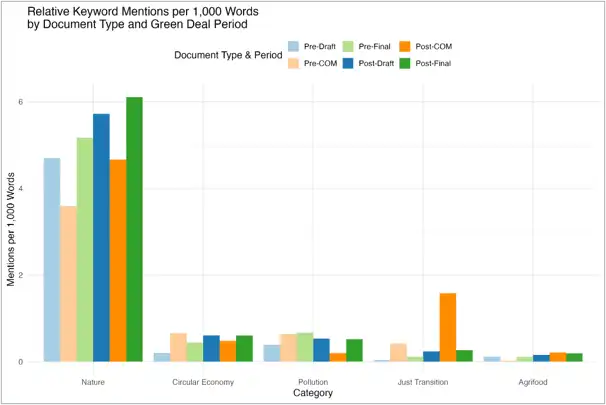
Note: The graphs represent the mean of per-document normalized values per 1000 words. The analysis is divided in a pre- and a post-Green Deal period, whereas the ‘Draft’ documents refer to the draft NECPs, ‘Final’ documents refer to final NECPs, and ‘COM’ documents refer to the EC’s Recommendations. This figure is based on EUMS’ NECP data (EC, n. d.)
Regarding draft NECPs, the increase could be an indicator that EUMS have begun to more intrinsically consider EGD-related issues in their national policymaking. However, this requires further investigation. Turning to final NECPs, they could be expected to have relatively more keyword mentions compared to the draft versions for each period, since they are, by nature, not finite and subject to the recommendations of the EC. In the post-Green Deal period, this increase can be observed for Nature, Just Transition, and Agrifood, but not for Circular Economy and Pollution, where mentions have remained relatively stable with only a small decrease in relative mentions. Regarding the latter, it can be seen that the EC also issued fewer recommendations on these issues, possibly due to the qualitatively sufficient nature of inclusion of these issues in draft NECPs. However, as this analysis cannot provide an in-depth explanation of why this drop has occurred, further research is needed to investigate this decrease in attention among both actors.

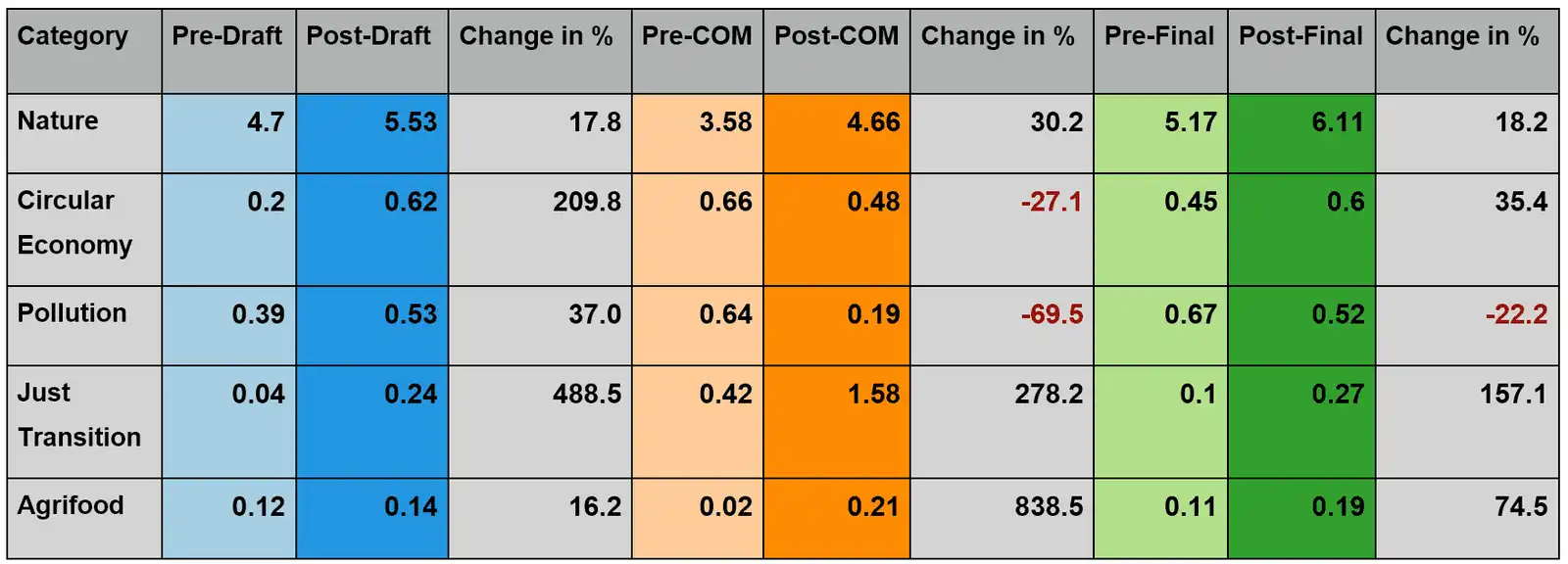
These findings are largely in line with expectations, with EGD-relevant issues increasingly finding their way into the national climate policies of EUMS. However, the decrease in Pollution by both the EC and EUMS, as well as the decrease in Circular Economy recommendations, require further investigation.
While these findings suggest that the average NECP has become “greener” after the Green Deal was published, they do not reflect developments at the individual Member State level. Moreover, the aggregated analysis does not account for different baselines of EUMS towards the integration of non-climate issues in the climate regime before the publishing of the EGD. Another limitation of this analysis is that it does not account for time trends, treating the documents only as a pre-Green Deal and a post-Green Deal group. However, this shortcoming will be addressed in the subsequent analysis of Environment Council Conclusions.
Evidence from Environment Council Conclusions
Regarding developments in the Council, Figure 3 shows different trends for the analytical categories, each requiring individual attention.

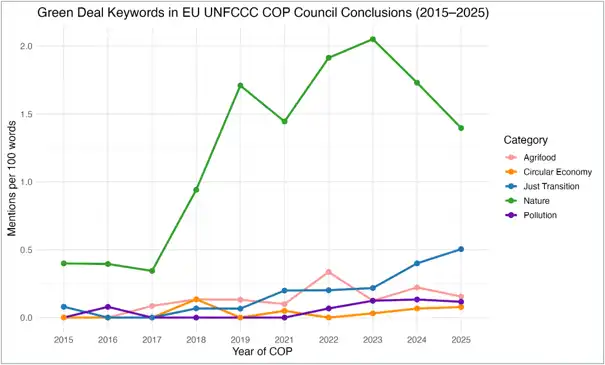
Note. The graphs represent the mean of per-document normalized values per 100 words. 2020 is omitted in the analysis since COP26 was postponed to 2021. The Figure is based on data from UNFCCC Environment Council Conclusions (2015-2025).
In the Nature category, mentions increased substantially from about 0.34 to 0.94 mentions per 100 words between 2017 and 2018, and further to 1.71 mentions per 100 words in 2019. One possible explanation is that in 2018, the first negotiations under the Paris Agreement took place, which (unlike the UNFCCC and the Kyoto Protocol) includes provisions specifically related to nature in Article 5 (La Viña & De Leon, 2015; UN, 2015). However, this link needs to be confirmed in subsequent research.
The 2019 increase may also reflect the salience of Nature-related issues following the European Elections and growing civil society pressures like Fridays for Future (Braun & Schäfer, 2022; Huber et al., 2025). The subsequent decrease in 2021 might be attributable to the COVID-19 crisis (Dupont et al., 2020; Lokmic-Tomkins & Bone, 2024), while the decline in 2024 and 2025 reflects a broader shift in EU priorities towards competitiveness and security following the 2024 European elections (von der Leyen, 2024). Overall, mentions in 2022 and 2023 are consistent with expectations, and remain considerably higher than pre-Green Deal levels.
Agrifood mentions remained relatively stable, with a spike in 2022 attributable to the reform of the EU’s Common Agricultural Policy and the Koronivia Joint Work on Agriculture (KJWA) within the UNFCCC (Council of the EU, 2022). This spike was not followed by a sustained increase, contrasting with the upward trend observed in NECPs. A key limitation here is that the Council Conclusions analysis cannot disentangle EGD-specific trends from the agenda of international climate negotiations more broadly. Nevertheless, as the trend is relatively stable, it is possible to consider the positive shift on the national level as evidence of an increased consideration of Agrifood-related issues by EUMS after the Green Deal.
Circular Economy was mentioned for the first time in 2018, referring to the welcoming of the EU Action Plan for the Circular Economy (Council of the EU, 2018), and gained traction from 2023 onwards, reaching about 0.08 mentions per 100 words in 2025. While absent in 2019 and 2022, the qualitative content of mentions increasingly underlines the need for a global transition towards circular and resource-efficient economies (Council of the EU, 2021), suggesting growing integration in line with expectations.
Pollution was first mentioned in 2022 with increasing mentions in subsequent years reaching about 0.12 mentions per 100 words in 2025, in line with expectations. This contrasts with the decrease observed in final NECPs, which may reflect sufficient attention already given to the issue in draft NECPs and warrants further investigation.
Just Transition was first mentioned in 2015 and 2018 in reference to workforce transitions under the Paris Agreement (Sabato & Fronteddu, 2020; UN, 2015), and has witnessed a steady increase since. However, its upward trend is difficult to attribute clearly to the EGD, as the establishment of the Just Transition Work Programme at COP27 in 2022 (Council of the EU, 2023) and the EU’s Just Transition Mechanism (Sarkki et al., 2022) overlap in time. Further research is needed to disentangle these parallel developments.
In summary, combining the insights from both analyses suggests limited empirical evidence of a shift by EUMS towards more coherent climate policymaking. However, keyword-based text analysis cannot capture context, sentiment, or the origin of mentions, and further qualitative work is needed to determine the degree of policy integration causally attributable to the EGD. Future analyses should also integrate additional national and international strategy documents beyond NECPs to obtain a more comprehensive picture.
Conclusion
The aim of this analysis was to address the question of how references to key EGD-related issues have evolved in climate action strategies of EU Member States after the publication of the EGD, drawing on data from NECPs and Environment Council Conclusions. By tracing changes in keyword salience and accounting for document length, I found limited empirical evidence that Green Deal-related issues have become increasingly salient in national and international climate policies of EUMS, hinting towards a more integrated climate policymaking.
Regarding NECPs, the analysis showed that the average NECP has become “greener” with increasing references to Nature, Just Transition, Circular Economy, and Agrifood after the publication of the EGD, while Pollution references decreased. However, these findings cannot speak for changes on the national level, which is an avenue for further research. Turning to Environment Council Conclusions, references to Nature, Circular Economy, Just Transition and, contrary to NECPs, Pollution increased after the publishing of the EGD. Agrifood mentions remained relatively stable. It remains unclear to what extent these tendencies are attributable to the Green Deal as they are also influenced by the agenda of international climate negotiations. Therefore, further research should focus on the exact dynamics that shape the Council’s substantive position for these negotiations.
Lastly, the recent decline in Nature references in Environment Council Conclusions after 2023 raises questions about shifting political priorities and the durability of integrated environmental policymaking. Understanding whether this decline is temporary or structural will be key for assessing how firmly broader environmental policy integration has been embedded through the EGD. How new priorities influence or undermine this approach will determine the future coherence of EU environmental governance.
Bibliography
Adelle, C., & Russel, D. (2013). Climate Policy Integration: A Case of Déjà Vu? Environmental Policy and Governance, 23(1), 1–12. https://doi.org/10.1002/eet.1601
Biedenkopf, K. (2015). The European Parliament in EU External Climate Governance. In S. Stavridis & D. Irrera (Eds), The European Parliament and Its International Relations (pp. 92-108). Routledge.
Braun, D., & Schäfer, C. (2022). Issues that Mobilize Europe. The Role of Key Policy Issues for Voter Turnout in the 2019 European Parliament Election. European Union Politics, 23(1), 120–140. https://doi.org/10.1177/14651165211040337
Bürgin, A. (2023). The European Commission: A Climate Policy Entrepreneur. In T. Rayner, K. Szulecki, A. J. Jordan, & S. Oberthür (Eds), Handbook on European Union Climate Change Policy and Politics (pp. 23–37). Edward Elgar Publishing. https://doi.org/10.4337/9781789906981.00013
Council of the European Union. (2017). Council conclusions on the Paris Agreement and preparations for the UNFCCC meetings. https://www.consilium.europa.eu/en/press/press-releases/2017/10/13/conclusions-paris-agreement-and-unfccc-meetings/pdf/
Council of the European Union. (2018, October 9). Preparations for the UNFCCC meetings in Katowice (2—14 December 2018)—Council conclusions. https://www.consilium.europa.eu/media/36619/st12901-en18.pdf
Council of the European Union. (2019, October 9). Preparations for the United Nations Framework Convention on Climate Change (UNFCCC) meetings (Santiago de Chile, 2-13 December 2019) ‒ Council conclusions. https://data.consilium.europa.eu/doc/document/ST-12796-2019-REV-1/en/pdf
Council of the European Union. (2021, October 6). Preparations for the United Nations Framework on Climate Change (UNFCCC) meetings (Glasgow, 31 October—12 November 2021) ‒ Council conclusions. https://data.consilium.europa.eu/doc/document/ST-12594-2021-INIT/en/pdf
Council of the European Union. (2022, October 24). Preparations for the 27th Conference of the Parties (COP 27) of the United Nations Framework Convention on Climate Change (UNFCCC) (Sharm El-Sheik, Egypt, 6-18 November 2022) ‒ Council conclusions. https://www.consilium.europa.eu/media/59789/st13994-en22.pdf
Council of the European Union. (2023, October 17). Preparations for the 28th Conference of the Parties (COP28) of the United Nations Framework Convention on Climate Change (UNFCCC) (Dubai, 30 November – 12 December 2023)—Council conclusions. https://data.consilium.europa.eu/doc/document/ST-14285-2023-INIT/en/pdf
Council of the European Union. (2024, October 14). Preparations for the 29th Conference of the Parties (COP29) of the United Nations Framework Convention on Climate Change (UNFCCC) (Baku, 11-22 November 2024) ‒ Council conclusions. https://data.consilium.europa.eu/doc/document/ST-14459-2024-INIT/en/pdf
Council of the European Union. (2025, October 21). Preparation for the 30th Conference of the Parties (COP30) of the United Nations Framework Convention on Climate Change (UNFCCC) (Belém, Brazil, 10-21 November 2025)—Council Conclusions. https://data.consilium.europa.eu/doc/document/ST-14310-2025-INIT/en/pdf
Dupont, C., Oberthür, S., & Von Homeyer, I. (2020). The Covid-19 Crisis: A Critical Juncture for EU Climate Policy Development? Journal of European Integration, 42(8), 1095–1110. https://doi.org/10.1080/07036337.2020.1853117
Dzebo, A., Shawoo, Z., & Browne, K. (2025). Does Policy Coherence Make National Implementation of Global Sustainability Agendas More Successful? Annual Review of Environment and Resources, 50(1), 539–562. https://doi.org/10.1146/annurev-environ-111523-102337
European Commission (EC). (2019, December 11). Communication from the Commission: The European Green Deal. https://eur-lex.europa.eu/legal-content/EN/TXT/?uri=CELEX%3A52019DC0640
European Commission (EC). (n. d.). National Energy and Climate Plans. https://commission.europa.eu/energy-climate-change-environment/implementation-eu-countries/energy-and-climate-governance-and-reporting/national-energy-and-climate-plans_en
Froese, R., & Schilling, J. (2019). The Nexus of Climate Change, Land Use, and Conflicts. Current Climate Change Reports, 5(1), 24–35. https://doi.org/10.1007/s40641-019-00122-1
Huber, S., Goyal, N., Hoppe, T., & Metze, T. (2025). How Issue Salience and Political Leadership Facilitate Policy Integration: The Adoption of the Energy Performance of Buildings Directive in the European Union. Policy Sciences. https://doi.org/10.1007/s11077-025-09592-7
Hustedt, T., & Seyfried, M. (2015). Co-ordination Across Internal Organizational Boundaries: How the EU Commission Co-ordinates Climate Policies. Journal of European Public Policy, 23(6), 888–905. https://doi.org/10.1080/13501763.2015.1074605
Klein, D., Carazo, M. P., Doelle, M., Bulmer, J., & Higham, A. (Eds). (2017). The Paris Climate Agreement: Analysis and Commentary. Oxford University Press.
Kurian, M. (2017). The Water-Energy-Food Nexus. Environmental Science & Policy, 68, 97–106. https://doi.org/10.1016/j.envsci.2016.11.006
La Viña, A. G. M., & De Leon, A. (2017). Conserving and Enhancing Sinks and Reservoirs of Greenhouse Gases, including Forests (Article 5). In D. Klein, M. P. Carazo, M. Doelle, J. Bulmer, & A. Higham (Eds), The Paris Agreement on Climate Change (1st edn, pp. 166–177). Oxford University Press. https://doi.org/10.1093/law/9780198789338.003.0010
Lokmic-Tomkins, Z., & Bone, A. (2024). Global Health and Climate Action: Achievements and Imperatives from COP28. Public Health Research and Practice, 34(2), e3422412. https://doi.org/10.17061/phrp3422412
Paleari, S. (2024). The EU Policy on Climate Change, Biodiversity and Circular Economy: Moving Towards a Nexus Approach. Environmental Science & Policy, 151(103603). https://doi.org/10.1016/j.envsci.2023.103603
Rasmus, S., Yletyinen, J., Sarkki, S., Landauer, M., Tuomi, M., Arneberg, M. K., Bjerke, J. W., Ehrich, D., Habeck, J. O., Horstkotte, T., Kivinen, S., Komu, T., Kumpula, T., Leppänen, L., Matthes, H., Rixen, C., Stark, S., Sun, N., Tømmervik, H., … Eronen, J. T. (2024). Policy Documents Considering Biodiversity, Land Use, and Climate in the European Arctic Reveal Visible, Hidden, and Imagined Nexus Approaches. One Earth, 7(2), 265–279. https://doi.org/10.1016/j.oneear.2023.12.010
Rayner, T., Szulecki, K., Jordan, A. J., & Oberthür, S. (Eds). (2023). Handbook on European Union Climate Change Policy and Politics. Edward Elgar Publishing.
Sabato, S., & Fronteddu, B. (2020). A Socially Just Transition through the European Green Deal? (Working Paper 2020.08). european trade union institute (ETUI). http://dx.doi.org/10.2139/ssrn.3699367
Sarkki, S., Ludvig, A., Nijnik, M., & Kopiy, S. (2022). Embracing policy paradoxes: EU’s Just Transition Fund and the aim “to leave no one behind”. International Environmental Agreements: Politics, Law and Economics, 22(4), 761–792. https://doi.org/10.1007/s10784-022-09584-5
Stavridis, S., & Irrera, D. (Eds). (2015). The European Parliament and Its International Relations. Routledge. https://doi.org/10.4324/9781315713984
Stefanis, C., Stavropoulos, A., Stavropoulou, E., Tsigalou, C., Constantinidis, T. C., & Bezirtzoglou, E. (2024). A Spotlight on Environmental Sustainability in View of the European Green Deal. Sustainability, 16(11), 4654. https://doi.org/10.3390/su16114654
Ullrichova, E. (2025). New Intergovernmentalism: European Council and Environmental Policy. Journal of European Integration, 47(5), 703–724. https://doi.org/10.1080/07036337.2024.2411238
United Nations (UN). (2015). Paris Agreement. https://unfccc.int/sites/default/files/english_paris_agreement.pdf
von der Leyen, U. (2024, July 18). Europe’s Choice: Political Guidelines for the next European Commission 2024-2029. European Commission. https://commission.europa.eu/document/download/e6cd4328-673c-4e7a-8683-f63ffb2cf648_en?filename=Political%20Guidelines%202024-2029_EN.pdf
Weitz, N., Strambo, C., Kemp-Benedict, E., & Nilsson, M. (2017). Closing the Governance Gaps in the Water-Energy-Food Nexus: Insights from Integrative Governance. Global Environmental Change, 45, 165–173. https://doi.org/10.1016/j.gloenvcha.2017.06.006