
Home>Fostering the Future of Green Finance: A Look Back at the Green Finance Challenge 2025 with HSBC Continental Europe


10 March 2026
Fostering the Future of Green Finance: A Look Back at the Green Finance Challenge 2025 with HSBC Continental Europe
The latest Green Finance Challenge has come to an end! For the third year in a row, the European Chair for Sustainable Development and Climate Transition had the great pleasure of organising the Green Finance Challenge in partnership with HSBC Continental Europe. This innovative and practical challenge brought together 40 students from Sciences Po’s Paris School of International Affairs (PSIA) and École d’Affaires Publiques (EAP). Working together in teams over the last three months, the students received close mentoring by HSBC Continental Europe experts, to tackle pressing challenges in sustainable finance.

Bridging Theory and Practice in Green Finance
The Green Finance Challenge was designed to provide students with hands-on experience in sustainable finance by examining real-world issues. Each group was assigned a theme and worked closely with HSBC Continental Europe mentors to produce a report on their findings. Students not only gained technical knowledge, but also had the opportunity to deepen their understanding of financial sustainability, regulatory frameworks, and investment strategies.
Group 1: Building diversified investment portfolios.
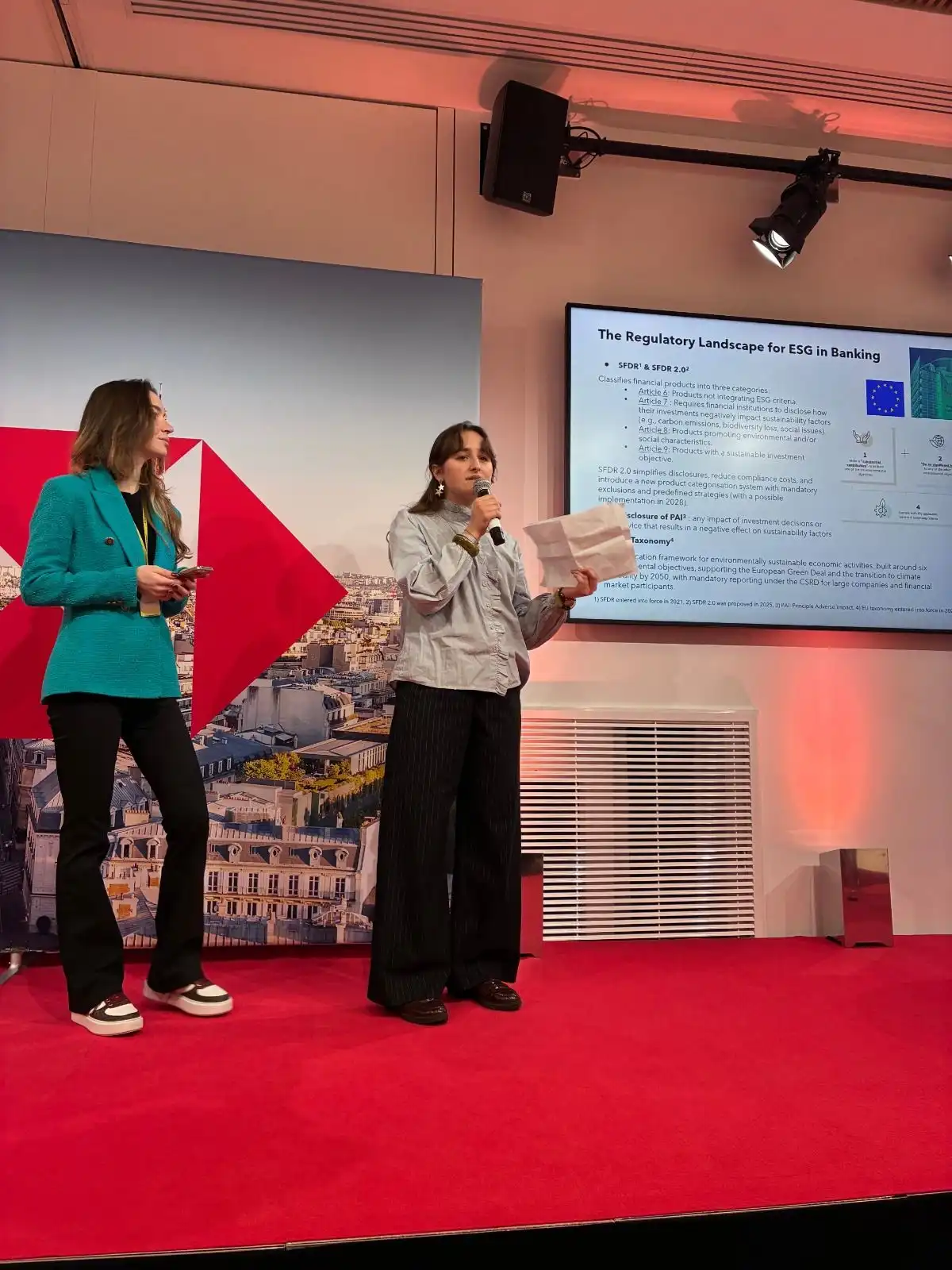
The first group of students explored how to build diversified investment portfolios that embed ESG commitments and evaluate how investments perform across different market cycles.
The students’ analysis consists of two parts. The first, qualitative part examines how peer banks build, present, and market their ESG investment offerings to clients. Students situated ESG within the broader banking context, covering the frameworks guiding ESG reporting, the state of ESG today and investing solutions, and the regulatory landscape, with a particular focus on the SFDR, PAI indicators, and the EU Taxonomy. This was complemented by an extensive review of competitive ESG offerings across six peer bank case studies. Secondly, the group conducted a quantitative analysis examining how ESG investments perform compared to non-ESG investment over the market cycle. They showed how methodological choices embedded in ESG index construction affect portfolio composition, ESG characteristics, and ultimately financial performance. In doing so, they demystify the underperformance of ESG equity indices. Their analysis focused on three ESG equity indices with distinct objectives and methodologies, each compared to their respective reference benchmarks to assess both ESG outcomes and performance behaviour. Their findings make a compelling case that ESG equity indices cannot be evaluated on the basis of headline performance comparisons alone.
Students involved: Uswah E Fatima, Teodora Radenovic, Emilie Carvallo, Gemma Giacomazzi, Elio Chessé, Isabelle Bensmail, Vilius Raisuotis, Kenza Zakarya, Nicolas Delagoutte, Germinal Montané

Group 2: Benchmarking the competitive ecosystem around Climate Tech.
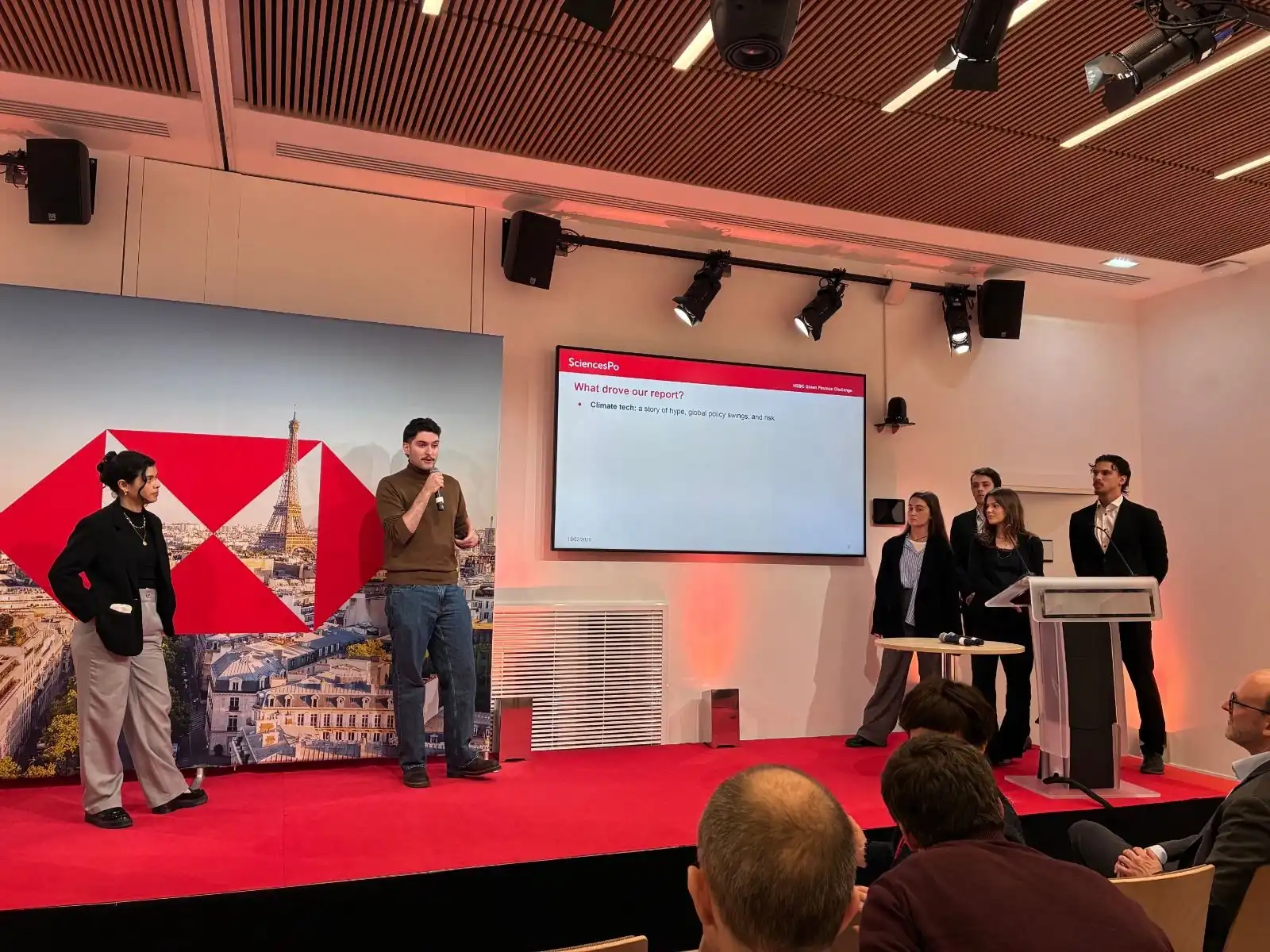
Our next group worked towards benchmarking the competitive ecosystem around Climate Tech (e.g. startups, VC funds). Part of their challenge was to come up with an assessment of public and regulatory frameworks (EIB, EU Green Deal, grants, etc.)
This assessment included a deep exploration of the complex, yet driving regulatory framework of the EU. Students found that public funding is a key catalyst but remains insufficient without stronger private capital mobilisation and EU-wide coordination, making financing strategy and public-private alignment decisive for investment success. Their research identified the following sectors as most competitive for investment: industry and energy (deep decarbonization, hydrogen, storage); dual-use technologies (climate and defense/security); the built environment (construction); carbon capture (CCUS); and critical raw materials (CRM). Drawing on case studies of three start-ups, the group then benchmarked HSBC's Central Europe operations against competitors such as BNP Paribas and Société Générale, yielding strategic recommendations across regulation, financing schemes, the competitive landscape, start-up engagement, and investment. The group concludes that while Europe lags behind the United States in terms of growth, regulatory stability and massive institutional support offer HSBC a unique opportunity to position itself as the preferred partner for the European industrial transition.
Students involved: Yago Hecht Wulff, Mathieu Lorain, Suzanne Nogues, Aitana Orrego Martinez, Carlotta Pareschi, Jade Renault-Mercier, Tevian Thomson, Cosimo Zatti

Group 3: Benchmarking the competitive ecosystem around clean energy & transportation.
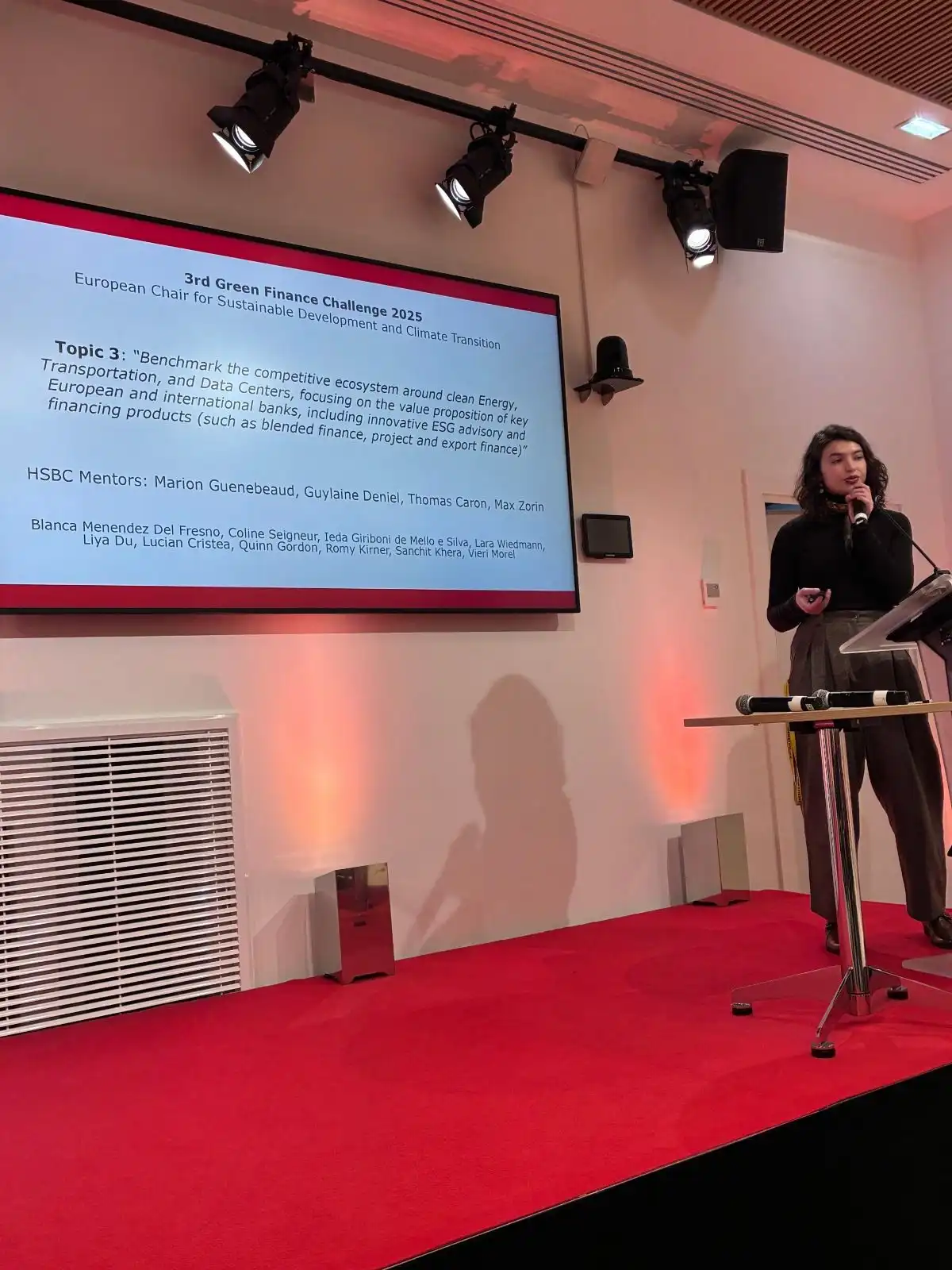
The third group worked towards benchmarking the competitive ecosystem around clean energy & transportation as well as data centers, focusing on the value proposition of key European and international banks, including innovative ESG advisory and financing products (such as blended finance, project and export finance).
Students examined global trends in energy transitions, the impact of EU policy trends, such as the Green Deal, and the rising importance of financial instruments like project finance and green hybrid bonds. Their analysis offers detailed insights into clean energy, covering solar, offshore wind, and hydropower, as well as clean transportation, including electric vehicles and sustainable aviation, and the growing role of data centers. In the following, their analysis contrasts HSBC’s market positioning against key competitors like Santander and BNP Paribas across each of these sectors.
The study concludes with targeted recommendations for HSBC to transition from an advisory role to industrial leadership by leveraging its Asian trade corridors and internalizing technical expertise.
Students involved: Blanca Menendez Del Fresno, Coline Seigneur, Ieda Giriboni de Mello e Silva, Lara Wiedmann, Liya Du, Lucian Cristea, Quinn Gordon, Romy Kirner, Sanchit Khera
Group 4: Developing ESG KPIs for HSBC.
And finally, the fourth group developed ESG KPIs for HSBC’s own operations to better track activities, focus on the most impactful areas, and communicate progress effectively.
Their work centered on the 'blind spots' that typically sit behind aggregated Scope 3 reporting, particularly emissions linked to intercompany and shared services, outsourcing, and technology. Students began by reviewing the regulatory and academic landscape around CSRD and operational emissions reporting, before developing a benchmarking methodology and applying it to a peer group of European banks. This allowed them to identify prevailing practices as well as the gaps that remain. They then assessed HSBC's current operational disclosures against both peer standards and regulatory expectations.
The outcome was a proposed set of KPIs designed to make operational ESG reporting more traceable, temporally comparable, and audit-ready, which is a particularly pressing requirement given the rising assurance expectations under CSRD and ESRS. Each KPI was designed with implementability in mind: clear definitions, formulas, and data owners. The framework also directly addresses the intercompany and shared-services gap by introducing service-unit and SLA-based indicators alongside standard ESRS-style metrics.
Students involved: Georges Collemiche, Siya Goyal, Julius Kasberger, Esha Modi, Maxim Mouret, Salomé Muscat Dries Paesen, Petra Pusztai, Marianna Pyka, Angèle Tellier
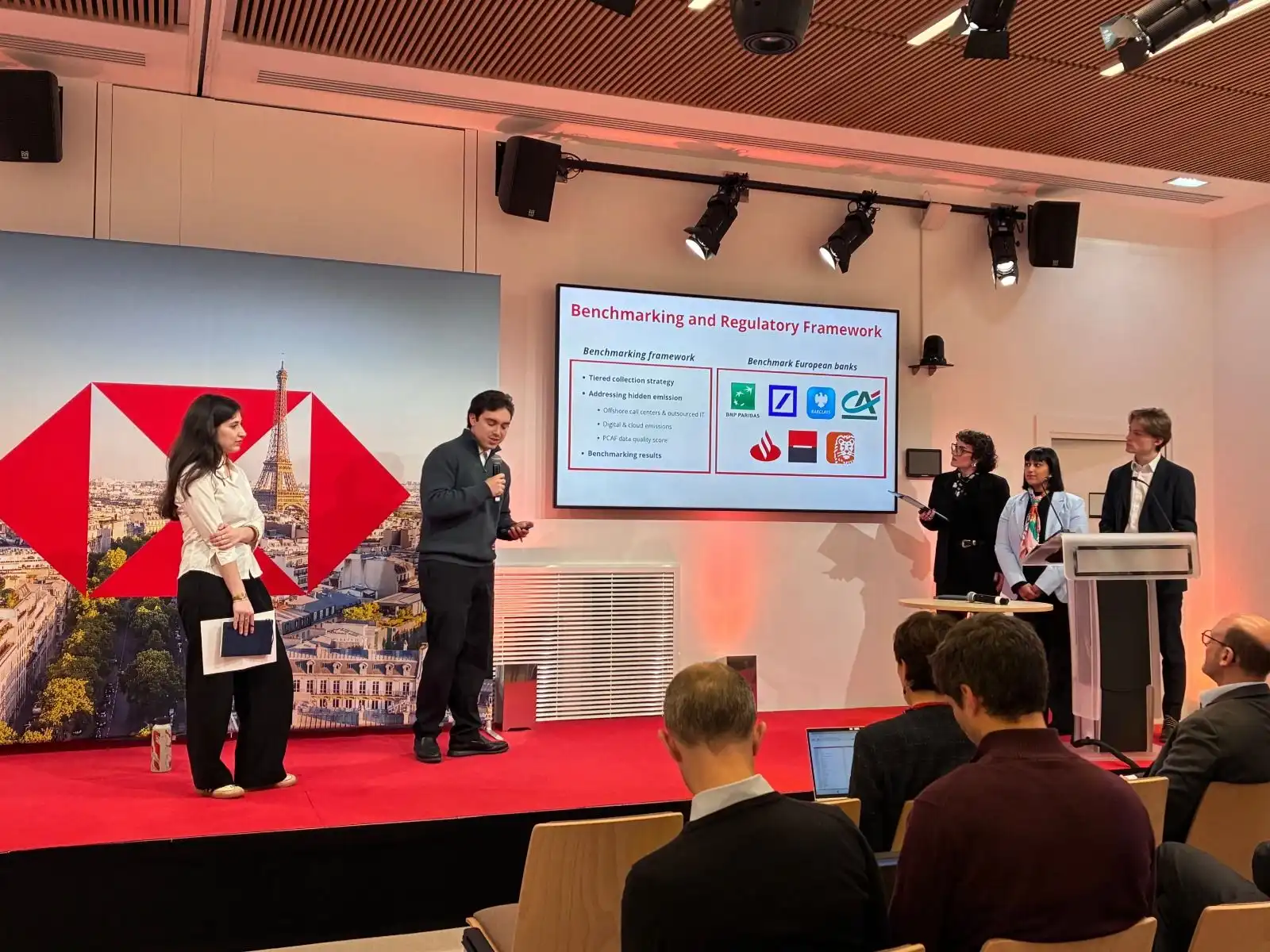
The Closing Event: Coming Together and Celebrating Achievements
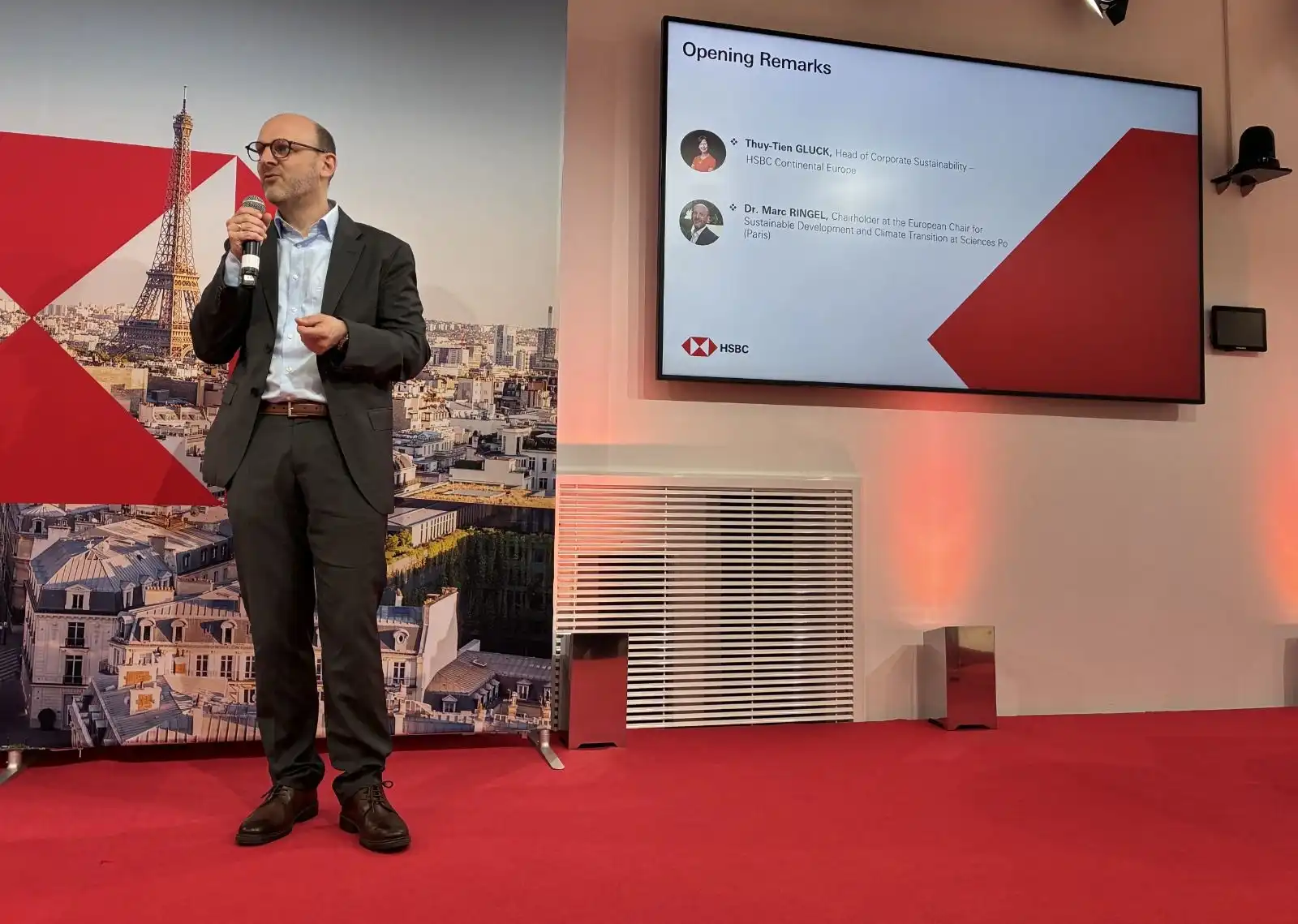
Our closing event on 19 February brought all teams and experts from HSBC Continental Europe together for one final, inspiring exchange. In this collaborative setting, students had the chance to showcase their research, dive deep into discussion, and receive direct feedback from the HSBC experts. Each group delivered compelling presentations, shedding light on key challenges and innovative approaches within their respective topics.
Beyond the presentations, the event offered a rare behind-the-scenes look at HSBC Continental Europe’s sustainability initiatives and commitments to responsible finance. Experts shared first-hand perspectives on the fast-changing world of green finance, giving students valuable insights into emerging trends and real-world practices. More than just a learning opportunity, this session helped bridge the gap between academic research and professional practice, while also opening the door to career advice and potential pathways within HSBC Continental Europe.
This engaging afternoon concluded on a high note with a networking cocktail, where participants connected with peers and HSBC professionals, exchanged ideas, and discussed potential career opportunities in sustainable finance.
This year’s Green Finance Challenge once again demonstrated its value as a space where academia and the financial world come together. By tackling real-world sustainability issues, students didn’t just build on their academic foundations, they made tangible contributions to an area of finance that is evolving at remarkable speed - bringing fresh perspectives to questions that matter.
A special thank you to HSBC Continental Europe for their outstanding coordination, to the mentors for their thoughtful guidance and active involvement, and most importantly to the students for their enthusiasm, creativity, and perseverance throughout the last months.