

Home>Why Migrants’ Death Matters


27 April 2026
Why Migrants’ Death Matters
Interview with Thomas Lacroix and Paolo Boccagni
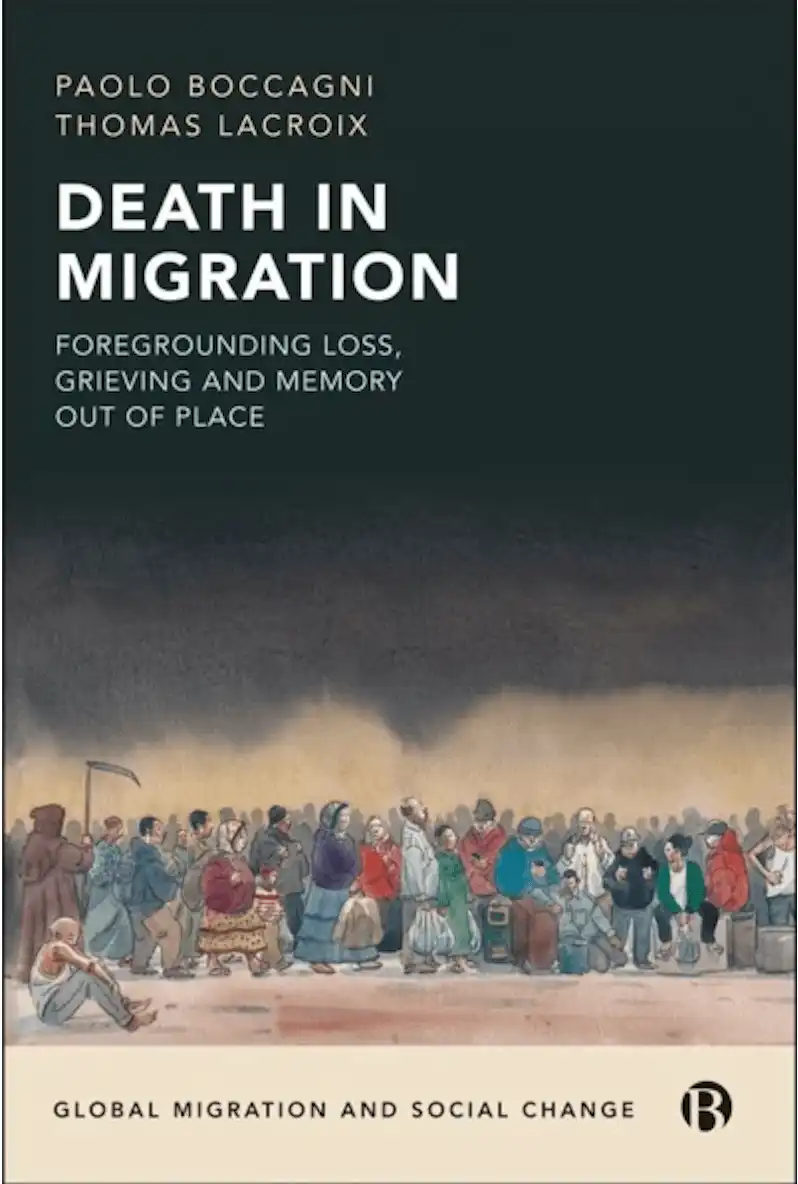
The issue of death in migration has long been excluded from migration research, even though death is an integral part of migration, just as it is in any human life journey. How should we approach this subject, what assumptions does it entail, and how can we move beyond them? Does the death of migrants hold a different value than that of non-migrants? Thomas Lacroix and Paolo Boccagni, authors of the book Death in Migration: Foregrounding Loss, Grieving and Memory out of Place (Bristol University Press), answer our questions in this interview.
Death in migration may occur during a perilous journey, but it may also occur after several decades of living in a host country. This broad understanding of death in migration allows us to see death as a part of every migration story. You note that there is little literature on the way death is part of migration, on the way death is dealt with, and its cultural, political, and societal aftermath. Can you explain why?
Indeed, death has, for a long time, remained outside the scope of migration studies, as if the fate of migrants was bound to return or assimilation (or disappearance outside of or within the host society), but not to death. This contrasts with the place that death occupies in the perception that migrants have of their own migration. For most of them, migration is associated with the fear of dying outside of their home and of a “bad death”: the deceased may receive inappropriate treatment and ritual on top of being buried or cremated far from relatives and ancestors. In a way, migrants don’t die or can’t die. This double impossibility may explain why death has, for so long, remained under the radar of migration experts.
But things have recently changed. The aging of migrants in Western societies has raised a number of challenges, including issues pertaining to the management of their death. The growth of Muslim quarters in non-Muslim cemeteries, the fate of isolated migrants who have lost homeland connections, and the rising number of non-profit as well as profit-making organisations providing mortuary services are among such issues attracting scholarly attention.
But a turning point has been reached with the surge of migrants’ deaths at the borders of Western countries in general, and in the Mediterranean in particular: over 34,000 since 2014 according to the International Organisation for Migration. This primarily social question became a political one. The term “necropolitical” was coined by Achille Mbembe to designate migration policies as a type of policy distinguishing between those who deserve to live and those who can be left dying. From a consequence of State policies, migrants’ deaths became a driver for social and political mobilisations. One observes a growing number of civil society organisations seeking to identify and commemorate the dead and to litigate State authorities.
It is haunting, but as you indicate, the death of migrants seems more valued than their life in most host countries. It can become a lucrative business. Can you explain and give us examples?
It is indeed a rewarding business, not only financially, but also politically. The growing number of people dying abroad has led to the development of a mortuary industry of brokers dealing with the paperwork, arranging the provision of religious rituals, organising local burial or body repatriation. There has not been any attempt to measure this death economy worldwide, but it is surely one of the largest profit-making sectors thriving on migration.
As part of this industry, one observes a wide array of organisations offering body repatriation insurance. Some of them are grassroots organisations of people coming from the same place of departure or living in the same areas of settlement (e.g. hometown associations, local places of worship) collecting money to cover repatriation expenses. Others are insurance companies and banks who have privatised this service. The Banque Populaire Marocaine, for example, covers such expenses for a family for 120 euros a year. Some sending states also offer such insurance to their nationals abroad. The Turkish-Islamic Union for Religious Affairs (DITIB) maintains a funeral fund boasting 300,000 members. For State authorities, such policies are a means to retain a symbolic tie with their expatriates and assert their legitimacy. It is interesting to observe the competition between these different actors to attract customers for both financial and political reasons.
Why does death in migration raise dilemmas about the emplacement and spatialisation of mourning, grief, and memory—and of the dead bodies themselves?
There are different aspects to consider here. For all migrants who retain transnational ties with their countries of origin, or in diasporic spaces, the choice of the place for their funerals, and then for burial, is associated with a likelihood that some of their loved ones won’t be able to be there physically—either to participate in the ritual or to attend to their graves, over time. In essence, the dilemma is between burial in the country of origin, thereby recovering continuity with the ancestral line and land, and leaving little trace in the context of immigration, and burial in the country of settlement, as a future-oriented act whereby migrants themselves become the “new ancestors” for their descendants (second generations and beyond), while disrupting the normative continuity with the place of origin. The more the loved ones of the dead are distributed across remote geographies, the more they may need to rest on online forms of grieving and memorialisation, rather than on the traditional, more legitimate and ritualised ones.
At a different level, death in migration raises a fundamental dilemma whenever it occurs upon border-crossing. It may then happen that migrants’ dead bodies are not identified or not even found. Their graves, if any, risk staying nameless, or anyway remote from those who are grieving them. In this regard, the role of transnational civil society has emerged as critical to raising awareness about the inherent violence of border death and the risk that dead migrants stay ungrieved, or even lose the right to have a name, and hence a memory, as a result of a global border regime that marginalises them in death—even more radically than it did in life. In this regard, there is a weird continuity between the lived experience and politics of death in migration, and the lived experience and politics of disappearance.
You write in your book that “several factors [...] make for a predominant moral definition of death as good or bad”. Can you develop the idea of thanatic morality?
The question of the so-called “bad death” is not specific to migrants and migration, but it takes a very specific meaning in migratory contexts. A bad death occurs when the body of the deceased receives inappropriate rites or is improperly mourned. This may happen in the absence of a competent caretaker, when the circumstances of death are deemed immoral (for example in case of suicide), or if the person is regarded as undeserving due to past behaviours or religious, sexual, ethnic… orientations. The definition of good vs bad death is inherently moral because it is linked to the way a community conceives what should be done and what should not, before, during, and after death.

What is more, the definition of a good/bad death is situated. Many groups regard death and burial outside of the homeland as improper. In this regard, the homeland can be understood as the place where a good death is possible, and migration as a moral misbehaviour. We think that this thanatic morality is the source of a moral economy binding migrants and non-migrants. This explains the importance not only of body repatriation, but also of the remitting behaviours of migrants that are to send money home lest they are accused of being selfish and corrupted by foreign individualistic values.
You devote an entire chapter to death in migration in the arts and humanities, in order to “shed light on the forms and intensity of artistic engagement in relation to the issues [...] of grievability, human dignity, the moral predicament of being exposed to death and its (necro-)politics”. What have you learned while working on this part of the project?
Death in migration is a topic that artists have addressed since antiquity: Homer’s Odyssey, which presents death as a transformative ordeal for Odysseus on his way back to Ithaca, or Ovid’s poetry expressing exile as a form of social and existential death, are two cases in point. These motives still imbue artistic productions: narratives of migrants’ journeys are often presented as contemporary odysseys of people confronted with a series of ordeals along their way. The film 14 kilómetros by Gerardo Olivares, and the cartoon l'Odyssée d’Hakim by Fabien Toulmé are two examples.
However, the surge of border deaths and the emotional stupefaction it has generated have inspired a large body of art pieces. The latter shed a crude light on these deaths lest they remain out of the mediatic gaze and therefore out of public consciousness. They challenge a necropolitics that de facto identifies irregular migrants as people who deserve to die. They open a space where it becomes possible to grieve the “ungrievable”. From Kader Attia to Ai Wei Wei, or the pictures of Max Hirzel, a large number of these artists re-use objects that belonged to or were used by migrants, such as clothes, life jackets, or remains of shipwrecks. They have forged a counter-forensic aesthetic confronting the audience with the here and now of border death. Like forensic experts, they make use of the traces left by migrants to retrieve the circumstances of their disappearance and trigger an emotional response. In this art, references to slavery and the “middle passage” are manifold. Jason de Caires’s famous immersed sculptures represent black people on sunken boats. Likewise, M. NourbeSe Philip, Fred d’Aguiar, and Margaret Busby all refer to the Zong, a slave ship infamous for having tossed, in 1781, 133 people overboard so that they could cash in the loss of their cargo from their insurer.
Artists thereby join activists and civil society organisations and contribute to the publicisation and politicisation of an issue happening at the fringes of Western societies. Together, they have created a transnational hybrid public space.
Interview by Miriam Périer, CERI.
Further reading
- Balkan, Osman, Dying Abroad: The Political Afterlives of Migration in Europe, Cambridge University Press, 2023.
- Banerjee, Bidisha, Judith Misrahi-Barak, and Thomas Lacroix. Thanatic Ethics: The Circulation of Bodies in Migratory Spaces, Routledge, 2025.
- Cuttitta, P., & Last, T. (eds.), Border deaths: Causes, dynamics and consequences of migration-related mortality, Amsterdam University Press, 2019.
- De León, Jason, The Land of Open Graves: Living and Dying on the Migrant Trail. University of California Press, 2015.
- Havik, P. J., Mapril, J., & Saraiva, C. (eds.), Death on the Move: Managing Narratives, Silences and Constraints in a Trans-national Perspective, Cambridge Scholars, 2018.
- Maddrell, Avril, Sonja Kmec, Tanu Priya Uteng, and Mariske Westendorp, Mobilities in Life and Death: Negotiating Room for Migrants and Minorities in European Cemeteries, IMISCOE Research Series, Springer, 2023.
- Saramo, S., Koskinen-Koivisto, E., & Snellman, H. (Eds.), Transnational death. Suomalaisen Kirjallisuuden Seura, 2019.
Visit the Thanatic ethics programme website: www.thanaticethics.com