

Home>The Welcoming of Migrants: A Continuum from the Local to the International


18 February 2026
The Welcoming of Migrants: A Continuum from the Local to the International
Interview with Thomas Lacroix and Bénédicte Michalon
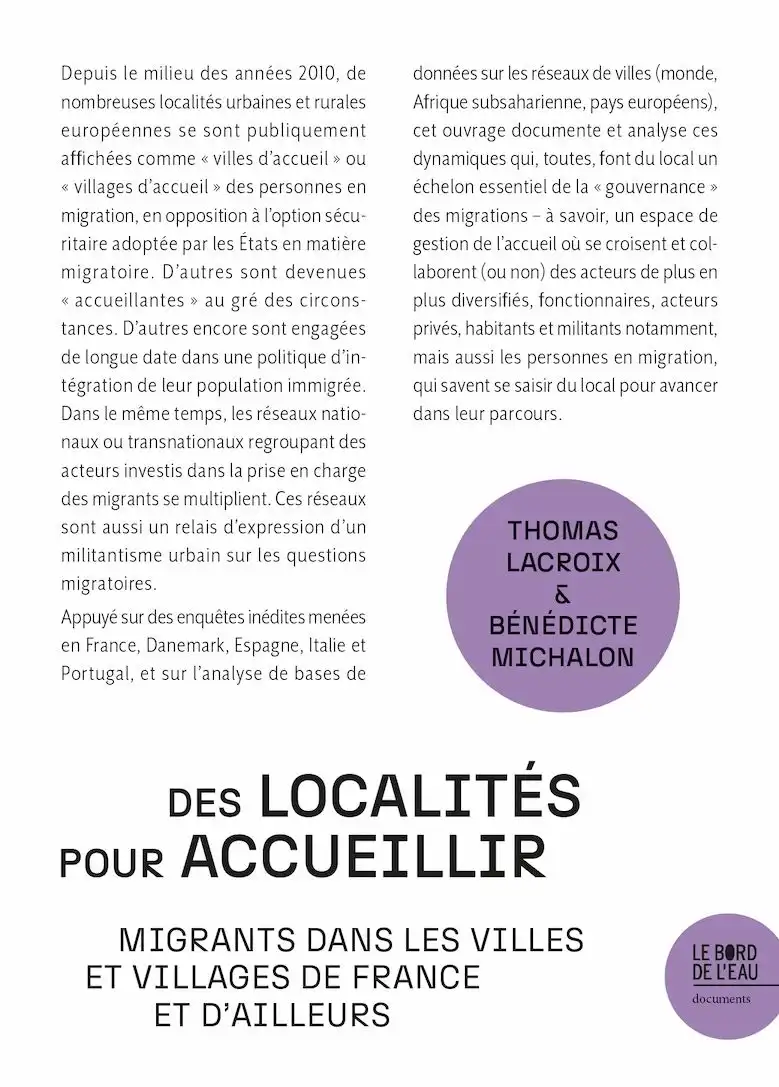
Since 2010, many European municipalities have declared themselves “welcoming” cities or villages for migrants, sometimes against the grain of national security-oriented policies. At the same time, the number of national and transnational networks bringing together local actors involved in migration governance has increased. The book Des localités pour accueillir (Welcoming localities, Le Bord de l'eau, 2025), co-edited by Thomas Lacroix and Bénédicte Michalon, is based on original research conducted in France, Denmark, Spain, Italy, and Portugal, as well as on the analysis of databases on city networks (worldwide, sub-Saharan Africa, European countries). The contributions in this book shed light on local level actors and dynamics, now at the heart of migration “governance”. The editors answer our questions.
One of the stated aims of the book is to bring together research conducted on localities with very diverse social, political, economic, and environmental characteristics. What theoretical framework and methodology have you adopted to compare localities with profiles as diverse as large cities and small villages in rural areas, as well as municipal organisations at the national, continental, and even global levels?
One of the stated aims of the book is to bring together research conducted on localities with very diverse social, political, economic, and environmental characteristics. What theoretical framework and methodology have you adopted to compare localities with profiles as diverse as large cities and small villages in rural areas, as well as municipal organisations at the national, continental, and even global levels?
This book stems from the programme L'accueil en question : les localités urbaines et rurales face aux migrations (“Reception in Question: Urban and Rural Localities Facing Migration”), funded by the Institut Convergences Migrations. It claims that the local level is where the dynamics of migrant reception take place. This approach represents a break with traditional research on immigrant integration. Firstly, the chapters focus on a particular moment in time that has been little studied in research on integration: the very first moments after arrival and the initial contacts between migrants and non-migrants. The significant increase in the number of asylum seekers, with limited resources and in precarious situations, has made welcoming migrants an increasingly pressing issue over the last decade, attracting considerable interest from the scientific community. Furthermore, research on integration frequently adopts a normative approach (i.e. based on an implicit standard of “good” integration) to national policies and/or methods of integrating individuals. The approach we are developing here is different and more pragmatic, because it is based on the act of welcoming and focuses on the local level, rather than on the individual or national levels emphasised in other areas of research.
The difficulty lies in the polysemy of the notion of “local”. In principle, it is difficult to consider international cities such as Paris and small villages (such as those studied in the Massif Central region in this project) on the same level. To overcome this obstacle, we drew on geographer John Agnew’s conception of the notion of “place”. He understands it as both a closed physical space, a place where a given event occurs, and a node of relationships interconnected with other distant places, within a larger whole. This definition fits very well with the pragmatic approach we wanted to develop: we consider the local area primarily as a “stage” where a number of actors (the migrants themselves, associations, individuals, municipalities, national authorities) are involved in a variety of welcoming gestures (private accommodation, municipalities’ welcoming policies, national asylum seeker support schemes, etc.).
But by understanding the local as a node, we also wanted to move away from a methodological localism that would reduce this local “stage” to a self-contained unit . In fact, cities that call themselves “welcoming” or that can be considered as such are always connected to each other by the circulation of people or ideas.

To understand these dynamics, our team used a variety of methods. The book brings together case studies on Paris, the Massif Central region, the Spanish city of Granada, and other municipalities in France and elsewhere. These case studies are based on an ethnographic approach to local situations. Some of them focus on “welcoming” actors (associations, individual hosts, etc.), while others focus on “welcomed” actors. Other contributions examine municipal policies, their implementation, and the discourses and conflicts that underlie them. The third part of the book brings together contributions that analyse the networks of actors that are developing at the national or international level around local reception dynamics. These chapters are based, in part, on qualitative surveys that track these networks in various locations, and in part on the analysis of a database of city networks specialising in migration issues.
One of the main findings of this collective research is the spotlight it shines on these networks of actors and their influence on local reception dynamics.
You often refer to the concept of scale in welcoming, and you indicate that the work presented in the book prompts reflection on the interlocking of these scales. Could you elaborate?
Placing these welcoming places within a broader dynamic of networking naturally led us to revisit the multiscalarity of the phenomenon. The dynamics of welcome are tangible in a local context, but they involve actors whose experiences and reflections are multiscalar (local, national, international) and/or who develop and maintain links with distant actors. In other words, reception at the local level is influenced by ideas, practices, and policies that are conceived elsewhere, at the national or international level.
Thus, the policy of welcoming people in exile has been a prerogative of the State since the 1970s. In France, the authorities have set up a housing system—the Dispositif national d’accueil (DNA, National Housing System)—which includes different types of accommodation centres, including the Centre d’Accueil des Demandeurs d’Asile (CADA, Asylum Seekers Housing Centre).
However, this system only covers half of the needs, and many asylum seekers or beneficiaries of international protection end up living on the streets. Some of these people are then taken in by associations and municipalities. In fact, local action is the result of national inaction. Similarly, municipalities often find inspiration in measures and policies implemented by other municipalities, both in France and elsewhere.
The most active cities promote their actions to other municipalities at the international level. Local-level reception is the subject of genuine urban diplomacy.
In addition to the concept of scale, that of networks is central in the book...
Yes, addressing the networking of reception localities and actors also means questioning a form of globalisation that drives a dynamic involving places that have no obvious connection with each other.
Our study shows that these dynamics are not specific to France, or even to Europe. Cities around the world are discussing ways of welcoming migrants. There is a lot of talk about “sanctuary cities” in the United States, such as New York and Chicago, which are trying to protect migrants threatened with deportation.
But in Latin America and Africa too, exchanges of good practices on how to welcome refugees are common. However, the media mainly report on the movements rejecting migrants that are expressed there. But the dynamics of hospitality are just as important and largely unknown. This invisibility of local action in favour of migrants also exists in France. It has been calculated that more than 11 million French people live in a municipality that acts in favour of foreigners, often going against national policies, but these actions receive little media coverage.
We can therefore talk about a globalisation of welcome dynamics. This welcome is spreading around the world due to similar conditions: the precarious situation of migrants and insufficient public resources. We can also talk about a globalisation of the welcoming ecosystem. The networks of actors, documented in the book, constitute environments where coalitions are formed and where people, practices, and money circulate on a global scale. For example, the city of Los Angeles has set up information desks for migrants in its municipal libraries, inspired by what is being done in Germany. In France, cities such as Villeurbanne issue municipal identity cards based on the New York or Swiss models.

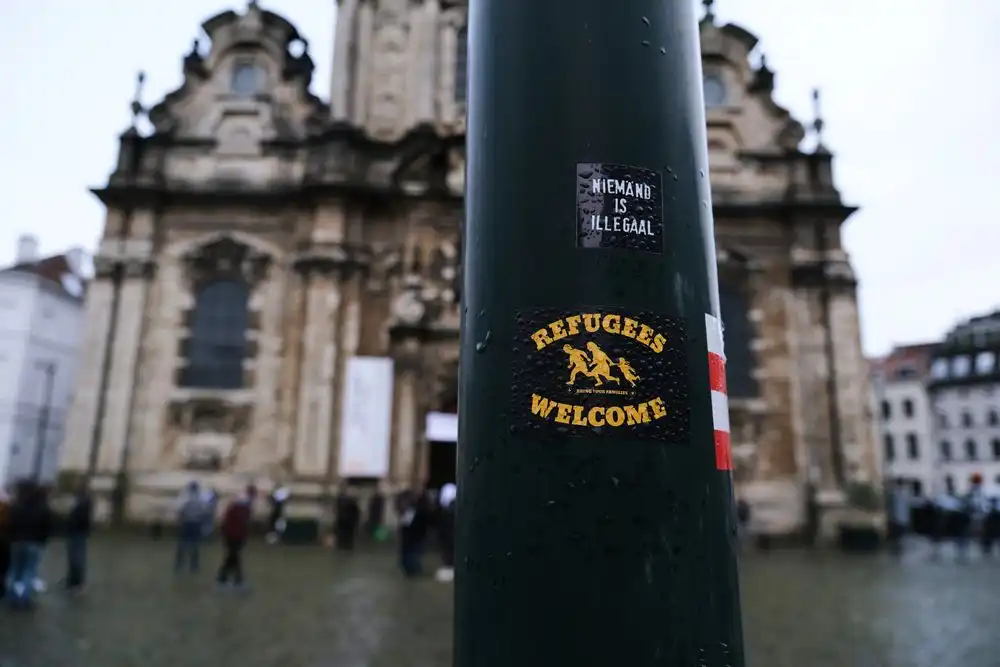
You mention that many urban and rural localities declared themselves “welcoming cities or villages” in the mid-2010s. What does this mean in practical terms?
This involvement is not new in France, where municipalities in the North and Normandy have been developing forms of local citizenship for foreigners since the 1970s, nor elsewhere in the world, particularly in North America, where cities have declared themselves “sanctuaries” for migrants since the early 1980s. The expansion of this movement since the 2000s is the result of several concurrent factors relating to both migration and relations between cities. On the one hand, there is a growing awareness of the increased presence of migrants facing precarious administrative and economic situations and a lack of political will and public resources to offer them a genuine welcome. These observations are common to many countries of immigration. We are also seeing the development of partnerships between cities at national and international levels. These partnerships cover a wide range of issues, with migration becoming an increasingly important one. It is in this general context that European and French municipalities have taken a stand against repressive policies, adopting an ethical and political position on the reception of migrants, but above all, accompanying this position with concrete practices to help migrants. Very quickly, it became necessary for municipalities to structure their initiatives, which had previously been scattered, in order to strengthen their political weight. This led to the creation in France in 2018 of a network of municipalities that aim to be “welcoming”, the Association Nationale des Villes et Territoires Accueillants (National Association of Welcoming Cities and Territories, Anvita).
The research presented in the book highlights the fact that these networks of cities working on migration issues mobilise a wide range of actors. Not all of them are elected officials or municipal staff: researchers, international organisations, and associations of various kinds are mobilising to enable these municipalities to implement measures to help new arrivals. The various contributions in the book also show that translating these positions into concrete actions is a real challenge for the municipalities concerned. As it is difficult for them to influence national security migration policies, they often have no choice but to use the loopholes and silences in national laws to take action. Their interventions are therefore mainly pragmatic in nature, responding to the immediate needs of migrants.
Finally, the scale of this movement must be put into perspective: while it has introduced a new dynamic and created relationships between local actors, it remains dependent on local politics and political change.
The welcoming of foreign nationals into the country is one of the prerogatives of the State. However, it appears that informal arrangements are replacing failing public systems. You mention a continuum. Can you tell us more about that?
It is well known to researchers and professionals in the sector that the way in which the French State and other European States deal with new arrivals does not meet people's needs. In France, half of those who should be entitled to public accommodation do not receive it and therefore find themselves in a very precarious economic and residential situation. These shortcomings have given rise to two concomitant phenomena, which are described and analysed in the book. On the one hand, the difficulty to access a proper accommodation has led many migrants to live on the streets, resulting in the emergence of camps in the French capital, as in many other cities in France and Europe. On the other hand, faced with this increase in migrant precariousness and its visibility in public spaces, many residents have mobilised to help migrants, either spontaneously or in a more structured way, through various types of associations. One form of assistance that has become very widespread is private home accommodation. The State has also encouraged such hosting practices, which operate outside the public system. These processes have made the micro-local level (the street, the neighbourhood, the district) a structuring factor in the dynamics of receiving people in exile. However, the housing trajectories of people living on the streets are more complex than one might think: a large number of them have at some point lived in public or association accommodation or housing, or with private individuals; others leave the streets to access temporary or permanent accommodation or housing. These trajectories reveal residential alternations, with periods in public facilities alternating with periods living on the streets or in alternative accommodation, provided by either associations or private individuals. This is why we have proposed interpreting these dynamics in terms of a continuum between the informal and institutional spheres: the State relies de facto on what exists outside public facilities to compensate for its own shortcomings. Such an approach makes it possible to account for the system in its entirety, as well as the experiences of the people concerned.
Interview by Miriam Périer, CERI.