

Home>Shared sacred sites in South Asia, a culture of hospitality?


31 August 2026
Shared sacred sites in South Asia, a culture of hospitality?
Interview with Laurent Gayer and Christophe Jaffrelot

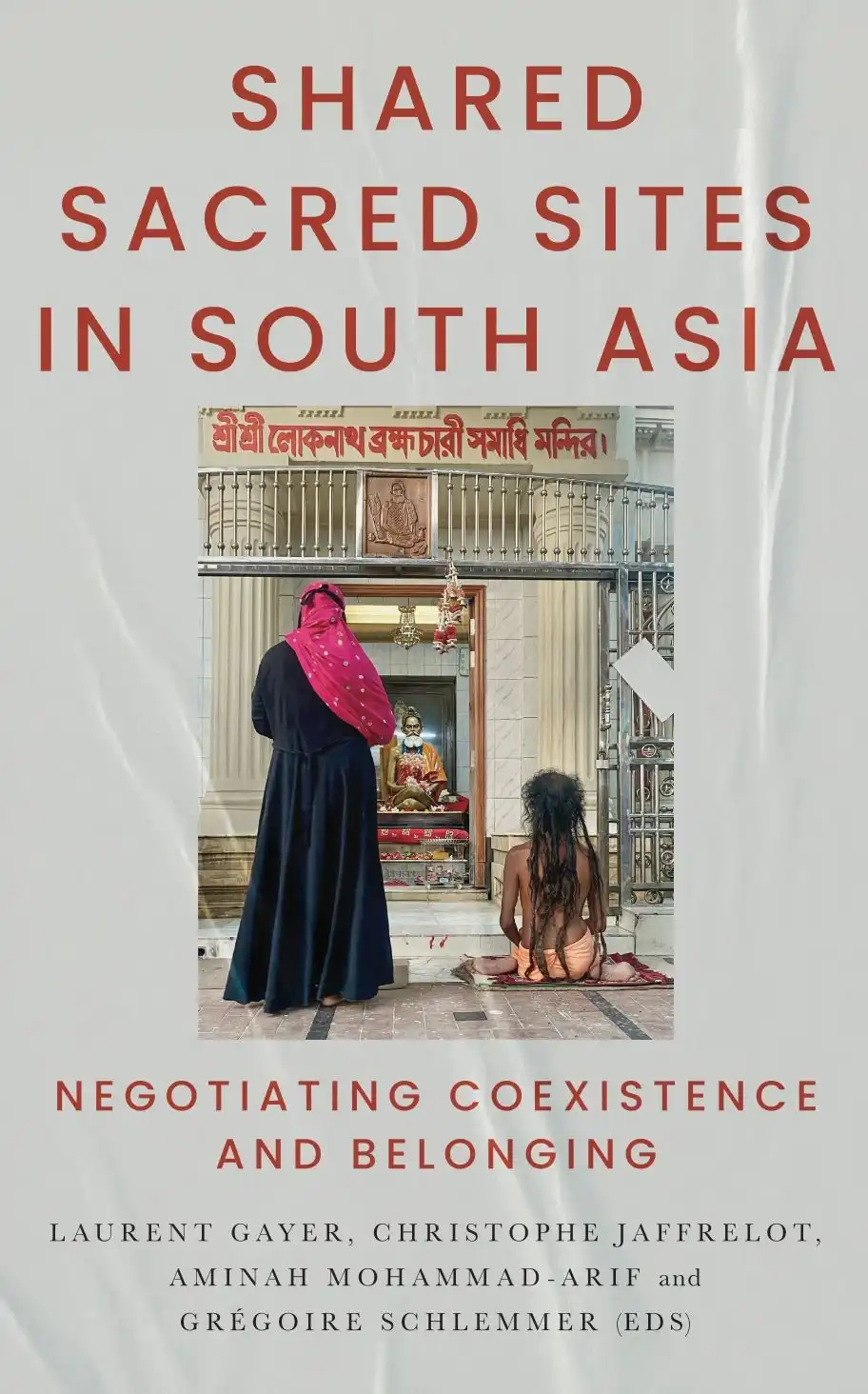
Does religious hospitality exist? While contemporary South Asia is frequently associated with rising interreligious friction, the region possesses a rich tradition of shared sacred spaces—ranging from venerated tombs to street shrines—where diverse communities continuously negotiate their coexistence. In Shared Sacred Sites in South Asia: Negotiating Coexistence and Belonging (Hurst 2026), a book co-edited by Laurent Gayer, Christophe Jaffrelot, Aminah Mohammad-Arif and Grégoire Schlemmer, a team of eleven social scientists examine the multifaceted modalities of these shared environments, spanning from passive co-presence to syncretic engagement. In this interview, CERI scholars Laurent Gayer and Christophe Jaffrelot outline the central themes of the volume and discuss how these practices of sharing inform our understanding of interreligious dynamics.
What is the background to this collaborative project? What research sources/material do the contributors draw on?
Laurent Gayer (L.G.): This book is the outcome of an interdisciplinary research project funded by the Agence nationale de la recherche (ANR ‘I-SHARE’), which consisted mainly of a dialogue between political scientists and anthropologists, with additional contributions from geographers. This project aimed to study sacred sites visited by different religious communities by asking two sets of questions.
First, what does the sharing of these sites tell us about the fabric of plural societies in times of rising religious and ethnic nationalisms? How exceptional are these places of worship? Do they reproduce or transcend religious and other fault lines prevailing in the larger society?
Second, the focus on shared sacred sites led us to reflect upon the politics of belonging, as the existence of such shared spaces questions the boundaries between groups and between religions, if not the very notion of “religious community” itself. We tried to determine the logics behind visiting places that, at first glance, do not belong to one’s own religion.
In order to answer these questions, we conducted a series of case studies using qualitative and ethnographic methods, including interviews and direct observation during repeated visits over several years. More originally, we also explored the sensory dimensions of religious experiences at these sites through photography and film. The last section of the book consists of a photo-essay presenting and discussing this visual material.
Can you rapidly define what you call “shared religious sites”, and the geographical scope of this edited volume?
L.G.: By ‘shared sacred sites’, we refer to places of worship that attract visitors belonging to different religious traditions. These sacred sites are social laboratories in which different communities experiment with the possibilities of pluralism, while at the same time coping with the inherent perils of such inter-religious encounters, ranging from subtle frictions to occasional outbreaks of violence.
Outside of South Asia, most studies of shared sacred sites have focused mainly on Mediterranean countries. And while in these countries the most common configuration of sharing the sacra involves Muslims visiting non-Muslim holy places, essentially Christian shrines, in South Asia the reverse is true. For centuries now, non-Muslims (mainly Hindus, as well as Sikhs and, to a lesser extent, Christians) have been visiting the shrines built around the tombs of Sufi saints, known as dargahs. The enduring appeal of these shrines, which transcends social and religious divides, explains why they have attracted the attention of scholars. Without ignoring the special place that Sufi shrines occupy in practices and representations of inter-communal mixing in the region, as well as in scholarship on the subject, we aimed to expand the spectrum of analysis. Thus, while giving dargahs their due share, the contributors to this volume have explored churches, samadhi mandirs (a kind of Hindu equivalent of dargahs), wayside shrines and small temples, as well as sacred lakes and other pilgrimage sites. The largest number of shrines studied here are located in India, but the book also includes case-studies from Pakistan, Nepal, Bangladesh, and Mauritius.
You write in the introduction that “those who adhere to ideologies based on religious reform or nationalism are particularly hostile to any form of conscious sharing that might blur the boundaries between ethno-religious groups”. Can you elaborate on this?
L.G.: Across South Asia, movements of religious reform have tried to redraw the boundaries of religious communities since the nineteenth century. From Hindu nationalists to Sikh and Muslim reformists, each of these movements has defended an exclusivist conception of religion, against more pluralist traditions. As a result, these reformist groups have been suspicious of shared sacred sites, where visitors of various faiths converge and intermingle. The nationalist groups that emerged in the wake of these socio-religious movements, during the first half of the twentieth century, have been equally wary of shared sacred sites, which they see as a threat against their project of nation-building on an ethno-religious basis. Dargahs are cases in point. Until recently, even Hindu nationalists would come to the most famous shared sacred site in South Asia, the Sufi shrine in the Indian city of Ajmer, to worship the saint and gain his baraka (blessings). However, Hindu militants have recently taken a strong stance against such visits, and in 2007, three people were killed in a bomb attack organised by Hindu nationalists to dissuade their coreligionists from visiting this popular site of pilgrimage.
Do shared religious sites ever cause (severe) security issues?
Christophe Jaffrelot (C.J.): Some of them do, primarily due to the occasional resorting to violence by sectarian groups against them. Sufi places of worship, which are shared sacred sites par excellence, are a case in point. They are targeted for two contrasting reasons. On one hand, Islamists attack them because of their openness to others and their “lack of orthodoxy”. In Pakistan for example, blasts have occurred at prestigious and popular sites/events accused of borrowing some of their rituals from Hinduism. However, the reverse has also happened in India: as mentioned above, Hindu nationalists engineered a terrorist attack at the Ajmer Dargah Sharif in order to discourage Hindus from visiting.
Such acts of violence are not frequent. Sacred sites shared by different groups, on the contrary, are generally peaceful places with minimum tensions where “strangers” coexist and even interact in a friendly atmosphere.
Are visits to such shared religious sites dependent on factors other than religion?
C.J.: Definitely! While many people visit them for spiritual reasons, such as praying or meditating, many others go there to receive something in return. You may not consider this transactional dimension as “religious”, but every creed works this way.
However, many people visit shared sacred sites for completely irreligious reasons. Firstly, they go to meet people more freely: these places are imbued with an atmosphere of freedom because of their liminal character, and they attract all kinds of individuals - I use this word on purpose - who may interact beyond caste, class, and even gender barriers. Historians of India consider that Sufi shrines, because they were located out of the city and its social norms, in a peaceful environment, literally invented the concept of a public sphere in the medieval era(1).
For pilgrims travelling from afar to visit sacred sites, the journey itself is the main motivation: they behave like tourists, having fun, relaxing, and enjoying the picnic areas etc.
What is the role of the state in the conditions of sharing these religious sites?
C.J.: The state may play three different roles.
First, it can ensure security, partly for the aforementioned reasons—namedly that shared sacred sites are targeted by sectarian groups. Policemen may be deployed and bodyguards provided for clerics.
Secondly, as with any shrine, the state may responsible for administration, collecting taxes, and regulating the distribution of donations between stakeholders, etc.
Thirdly, the state may promote these sites to improve its image vis-à-vis minorities or internationally to show the world that pluralism prevails within its borders.
Do other actors—private or political—play a role in exacerbating potential tensions around shared sites?
C.J.: The sectarian groups mentioned above do not only resort to violence—in fact, they rarely do so. Instead, they try to create tensions by vilifying these places that embody what they are fighting against ideologically: symbols of hybridity, dialogues beyond religious frontiers, cultural liberalism in terms of gender and equality between people at large.
By contrast, other groups try to preserve these sites, not only (sometimes not mainly) because they believe in multiculturalism, but also for pragmatic reasons. Businessmen are a case in point: they may not belong to the religion of the sites where they sell their goods, and they may not even visit them, but they are very attached to the popularity of these places because it is good for business!
Interview by Miriam Périer, CERI.