

Home>Is Music a Common Tool of Multilateralism?


29 April 2026
Is Music a Common Tool of Multilateralism?
Interview with Frédéric Ramel
Every year since 1945, on 24 October, the Member States of the United Nations have gathered for a concert. Both a ritual and a symbol, this musical event serves as a diplomatic tool for both the Member States and the organisation, but it also marks a milestone in international history. Frédéric Ramel, author of Dix œuvres musicales à l’Onu. Une diplomatie du sensible (CNRS Editions, 2026) answers our questions on what this traditional concert conveys and what the study of international relations, through a sensory lens, offers us.
How did the UN tradition of the 24 October concert come about, and how does it work?
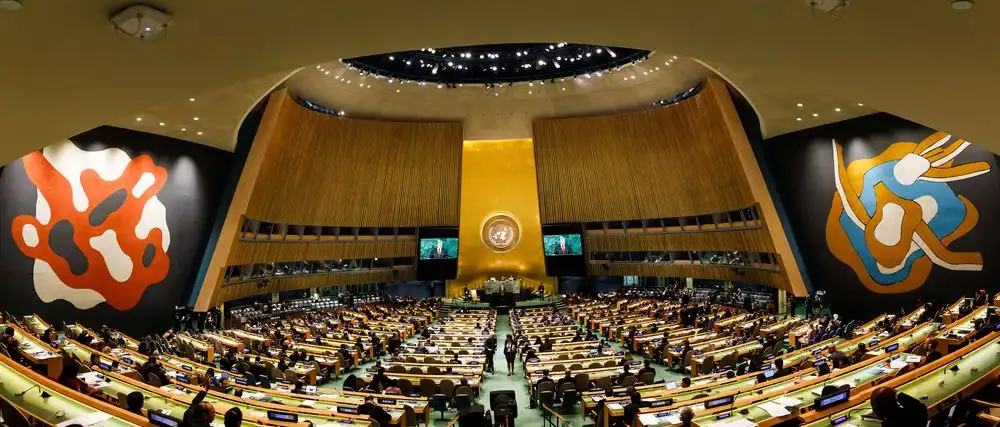
The idea of marking the entry into force of the United Nations’ founding charter (the Charter of San Francisco, ratified in 1945) with a musical celebration was established from the very inception of the organisation. However, it was not until the arrival of the Swedish Dag Hammarskjöld as Secretary-General that a true annual musical tradition emerged on 24 October. Until then, the concert had been organised in conjunction with the New York cultural scene, notably at Carnegie Hall. From 1954 onwards, Hammarskjöld decided to bring music into the very heart of the United Nations, at the centre of the General Assembly. This decision required significant technical adaptations to a hall that had not been designed to accommodate symphony orchestras or other musical ensembles.
The practical and programmatic organisation of this annual event falls to the Department of Public Information, which became the Department of Global Communications in 2019, in collaboration with one or more sponsoring states. Since the mid-1990s, private donors have also contributed to the funding.
Ultimately, the institutionalisation of this concert owes much to Dag Hammarskjöld, who might be described here as an entrepreneur of symbols.
According to Article 1 of the United Nations Charter, the organisation is required to serve as “a centre for harmonising the actions of nations in the attainment of (the) common ends of international peace and security, respect for the principle of equal rights and self-determination of peoples, and international cooperation”. Can music help to sustain this pursuit of the common good?
It can do so in three ways. Firstly, the UN gives music a ritual function. Through a ritual, existing tensions are temporarily suspended in order to highlight the need to come together. This is a way for states to express their commitment to the principle of cooperation. This is what music symbolises, as it is based on the pooling of energies deployed by musicians during a single performance.
Secondly, entrusting the task of organising the concert to states of the “Global South” from the 1990s onwards demonstrates a desire to tell the world that the centre of gravity does not lie in Western countries. This represents an expansion into other sonic realms. Thus, any state can be regarded as a builder in this quest for the common good.
Finally, music can help sustain this quest for the common good once we acknowledge the idea that a spirit of openness toward others requires constant listening. This fosters a realignment of state interests. In the entry “Entonner” (strike up) of his Dictionnaire de musique, Rousseau emphasises the need to use the same tuning fork, the same frequency, the same “A” to enable instrumentalists to play in tune. He makes this the very foundation of political work within republics, a task that consists of maintaining harmony among citizens, just as musicians do during a concert. Rousseau is sceptical about this spirit of alignment on an international scale. But our century is not his. Might it not, nevertheless, be conceivable to cultivate this spirit of alignment on this scale? In the introduction to my book, I refer specifically to music as a universal language, a constant point of reference within the United Nations. Nevertheless, it is more the relationship to music that is universal (sensitive to the vibrations it produces, human beings develop this relationship across all cultures) than its substance. Being moved by music is not an automatic phenomenon. It depends largely on early exposure or learning.
In other words, this search for common ground through music aims to recognise that most music contains within it a movement toward the universal, toward something that expresses what humanity is and what humanity has in common.
What does music reveal about how the universal has been perceived and embodied over the years?
A clear trend emerges when we look at the programme for the 24 October concerts at the UN since the mid-1950s. Western classical music was favoured from the nineteenth and twentieth centuries until Kofi Annan’s first term in 1997. This choice reflected a division of musical genres between United Nations Day (24 October) and Human Rights Day (10 December), which relied primarily on traditional music from the various continents. During this initial period, non-Western composers were included in the programme because they employed forms and instrumentation (the combination of different instruments) derived from the West: Heitor Villa-Lobos or Carlos Chávez, for example.
From 1997 onward, the repertoire broadened to encompass globalised popular music (Sufi rock, pop music, etc.) and traditional music. This openness reflects not only a desire to bring the UN closer to all peoples but also a different conception of the universal. By placing Western classical music centre stage, a dominant conception of the universal is expressed. Opening up to other forms and soundscapes, therefore, reflects an oblique or lateral conception of the universal, one that aims to be more inclusive.

As you point out in this book, the social sciences—and international relations in particular—have turned to the visual since the early 2000s, whilst interest in acoustics is both more recent and more tentative. What, in your view, does this “sensory” dimension bring to international relations?
Although difficult to implement empirically, an approach through acoustics offers several advantages for the study of international relations. Firstly, it shows that this aspect of ourselves (humans as beings made of vibrations and receptive to vibrations) is not beyond the reach of diplomacy and multilateral forums. Like any other cultural artefact, music is subject to various uses, and even manipulation, for the purposes of nation-branding by sponsoring states. Music can also embody a more inclusive political gesture, such as the invitation extended to a Sufi rock band a few months after 11 September 2001 to celebrate a different vision of Islam from that promoted by jihadists.
Furthermore, this sensitivity-based approach emphasises that the quest for the universal does not rest solely on logos or the drafting of legal rules. Such a quest also forges a path through sound. By listening to and embracing other soundscapes, we cultivate a spirit of openness to otherness.
Finally, I would say that through music and sound—which encompasses noise, silence, and noise pollution, amongst other things—the dynamic between the closed and the open becomes keenly apparent. International relations, and more specifically the global arena, are indeed at the heart of what Henri Bergson crystallises in his Les deux sources de la Morale et de la Religion: the oscillations between openness to the other and narrowing, or even retreating into our circles of belonging, and in particular into nations. Music is, by its very nature, ambivalent. It can be used to torture prisoners or promote a country’s identity, to boost the morale of soldiers in war or to bring societies closer together through cultural exchanges between artists and ensembles. It all depends on what political actors make of it. In the ten works selected for the book, I have explored the supposedly optimistic side of this relationship with music as a vehicle for the universal. But I have also sought to highlight the tensions inherent in the programming. In this case, the very limited presence of women composers, and the slow trend toward the integration of aesthetics other than those produced by Western classical music—a trend that cannot be explained by the onset of decolonisation but by the arrival at the helm of the UN of a second “entrepreneur of symbols”: Kofi Annan.
You examine ten works in the book; I suggest we discuss two of them: Dmitri Shostakovich’s “Symphony No. 9” and Dana Al Fardan’s “Hope”. For each, could you tell us when the work was performed and which state sponsored it? Could you also outline the context and explain why this is relevant to analysing the choice of the work in question?
Shostakovich’s Symphony No. 9 was performed twice: in 1965 and in 2000. In neither case was the Soviet Union or Russia the sponsoring state, which is understandable given that this composition, so eagerly awaited by Stalin, provoked his fierce anger after he heard the premiere in 1945. This symphony is akin to a critique of war and, by implication, of all totalitarian regimes founded on fear. The first performance, sponsored by the United States, was organised by the New York Philharmonic under the baton of Leonard Bernstein. As the Vietnam War was beginning, performing a work by Shostakovich amounted to acknowledging the aesthetic value of music created in the East but which was, indirectly, critical of the Soviet regime. It is also worth noting that Leonard Bernstein, throughout his career as a conductor, did much to promote the dissemination of Shostakovich’s music. In short, the choice fell on the music of a Russian composer without, however, glorifying Moscow.
In 2000, it was the Vienna Symphony, celebrating its centenary and conducted by Vladimir Fedoseyev, that included the symphony in its programme. Fedoseyev is a Russian conductor renowned both in the East (he retains his position as principal conductor of the Moscow Radio Tchaikovsky Symphony Orchestra) and in the West. The context is no longer that of the Cold War but of the rebuilding of ties between Russia and the West. Here, the Ninth appears to serve as a unifying force between the two former enemy camps. It becomes a shared cultural heritage.
Hope by Dana Al Fardan is a song originally composed to support the humanitarian aid provided by Qatar to Gaza in 2019, the very year this song featured in the 24 October concert. It presents a dual interest for analysis. The first relates to the sponsoring state: Qatar. A small Gulf state, it exerts a highly diverse international influence ranging from sport to mediation in armed conflicts, via culture. This concert is fully in line with Qatar’s stated desire to play a significant role on the global stage, including in the field of music. Furthermore, Hope offers a shift away from the conventions associated with humanitarian songs. This musical genre has its origins in the compassion felt by Western artists in response to the suffering of distant strangers, primarily in sub-Saharan Africa, from the 1980s onwards.
Hope reveals at least two shifts in emphasis: Southern nations are not absent from the delivery of such aid, and liberal democracies are not the only ones to provide it. The inclusion of this song, which brings the concert to a close, thus reflects a certain “de-Westernisation” of international relations.
“The Environmental Symphony: The Movement” by Allan Zavod introduces a formal innovation in that it incorporates imagery into the music. What can you tell us about it?
To a certain extent, it is an immersive piece, as it plunges us into a world that is both auditory and visual, as well as featuring a textual element with the presence of a narrator—or even several—for the performance on 24 October 2023. It is fully in line with one of the trends in contemporary creation, namely the concept of a musical performance that combines a variety of media. Zavod commissioned Australian designer Ross McNair for this project.
The aim is not to illustrate the music but rather to interweave with the musical narrative to heighten awareness of humanity’s ecological footprint throughout the work’s five sequences: creation, the industrial revolution, the calm before the storm, global warming, final warning, and the urge to preserve. I would also say, above all, that The Environmental Symphony is symptomatic of eco-acoustics: that branch of music which seeks to inspire human commitment to planetary protection. A musical work on its own cannot produce a collective awakening. Nevertheless, it acts as a link in a wider chain that suggests a resonance with the living environment from which humanity originated. Part of my current work aims to explore the links between this idea of resonance and the idea of the “planetisation” of the world, which, incidentally, goes beyond environmental awareness to embrace a major theme: that of inhabiting differently the cosmic planet on which we were born.
Interview by Miriam Périer, CERI.
Further reading:
- Ramel, Frédéric, « And if international relations were also resonant? Exploring the planetary through acoustics ». Political Anthropological Research on International Social Sciences (PARISS), 5, 2, 2025, p. 1-33.
- Ramel, Frédéric, “Ce que nous donne à « écouter » Soundtrack to a coup d’Etat. Projecteur sur les ambivalences de la musique en relations internationales”, CERILab, March 2026.
- Aline Bieth, La musique, un outil diplomatique?, En attendant Nadeau, 13 April 2026.