

Home>Freedom for Fariba, Freedom for Research
4 June 2020
Freedom for Fariba, Freedom for Research
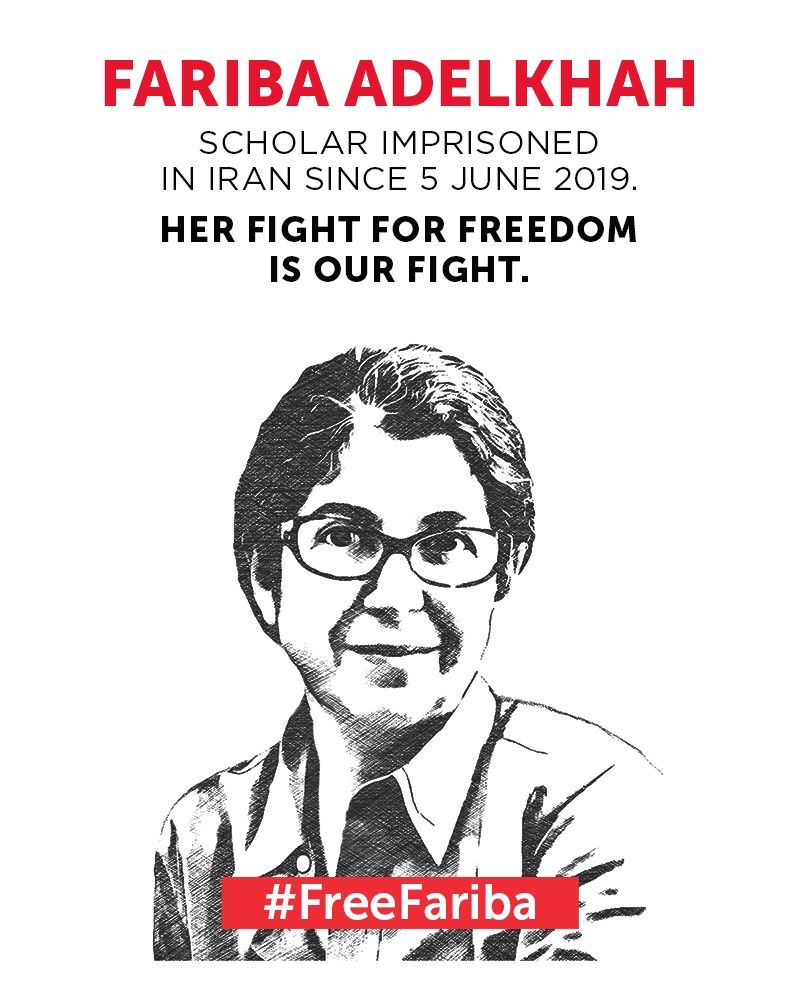
Senior Researcher at the Centre for International Studies of Sciences Po (CERI), Fariba Adelkhah was arrested one year ago today, on Wednesday 5 June 2019, together with Roland Marchal, CNRS researcher at CERI. Roland was freed from the Iranian prison on 20 March 2020 as a result of long and complex diplomatic negotiations, after nine and a half months of a very tough detention. He met his family and friends again, his colleagues from the CERI. He can now slowly start over. Fariba, alas, is still detained in the prison of Evin. She was convicted to six years of prison on 16 May—five for “conspiring against national security” and one for “propaganda against the Islamic Republic”—a particularly severe sentence. This revolting condemnation, which is not based on any serious evidence or established fact, responds to obvious political motivations on the part of the Revolutionary Guards, who are at the origin of the whole affair. The only “proof” that Fariba’s accusers have been able to put forward are her scientific writings, resulting from research she has been conducting in broad daylight.
At the time of her arrest, after several years working in Afghanistan, Fariba had recently returned to Iran to conduct a long-term inquiry there on networks of clerics. In doing so, she was returning to the Iranian field she had tirelessly explored in the past to better explain, in all its complexity, this “post- Islamic revolution society”. Her research activities have never been secret. Fariba has always conducted them with this objective of understanding, but for an authoritarian regime on the defensive, research is easily seen as a façade for espionage.
Unfortunately, Fariba is far from being the only one in prison for similar reasons in Iran. Other scholars have been arrested during the past years, such as her companion of misfortune, Australian Kylie Moore-Gilbert, and Kameel Ahmady, a British-Iranian anthropologist released on bail in November 2019. Even if scholars are not the only victims of this arbitrariness, they are highly sought after prey. It is not necessary to work on contemporary issues to be jailed: American PhD student Xiyue Wang, from the Department of History at Princeton, was conducting research on the Qajar dynasty that dominated Persia between the end of the eighteenth century and the beginning of the twentieth century. Arrested in August 2016, he was condemned to ten years in prison before being released in December 2019 as part of a prisoner exchange.
These facts attest that in Iran, as elsewhere in non-democratic countries, researchers can easily be suspected and find themselves trapped in an infernal mechanics worthy of Franz Kafka’s The Trial. Fariba’s terrible fate invites us to think further about the freedom of research, which, in authoritarian situations in particular, remains precarious, if not directly threatened. We, as scholars, are faced with a real difficulty: we must continue our work of elucidating the social, even in fields deemed difficult, but we cannot ignore that, even if we act cautiously, we can find ourselves in the position of the accused. Could the establishment of a genuine “status of scholar” at the international level represent a step forward? It could, in the sense that it could allow for the fixing of the researcher’s rights of investigation (in accordance with national laws). But, let’s not delude ourselves: such a status would not resolve everything, far from it. Indeed, despite the fact that the profession of journalist benefits—in theory—from a protective shield, this has never prevented the abduction, forcible confinement, or even disappearance of journalists working in difficult areas or “closed countries”.
The freedom of research in the name of which Fariba started her hunger strike with her co-detainee, Kylie Moore-Gilbert, on 24 December 2019 and that lasted fifty days will remain a permanent fight in a world in turmoil where democratic regressions are plentiful.
In her open letter to President Ahmadinejad in 2009, following the repression of the Iranian Green Movement that had emerged following the controversial presidential election results, Fariba wrote that she would not have the courage of Clotilde Reiss, the French PhD student who had been arrested at the time, accused of “spying”. Fariba has, since then, largely showed that she has an incomparable moral strength and a flawless determination to defend, ruthlessly, beyond her own freedom, the freedom of all researchers.
Freedom for Fariba! Freedom for research!