
Accueil>Retour sur la rentrée solennelle 2026-2027 de l’École de la recherche


17 septembre 2026
Retour sur la rentrée solennelle 2026-2027 de l’École de la recherche
Le jeudi 3 septembre 2026, l’École de la recherche de Sciences Po a accueilli ses nouveaux étudiants lors de sa rentrée solennelle dans l’amphithéâtre Jacques Chapsal. Ce moment inaugural, dirigé par la doyenne Dina Waked en présence de l’équipe pédagogique, visait à présenter les grandes orientations de l’année à venir, à favoriser les échanges et à rappeler les ressources à disposition des étudiants.
Discours de Dina Waked, doyenne de l'École de la recherche
Dear students, colleagues and staff,
It is my privilege to welcome you for a new academic year at Sciences Po's School of Research.
I warmly congratulate all of you who are starting your degrees at the School of Research, whether you are pursuing a master's or a doctoral degree, you have come a long way in your quest for further research. I also want to welcome those returning for another year; it is always a pleasure to see you again.
This summer, in the reading and viewing I recommended to students of the school of research, I kept returning to two works that I want to start with today, because together they hold an image I want to carry through what I want to say.
The first is the film Destiny, by the Egyptian director Youssef Chahine, whose centennial we mark this year. Set in twelfth-century Córdoba, the film follows the philosopher Averroes, Ibn Rushd, as he defends Aristotelian rational thought against those who are fearful of his ideas and want his books burned.
The second is Radwa Ashour's novel Granada, one of the major achievements of modern Arabic literature. It follows a family across three generations in the Andalusia of the late fifteenth century. Early in the book, a bookseller named Abu Jaafar quietly moves his library out of the city before it can be burned, saving what he can, so that something of that world's thought and memory survives into the next generation.
Both stories, across different centuries and different forms, are ultimately about the same quiet act: someone deciding that an idea, a text, a way of thinking, is worth carrying forward, worth protecting, worth handing on.
That is the spirit I want to welcome you into today. A shared responsibility that researchers have always carried, in every era, sometimes in dramatic circumstances and sometimes in very ordinary ones: to keep knowledge alive.
1. On the responsibility of keeping knowledge alive
Research, at its heart, is an act of care for what we know and how we know it. Every generation of scholars inherits ideas, questions, and methods from those before them, and every generation has the job of carrying them forward, testing them, enriching them, sometimes correcting them, but never simply letting them disappear.
This matters because knowledge is fragile in ways that aren't always visible day to day. Ideas can be forgotten as easily as they can be forbidden. A question stops being asked. A body of scholarship falls out of fashion and out of syllabi. A perspective that once had a home in the university quietly loses its place. None of this requires a dramatic act of censorship; it can simply be the result of neglect, convenience, or fear of controversy.
I personally believe research is one of the places where societies keep their capacity to think seriously about themselves, where hard questions can still be asked, however uncomfortable the answers. Like Abu Jaafar with his books, part of what you are being trusted with, starting today, is the quiet responsibility of carrying certain kinds of thinking forward so they remain available to the people who come after you.
2. On critical spirit
Keeping knowledge alive doesn't mean preserving it unchanged, like a book sealed in a vault. It means engaging with it seriously enough to actually test it. A syllabus, a canon, a dataset, an accepted theory, an archive of history none of it is neutral. Every one of these things reflects choices about what counts as knowledge and whose work made the list. That is exactly why you cannot simply inherit what you are handed, whether it comes from a professor, a discipline's tradition, or an algorithm's confident summary. Ask why certain texts, certain voices, certain methods became central, and others didn't. Rely on facts, but double-check them as many are now generated by machines. Verify your sources, and then verify them again.
Whether you are in an archive, working through a dataset, or rereading a text everyone assumes has already said all it has to say: interrogate it, poke it, reassess it. Go back to the sources. Ground yourself in the material, not in the received wisdom about the material. That rigor is itself a responsibility and a commitment and it's how you make sure what you carry forward is worth carrying.
3. On writing
Averroës kept writing despite those that wanted him to stop. Abu Jaafar kept his books despite those that wanted them burned. In both stories, the survival of an idea depended on someone taking the trouble to record it, preserve it, and pass it on in their own hand. I think that act matters just as much today, even as, especially as, a machine can produce a fluent paragraph in seconds. Precisely because a machine can generate something correct and generic in an instant, it becomes more precious to write something that is genuinely yours: an argument built the hard way, a sentence that carries your voice, a narrative only you could tell because only you sat with the material, with your sources, long enough to find it.
Do not let the ease of the artificial make you forget the pleasure of the difficult.
Writing well, thinking on the page, discarding six or ten words before finding the right one. This is not a chore standing between you and your research, it is part of the research, and it may be its deepest and most private satisfaction.
Critical inquiry gives you the material and the courage to ask hard questions. Writing is how you make sure the answers are not lost. I hope you rediscover that pleasure over the years ahead, whatever tools exist alongside you.
A closing word
Sciences Po is a unique place to do this critical, rigorous, courageous work. Our school brings together master's and doctoral students spanning our five primary disciplines: economics, history, law, political science, and sociology – alongside a permanent faculty dedicated to Sciences Po being a research university. Use that breadth and cross over; talk to colleagues in other disciplines. The real world does not respect the boundaries between them, and neither should your curiosity.
One last thing. Look around this room. The people near you today are not only your classmates, they are likely to be your colleagues and friends for the rest of your career: the people you call when you need a co-author, when you need to know if an idea holds up, when you need someone in your corner. Build those bonds now, deliberately. You will need each other in the years ahead, and research, at its best, is rarely done alone.
I wish you all courage, curiosity, and the determination to ask the hardest questions, pursuing rigorous research methods and the will to keep writing and saving books from being erased and forgotten like Chahine’s Averroes and Ashour’s Abu Jafaar.
Welcome to the School of Research.
Rentrée solennelle

Rentrée solennelle

Rentrée solennelle

Rentrée solennelle

Rentrée solennelle

Rentrée solennelle

Rentrée solennelle

Rentrée solennelle

Présentation de l'association de l'Ecole : SoRA
Informations utiles
L’intégrité académique : le cadre commun en vigueur à Sciences Po
Sciences Po est résolument engagée en faveur de la promotion de l’éthique, de l’intégrité scientifique et académique, piliers de l’excellence de ses missions de recherche et de formation.
Le projet éducatif de Sciences Po valorise, auprès de ses étudiantes et étudiants la construction d’une pensée autonome et critique, l’honnêteté intellectuelle, ainsi que le respect du droit d’auteur et du droit à l'image dans l’utilisation des sources.
Lutter contre les violences sexistes et sexuelles
Parce que les violences sexistes et sexuelles n’ont pas leur place à Sciences Po, l’institution a mis en place une politique globale allant de la prévention à la sanction des auteurs de violence avec une priorité accordée à l’écoute et à l’accompagnement des victimes.
Pour toute question ou besoin d'accompagnement contactez : referent.vss@sciencespo.fr ou prendre directement rendez-vous en ligne.
Lutter contre les discriminations
Parce que les discriminations sont une grave atteinte aux droits humains, l’établissement s’est engagé dans une démarche de lutte contre les discriminations contribuant ainsi au bien-être collectif et individuel, à l’inclusion et à l’égalité.
Pour toute question ou besoin d'accompagnement contactez : referent.lcd@sciencespo.fr
Handicap & accessibilité : accompagnements pour les étudiants
Si vous êtes en situation de handicap temporaire ou permanent, ou si vous souffrez d’un trouble de santé invalidant, Sciences Po va s’assurer du meilleur déroulement possible de votre scolarité et de votre intégration dans la vie étudiante.
Le Pôle handicap est à votre disposition pour :
- prendre en compte vos besoins ;
- vous proposer des aménagements spécifiques ;
- permettre du mieux possible l’accessibilité des cours et des locaux ;
- coordonner les actions et les informations avec les différents services de Sciences Po ;
- vous accompagner dans vos démarches.
Contact : pole.handicap@sciencespo.fr - 01 45 49 51 19
Centre des services aux étudiants - 1er étage au 13, rue de l'université
Sur rendez-vous, du lundi au vendredi de 9h30 à 13h et de 14h à 17h30.
Santé
Sciences Po dispose d'un « Pôle Santé » composé de plusieurs professionnels (médecin, infirmière, psychologue, etc.), situé au 13 rue de l'Université, accessible à tous les étudiants, les prises de RDV sont possibles via Doctolib.
De plus, plusieurs membres de l'équipe de l’École de la recherche sont formés aux premiers secours.
Portes Ouvertes Masters virtuelles en octobre 2025

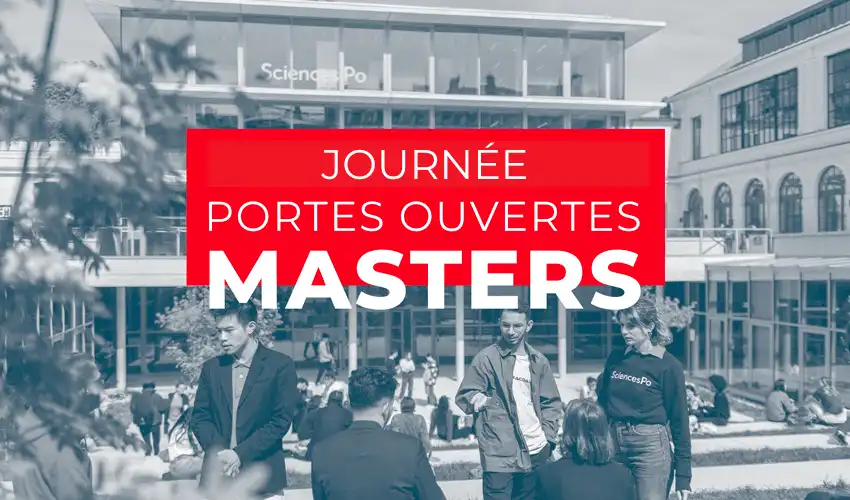
Le 17 octobre 2026 : découvrez nos 30 masters et échangez avec les équipes et les étudiants de nos 8 Écoles professionnelles.