
Home>Junqing Chao, 2025–2026 Squire Patton Boggs Excellence Grant


28 May 2026
Junqing Chao, 2025–2026 Squire Patton Boggs Excellence Grant
Awarded the 2025–2026 Squire Patton Boggs Excellence Grant, Junqing Chao is currently enrolled in the LLM Degree in Transnational Arbitration and Dispute Settlement (TADS) at Sciences Po Law School.
Coming from China, she began her arbitration journey during her Ph.D. studies and later enriched it through hands-on experience in international arbitration practice. During the TADS, she has further integrated theory and practice while expanding her perspective through exposure to diverse legal traditions and approaches, equipping her to explore the field of arbitration through a broader and more nuanced lens.
Can you describe your academic and professional background prior to studying at Sciences Po?
My arbitration journey began with my Ph.D. research at the University of Hong Kong, which focused on international investment law and arbitration. In the final year of my Ph.D., I completed a six-month internship at the International Centre for Settlement of Investment Disputes (ICSID). This invaluable experience exposed me to the real-world dynamics and challenges of arbitration and inspired my transition from academic research to legal practice.
After graduation, I joined King & Wood Mallesons in China, where I worked on international commercial and investment arbitration for more than five years. There, I had the opportunity to work on a number of complex, high-value, cross-border disputes, which helped me not only build and strengthen my practical skills, but also develop a solid understanding of how complex arbitration cases are structured and presented.
More importantly, these cases made me realize that exceptional arbitration practitioners need not only strong legal expertise but also the ability to look beyond their own jurisdiction and understand different commercial cultures and legal systems. This realization motivated me to pursue the TADS LLM at Sciences Po.
What was your experience at Sciences Po Law School?
My experience at Sciences Po Law School has been extremely rewarding. The TADS program has not only strengthened my theoretical foundation but also provided me with a fresh perspective on arbitration practice. In particular, class discussions and instruction have helped me work through many issues I previously encountered in practice, reintegrate my theoretical knowledge, and think more deeply about how theory and practice can be better integrated.
Beyond the coursework, I have also learned from professors and practitioners how to approach and resolve complex issues, as well as how to understand and contribute to the development of international arbitration. In addition, I have greatly benefited from engaging in in-depth discussions with classmates from diverse backgrounds, an experience enriched by the program’s strong emphasis on diversity. It is not only about understanding the traditions and approaches of different jurisdictions, but also about learning how to view a single issue from multiple perspectives—something I consider essential in international arbitration.
Tell us more about your recently published book?

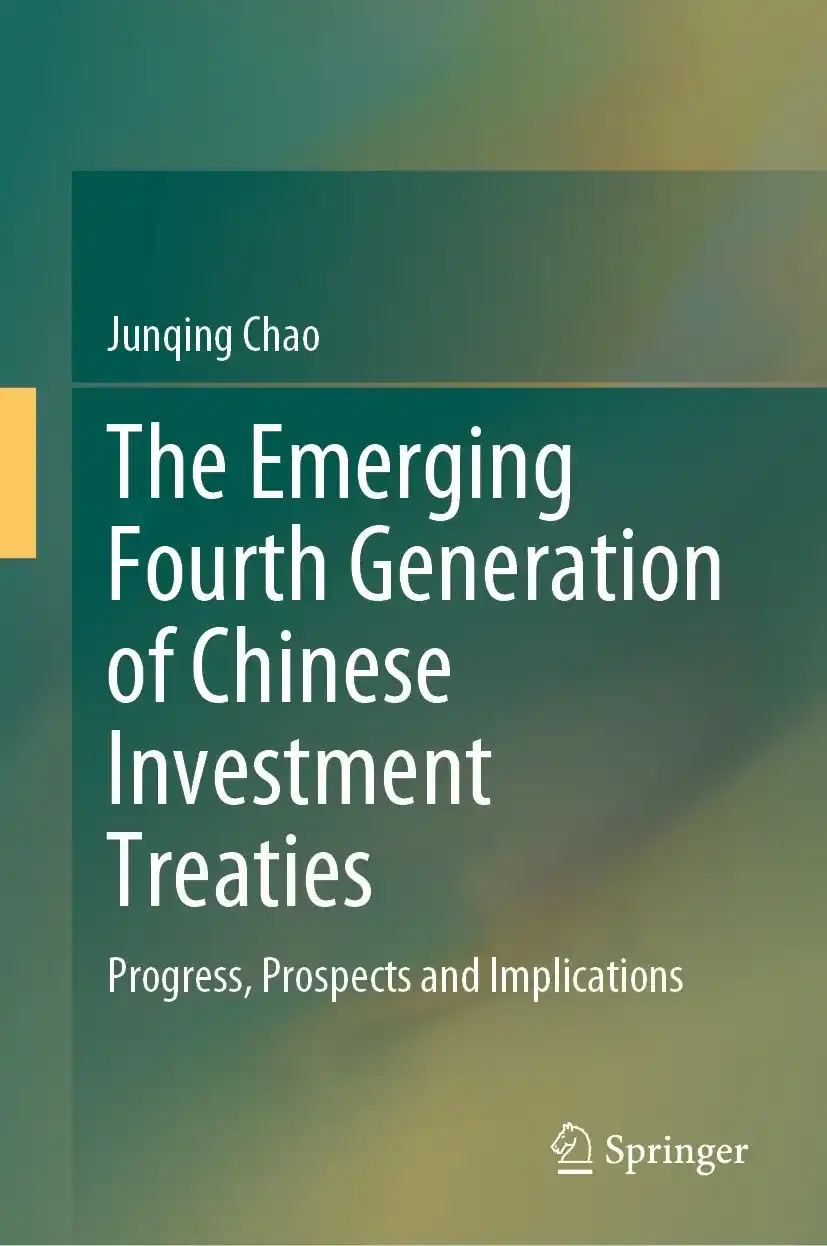
My book, The Emerging Fourth Generation of Chinese Investment Treaties: Progress, Prospects and Implications (Springer, 2026), builds upon my doctoral thesis and practical experience in arbitration, offering insights that I hope will be valuable to both scholars and practitioners. It provides a comprehensive and systematic analysis of China’s fourth-generation investment treaties and explores their potential impact on international investment law.
I was motivated to write this book because my professional experience has given me a practical understanding of how business and arbitration operate, enabling me to better appreciate the real-world implications of investment treaties. Moreover, when I completed my Ph.D. in 2019, many issues surrounding China’s fourth-generation investment treaties remained unresolved. Over the past five years, however, significant developments have taken place, including the conclusion of the China–EU Comprehensive Agreement on Investment, the enactment of China’s new Foreign Investment Law, and the increasing participation of Chinese companies in investment arbitration. Having witnessed these developments firsthand, I felt it was time to revisit this topic.
I have always believed that a close integration of theory and practice allows for a deeper understanding of international arbitration, and this book forms part of that ongoing and rewarding journey.
What does it mean to be a Squire Patton Boggs Scholar and what's next on your horizon?
Being a Squire Patton Boggs Scholar is a great honor for me. I am sincerely grateful for the recognition and support from Squire Patton Boggs, which have provided tremendous encouragement to me as a young scholar and practitioner. Inspired by this support, I will continue my journey in arbitration with curiosity and determination, with the goal of making meaningful contributions to the field.
Going forward, I hope to continue building my practice in international arbitration. I see myself growing not only into a specialist in international commercial and investment arbitration, but also into a bridge between China and the international arbitration community. Beyond cases, it is about fostering understanding, broadening perspectives, and contributing to the continued development of transnational arbitration.
Any advice for those who would like to join the LLM in Transnational Arbitration and Dispute Settlement?
Stay open-minded and embrace all possibilities. Sometimes, the most significant breakthroughs come when you least expect them. At TADS, what you gain goes far beyond professional knowledge—you will learn from professors, practitioners, and classmates with diverse experiences and perspectives, and gain insight into the dynamics and challenges of the arbitration field.
TADS is not just a degree; it is also a big family. I will always remember the academic discussions and exchanges of ideas, the mutual support during difficult times, and the moments when we celebrated each other’s achievements. We remain connected and continue to explore the world of arbitration together.
Virtual Graduate Open House day, October 2025

On 17 October 2026: meet faculty members, students and representatives and learn more about our 30 Master's programmes.