

Home>Jean Drèze, recipient of the 2026 Global Inequality Research Award


12 June 2026
Jean Drèze, recipient of the 2026 Global Inequality Research Award


Created by the World Inequality Lab (WIL) and the Centre for Research on social InequalitieS (CRIS), the Global Inequality Research Award (GiRA) was, in its second edition, awarded to development economist Jean Drèze. Bina Agarwal and James K. Boyce had been the first recipients of the prize in 2024. The Global Inequality Research Award recognises scholars who have made a significant contribution to understanding economic and social inequalities and the public policies designed to address them.

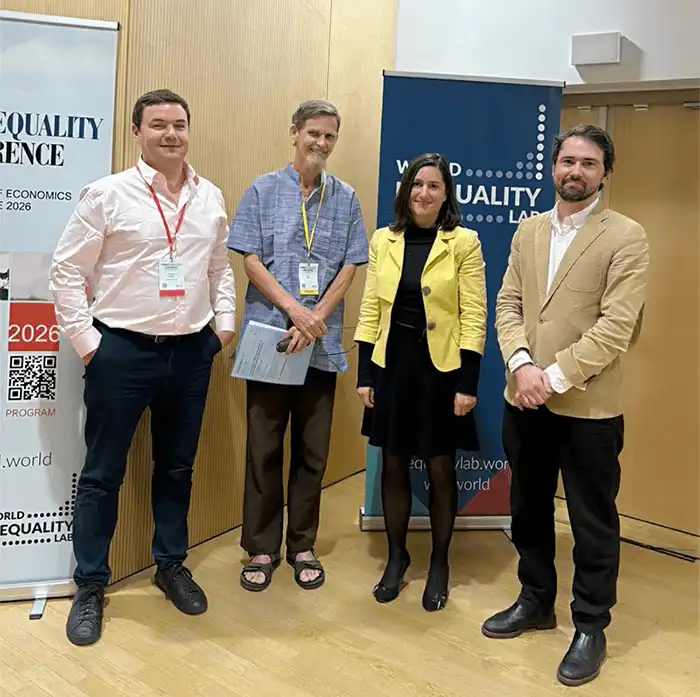
The prize was presented by Lucas Chancel and Thomas Piketty at a ceremony during the 2026 World Inequality Conference at the Paris School of Economics.
Born in Belgium, Jean Drèze moved to India in the late 1970s and became an Indian citizen in 2002. He has taught at the London School of Economics and Political Science and at the Delhi School of Economics. His work focuses primarily on development issues in India, including famines, poverty, gender inequality, child health, education, and social protection. He has co‑authored several landmark books with Amartya Sen and co‑written influential papers with Angus Deaton on nutrition and poverty, and with Nicholas Stern on policy reform in contexts of significant price distortions. These contributions have become key references for the analysis of inequality and social policy in India.
Jean Drèze is also widely recognised as an engaged scholar and activist. He has been closely involved in citizen campaigns for social rights in India, notably the Right to Information and the Right to Food. He played a key role in the design and promotion of emblematic social policies, including the National Rural Employment Guarantee Act (MGNREGA/NREGA) and the National Food Security Act, which have helped to shape a rights‑based social protection framework in India.
Suggested Readings:
- The Political Economy of Hunger: Entitlement and Well-Being (Vol. 1, 1991, with Amartya Sen), Oxford University Press. This edited volume explores the structural, political, and institutional determinants of hunger, going well beyond food output to examine entitlements and public action.
- India: Development and Participation (1996), Oxford University Press, is a co‑authored volume on the role of public action and institutions in reducing socio‑economic deprivations, including food insecurity, and in expanding fundamental freedoms in areas such as education, health, social protection and democratic participation.
- Nutrition in India: Facts and Interpretations, Economic and Political Weekly / Working Paper, 2008. Co-authored with Angus Deaton, this paper examines trends in consumption and nutritional status in India, highlighting the paradox of declining calorie intake despite rapid economic growth and persistently poor anthropometric indicators. It identifies several puzzles in the data and argues for improved nutrition monitoring, feeding into wider debates on poverty measurement and welfare in India.
- A Short History of MGNREGA: Twenty Years in Ten Charts (with Rahul R), “ Levy Economics Institute Working Paper No. 1095, 2025. This working paper provides a data-rich retrospective of India’s Mahatma Gandhi National Rural Employment Guarantee Act (MGNREGA), focusing on employment generation, participation of marginalized groups, wages, and inter-state variation over its first twenty years.
- The Perils of Embedded Experiment, Review of Development Economics, 2024, uses a case study of a large-scale experiment within India’s public administration to highlight the ethical and practical risks of ‘embedded experiments’, especially in corruption-prone government settings.
- School Participation in Rural India (with Geeta Gandhi Kingdon), Working Paper, 1999. This study examines determinants of school participation in rural north India, showing how gender, household characteristics, and school quality interact to shape educational outcomes, especially for girls.
- Credit in Rural India: A Case Study, Working Paper, 1997. This study investigates rural credit markets in the village of Palanpur in north India, shedding light on access constraints, informal arrangements, and their implications for rural poverty and investment in the local economy.
- Fertility, Education and Development: Further Evidence from India, Working Paper, 2000. This paper analyses the decline in fertility in India using district‑level panel data for 1981 and 1991, showing the central role of women’s education, child mortality and son preference, and providing important empirical evidence for demographic and economic debates on fertility decline.
- A Strategy for Development, by Nicholas Stern, Washington, DC: World Bank. This book lays out a comprehensive view of development strategy, linking growth, poverty reduction, and institutional reform from a World Bank perspective. Read alongside Drèze and Sen’s work on India, it helps situate their analysis of deprivation and public action within the broader mainstream debates on development policy in the early 2000s.