


Home>Academics>Master in Urbanism: Social Sciences and Urban Planning
Master in Urbanism: Social Sciences and Urban Planning
Two-Year Master's
Programme in French
120 ECTS minimum
Virtual Graduate Open House day – 17 October 2026

Interested in joining a master’s programme at Sciences Po? Come and discover our 30+ master’s programmes across our eight professional schools, as well as the admissions process. Speak with our deans, academic coordinators and students, as well as our admissions teams.
The Master’s in Urban Planning becomes the Master’s in Urbanism: Social Sciences and Urban Planning
From the start of the 2027 academic year, the “Master’s in Urban Planning” programme will evolve into a four-semester Master’s degree: a first year of study at Sciences Po, followed by a second year consisting entirely of work-study placements (apprenticeship). This reform reaffirms the programme’s distinctive focus on the operational transformation of territories, whilst strengthening its grounding in the social sciences and its vocational orientation. Lectures, workshops, role-plays, group projects and work-study placements will enable students to develop the skills needed to lead projects and play an active role within the organisations that shape cities and territories.
Please note: the Master "Urban Planning Programme" is taught entirely in French under the title "Cycle d'urbanisme : sciences sociales et aménagement".
Mastering urban transitions
The Master’s programme in Urbanism: Social Sciences and Urban Planning is a two-year course that trains future professionals to understand the transformations taking place in cities and regions and to support their practical implementation. At the intersection of social sciences, territorial analysis, and technical, legal, and financial expertise, this programme focuses on the major contemporary challenges facing urban development: environmental and digital transitions, changing lifestyles, inequalities, the attractiveness of regions, the transformation of urban spaces, and the adaptation of cities to new challenges.
The programme integrates the design, planning and implementation of urban and regional projects, with a particular focus on their spatial dimensions and the practical conditions for their realisation.
By fostering dialogue between theory and practice, this Master’s programme prepares students to situate the management of regional projects within decision-making networks, power relations, and public policy frameworks, enabling them to play a key role in creating and managing the urban spaces of the future.
The first year, taught at Sciences Po, enables students to acquire the fundamentals of urban planning and to develop their analytical and design skills. The second year is devoted entirely to an apprenticeship within a professional organisation, enabling students to put their knowledge into practice, develop their expertise, and quickly take on responsibilities within public, semi-public, or private organisations.
The programme is open to holders of a bachelor’s degree.
Objectives and skills
- Understanding socio-economic issues related to urban planning
- Decoding current urban and territorial phenomena
- Developing skills in strategic analysis: the ability to operate in complex environments and collaborate with various stakeholders
- In-depth urban planning and development training: the ability to spatialize urban thinking and projects
- Mastery of technical, legal, and financial tools specific to territory and city production (development financial analysis, territorial diagnosis, Geographic Information Systems - GIS -, housing programming, etc.)
- Professionalization through collective projects, practical scenarios, simulations, and study trips in France or Europe
These skills are developed through work on different scales, from planning to real estate logic, including managing complex urban projects.
Programme structure (2026-2027)

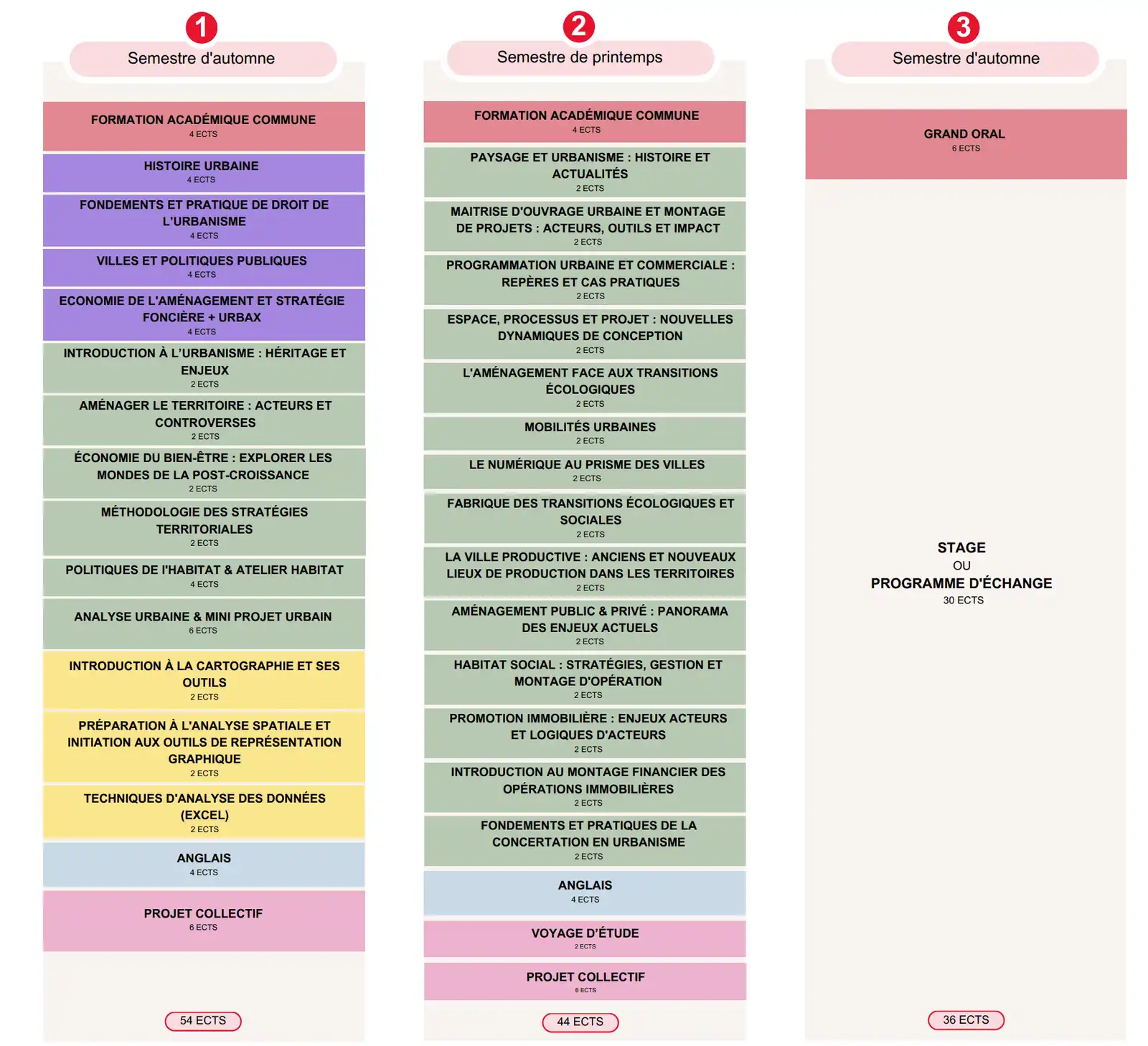
The programme is organised into four semesters: two semesters of full-time study at Sciences Po and two semesters of work-based learning, structured as three weeks at a partner organisation followed by one week of workshop-style classes at Sciences Po. In addition, the programme includes an annual study trip and a group project in the first year.
First semester
The first semester focuses on the fundamentals of spatial understanding: analysing the physical environment, urban dynamics, the built environment and public spaces, as well as proficiency with tools for representation, drawing, cartography and geographical information systems. An initial workshop gives you the opportunity to put these skills into practice at a study site.
Group projects begin, supervised by the course coordinator and supported by tutors, taking place two days a week, on Thursdays and Fridays.
Second semester
The second semester broadens the approach from the first semester to encompass territorial systems: mobility, the regional economy, housing, networks, infrastructure, urban metabolism, and ecological transitions. A group workshop guides students in formulating an action plan and exploring the conditions for its implementation: the stakeholder system, land tenure, the legal framework, financing arrangements, phasing and evaluation.
Study trip to France or elsewhere in Europe.
Third semester
The second year is entirely in apprenticeship, with students spending three weeks in a professional setting followed by one week at Sciences Po, to allow for reflection on their work-study experience. These periods at Sciences Po will take the form of debriefing seminars designed to put professional practices into perspective, compare students’ experiences and engage in dialogue with the host organisations. In addition, a number of supplementary teaching modules will be offered during the M2 to develop cross-disciplinary skills (law, finance) and acquire soft skills (negotiation, handling disputes, crisis management, public speaking).
Study trip
First-year Master's students go on a week-long study trip to discover a region and understand its economic, social, environmental, and cultural dynamics. This trip offers a chance to engage with diverse stakeholders, including local elected officials, business representatives, associations, urban planners, and residents, and to explore development projects, infrastructure, third places, and public policies in action.
At the end of the trip, students write a collective report summarising their analyses and proposals on the challenges facing the region they have explored. Discover our latest trip to Marseille.
Throughout their studies, students do field research on other occasions: during pre-term visits or as part of their group projects.

Course outlines
- Semester 1
- Semester 2
- Semester 3
- Semester 4 (upcoming)
Note: Curriculum plans evolve every year to address various needs and developments.
Entry requirements and accreditation
The Urbanism: Social Sciences and Urban Planning (Master’s) is open to all holders of a French or international bachelor’s degree (bac +3), whether they are students or early-career professionals, regardless of their field of study.
A very strong level of written and spoken French is required (see the language requirements table).
The programme is accredited by APERAU (the French Association for the Promotion of Teaching and Research in Urban Planning and Development).
Admission procedures for the master's degree
There are multiple pathways for admission to the Master in Urbanism: social sciences and planning :
French procedure
This procedure (FR) applies to candidates who have previously completed a degree in France. Applications are submitted online on the Sciences Po admissions website.
Procedure for graduates from partner universities in France (FR)
International procedure
This procedure applies to candidates who have not previously completed a degree in France. Applications are submitted online on the Sciences Po admissions platform.
Check which admissions procedure applies to you
Procedure for students bridging after one year of the Master of Regional and Urban Strategy
A bridge is possible between the first year of the Master of Regional and Urban Strategy and the Urbanism: social sciences and planning program
Please contact Bertrand Vallet for more information.
Career opportunities for the Master in Urban Planning
The Master in Urban Planning benefits from a strong alumni network in various fields related to urban development (urban planning, development, urban policy, housing, etc.), within diverse organizations (government ministries, local authorities, private and public developers, urban planning agencies, consulting firms, elected officials' offices, real estate developers, etc.). It also relies on an active and dynamic alumni association, Sciences Po Urba.
In recent years, more than half of the Master students have found employment (fixed-term or permanent contracts) immediately upon completing the second semester.
Nearly 55 years after the creation of the Master's programme, surveys show a diversified professional integration: graduates work in government services or local authorities (regions, departments, and increasingly in municipalities or inter-municipal groups), in the semi-public sector (urban planning agencies, development agencies, public establishments, particularly in the housing sector). Many work in the private sector, from design to real estate development.
More about career opportunities after a Master's degree at the Urban School:
Alumni testimonials


Contacts
Academic Director: Marco Cremaschi
Academic Advisor: Bertrand Vallet (bertrand.vallet@sciencespo.fr)
Academic Assistant: Jérôme Michel (jerome.michel@sciencespo.fr)


