


Accueil>Summer School>Programmes pré-universitaires>Programme sur campus>Cours principaux
Cours principaux du programme pré-universitaire sur campus

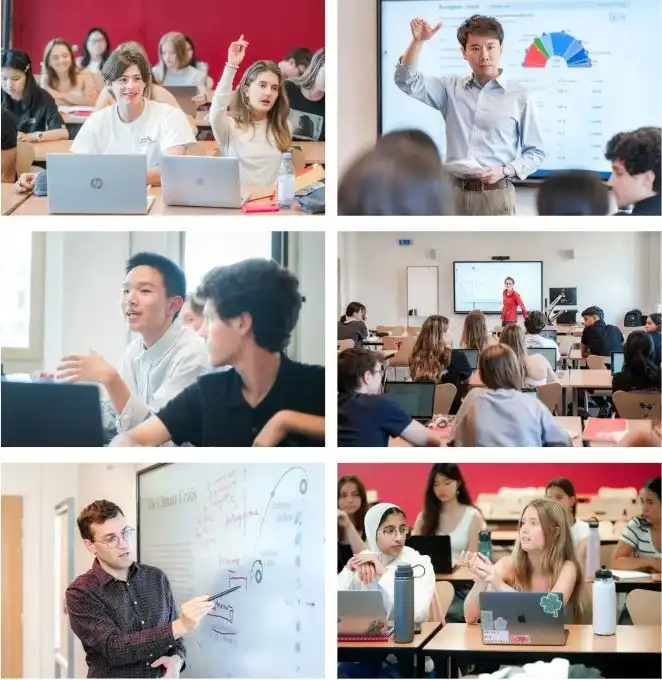
Les cours principaux sont dispensés par différents intervenants issus du corps enseignant de Sciences Po et/ou par des experts reconnus du monde universitaire international. L’offre de cours fondamentaux en sciences sociales couvre un large éventail de thématiques en lien avec les relations internationales. À l’exception du cours « La démocratie en Europe », l’ensemble des enseignements est proposé en anglais. Les participants choississent un cours principal par semaine, pour suivre deux cours au total durant le programme.
Les étudiants prennent également part à des séances interactives en petits groupes consacrées à la méthodologie universitaire, qui visent à renforcer leurs compétences académiques essentielles, notamment en matière de rédaction académique, de méthodes de recherche et de présentation orale.
Rejoignez-nous le 28 novembre pour la journée portes ouvertes virtuelle ! Notre équipe sera présente pour vous présenter les programmes pré-universitaires. Inscrivez-vous !
Les cours principaux en 2027
Semaine 1 :
- Professeur : Carl Rihan
- Descriptif (en anglais) : This course offers a foundational introduction to International Relations and Foreign Policy Analysis: why states behave as they do, how their leaders decide, and how they operate within an international order that is being contested and remade. It is designed for students considering undergraduate studies in international affairs, political science, economics or global governance.
Téléchargez le course overview pour Foreign Policy (PDF, EN, 327 Ko).
- Professeur : Earl Wang
- Descriptif (en anglais) : The course serves as an introduction to the field of study in European Union (EU) foreign policy. Students will acquire knowledge about the institutional design and dynamics of EU foreign policy, and concrete examples of the EU’s engagement in global affairs.
Téléchargez le course overview pour European Union Foreign Policy (PDF, EN, 220 Ko).
- Professeur : Barthélémy Michalon
- Descriptif (en anglais) : This course aims at discovering, acquiring and practicing basic negotiating techniques, especially in an international context. Throughout the course, students face a wide variety of scenarios and challenges (ranging from everyday life situations to international issues), which they are expected to tackle by resorting to negotiation, with different degrees of complexity.
Téléchargez le course overview pour Get A Deal (PDF, EN, 260 Ko).
- Professeur : TBA
- Plus d'informations pour ce cours seront bientôt disponibles !
Semaine 2 :
- Professeur : Carl Rihan
- Descriptif (en anglais) : This course gives students the literacy to understand how the technologies reshaping world politics actually work (data, cyber operations, algorithms, connected devices, cryptocurrencies and artificial intelligence) and the analytical tools to judge what each of them does to the balance of power, to security and to human rights.
Téléchargez le course overview pour Emerging Technologies (PDF, EN, 320 Ko).
- Professeur : Earl Wang
- Descriptif (en anglais) : The course serves as an introduction to the field of study in European Union (EU) foreign policy. Students will acquire knowledge about the institutional design and dynamics of EU foreign policy, and concrete examples of the EU’s engagement in global affairs.
Téléchargez le course overview pour European Union Foreign Policy (PDF, EN, 220 Ko).
- Professeur : Barthélémy Michalon
- Descriptif (en anglais) : This course aims at discovering, acquiring and practicing basic negotiating techniques, especially in an international context. Throughout the course, students face a wide variety of scenarios and challenges (ranging from everyday life situations to international issues), which they are expected to tackle by resorting to negotiation, with different degrees of complexity.
Téléchargez le course overview pour Get A Deal (PDF, EN, 260 Ko).
- Professeur : Mathieu Fulla
- Ce cours interrogera les causes du rejet de plus en plus massif par les Européens des structures traditionnelles de la démocratie libérale et montrera que ce phénomène n’est pas - loin de là ! - synonyme d’un déclin du politique, qui se réinvente sous d’autres fromes, à droite comme à gauche.
Téléchargez le course overview pour La Démocratie en Europe (PDF, EN, 284 Ko).
Téléchargez l'emploi du temps académique du programme (PDF, EN, 140 Ko).


